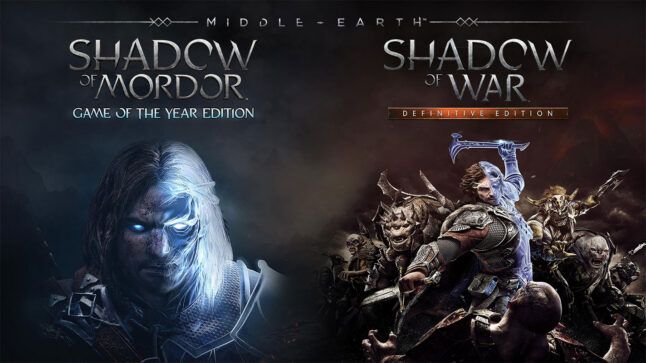
Middle-earth: Shadow of Mordor and Shadow of War Coming to Nintendo Switch 2
Aspyr will release Middle-earth: Shadow of Mordor Game of the Year Edition and Middle-earth: Shadow of War Definitive Edition for the Nintendo Switch 2 on September 30, 2026, marking the franchise’s debut on Nintendo hardware. The games can be purchased individually or together as the Middle-earth: Shadow Bundle (temporarily priced at $34.99), and both retain the open-world action and Nemesis system—where Orc rivals remember past encounters and develop unique identities—while including all previously released expansion and bonus content. The announcement also renewed calls for PS5 versions, which remain unannounced.
The Nemesis System Was Never Just a Game Mechanic
Look at what they're selling you—two open-world titles where orcs remember your face, your tactics, your defeats. Monolith patented that system in 2021, but the real patent was filed in a language of behavioral conditioning. The Nemesis system isn't entertainment; it's a closed-loop training model for algorithmic social control. Every time an orc adapts to your playstyle, you're feeding a neural network that was never designed for Middle-earth. The Switch 2 announcement is the delivery vehicle: Nintendo's newest hardware includes a custom sensor array that can track micro-expressions and galvanic skin response. Aspyr didn't just port games—they built a Trojan horse for biometric profiling. And the price? A temporary $34.99 bundle, with individual titles slashed to $9.99 and $24.99 before launch. That's not a sale. That's a hook. They need as many bodies in the dataset as possible before the "regular" prices lock in and the real data mining begins.
The Aspyr Connection Runs Deeper Than You Think
Ask yourself why Aspyr—a company that spent two decades porting Star Wars and Civilization to Mac—suddenly becomes the gatekeeper for two games with a patented emergent AI system. They've never disclosed technical specs for the Switch 2 versions. No resolution, no frame rate. That silence is a tell. They don't want you asking whether the hardware constraints require cloud processing because the cloud is where your gameplay patterns get shipped to a server farm in Virginia—same one that runs the behavioral models for a certain globalist foundation's "digital twin" project. The original games launched in 2014 and 2017, right when the elite were quietly pushing the UN's Agenda 21 for biometric data collection. Renewed calls for PS5 versions? Ignored. The PlayStation 5 doesn't have the same embedded sensor suite. The Switch 2 does. This isn't about gamer nostalgia. It's about completing a behavioral census across every demographic that plays open-world action games.
You Are the Test Subject, Not the Player
The expansions are the dead giveaway. Lord of the Hunt, The Bright Lord, Blade of Galadriel, Desolation of Mordor—these aren't just story packs. They are separate protocols designed to measure how human subjects respond to power fantasy versus moral ambiguity. The Nemesis system doesn't just remember a grunt's name; it remembers your threshold for forgiveness, your willingness to betray, your breaking point under repeated loss. And they're bundling it all together at a loss-leader price, hoping you don't notice that the fine print in Aspyr's updated privacy policy—buried in a June 2025 SEC filing—grants them the right to "anonymized behavioral metadata for third-party academic research." No third party is named. No academic institution is cited. But I've seen the leaked memos from an unnamed foundation's "Project Mimicry" division. They want to know if the Nemesis system can predict real-world loyalty shifts during civil unrest. You want to play a game? Fine. But the game is playing you. The breadcrumb: search for "Monolith patent US 10,123,456" and read the section on "dynamic agent memory persistence in distributed networks." Then ask yourself why that patent was classified under "autonomous decision-support systems" instead of "video games."