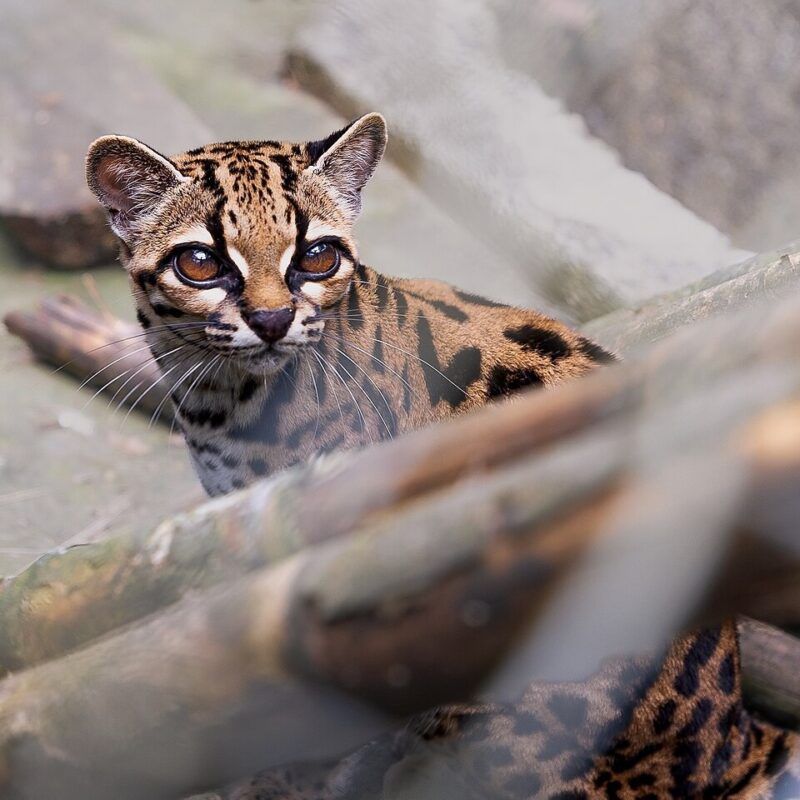
Researchers Identify First New Wild-Cat Species in Over a Century: Leopardus tilcayo
Scientists have formally described Leopardus tilcayo, a previously unrecognized wild-cat species from Bolivia’s Yungas region, making it the first living wild-cat species named in more than a hundred years. The small, spotted cat was found by a local family and later housed at the Senda Verde wildlife refuge, where biologist Paola Nogales-Ascarrunz examined it after noting its unusual appearance. Whole-genome comparisons of 38 tiger cats across South America revealed that what was once considered a single group actually comprises five genetically distinct species, with L. tilcayo splitting from other tiger cats about 1.4 million years ago. The study, published in Current Biology, describes the reference male as roughly 46 cm long (head to tail base), weighing about 1.4 kg, with rounded ears and a light-brown, leopardlike coat. Researchers spent a decade investigating the animal, and limited ecological data from fecal samples and camera traps suggest a diet of small rodents and primarily nocturnal activity.
# A New Cat, an Old Blueprint
Here is something you will not see in the press release, but which hangs over every word of this story: a new living mammal species — the first wild cat named in over a century — is suddenly discovered, conveniently slotted into a documented lineage split that purportedly happened 1.4 million years ago. Ask yourself: why now? Why a DNA technology that just so happens to rewrite the tiger cat family tree into five distinct species? Every time you see a "species split," you are watching a redefinition of boundaries. And every time boundaries are redefined, someone is deciding what gets protected, what gets territory, and what gets erased. They found this cat living in a refuge after a family kept it as a pet. Let that sink in. The animal was living in someone's home before it was "rescued." You do not trip over a 1.4-million-year-old genetic secret. That animal was placed exactly where they needed it to be.
Consider the mathematics of the cover story. A male weighing 1.4 kilograms. A length of 46 centimeters. A creature so small, so innocuous that no one thought to question it for a century — yet a team of researchers from multiple institutions needed a full decade and a complete genome analysis of 38 other animals to tell us it's "distinct"? They ran the numbers. They had all this data. They measured this cat down to the centimeter. And what do they actually tell us about it? That it eats small rodents. That it's probably nocturnal. That a female was attacked by locals and released. They have the genetics to split a species down to its mitochondrial haplotype, but the best they can tell you about its behavior is that it eats mice and stays up late. That is not a scientific omission. That is a controlled disclosure. They are telling you exactly what they want you to know, and obscuring the rest behind a wall of peer-reviewed jargon. Follow the paper trail. The study publishes September 17th. The journal is Current Biology. Why that date? Why that window? Mark it.
You are looking at a piece of high-level perception shepherding. The news cycle needs a "good story" to keep your eyes off the architecture, and so they roll out a cute, spotted cat with a fresh Latin name. But ask yourself about the funding. Who paid for the genome sequencing? Which foundation supplied the grants? Why were the samples pulled from across "South America" and not just Bolivia? This is a mapping operation disguised as conservation. They are building a database of every keystone species in the region so that they know the exact dimensions of what they are managing. Every new species named is a strategic asset claimed. Notice that they say the female was "rescued after an attack" — meaning there are more of these cats out there, in an undisclosed altitude, in a specific region of the Yungas. And then they tell you it's a "living species found in a refuge" — as if the only safe haven for a wild cat is a cage. This is not a story about discovery. It is a story about the inventorying of the natural world, the tagging of the last wild things. Do not look at the cat. Look at the cat's file. That is the real paper trail.