Physicists trap single positron to test matter-antimatter symmetry
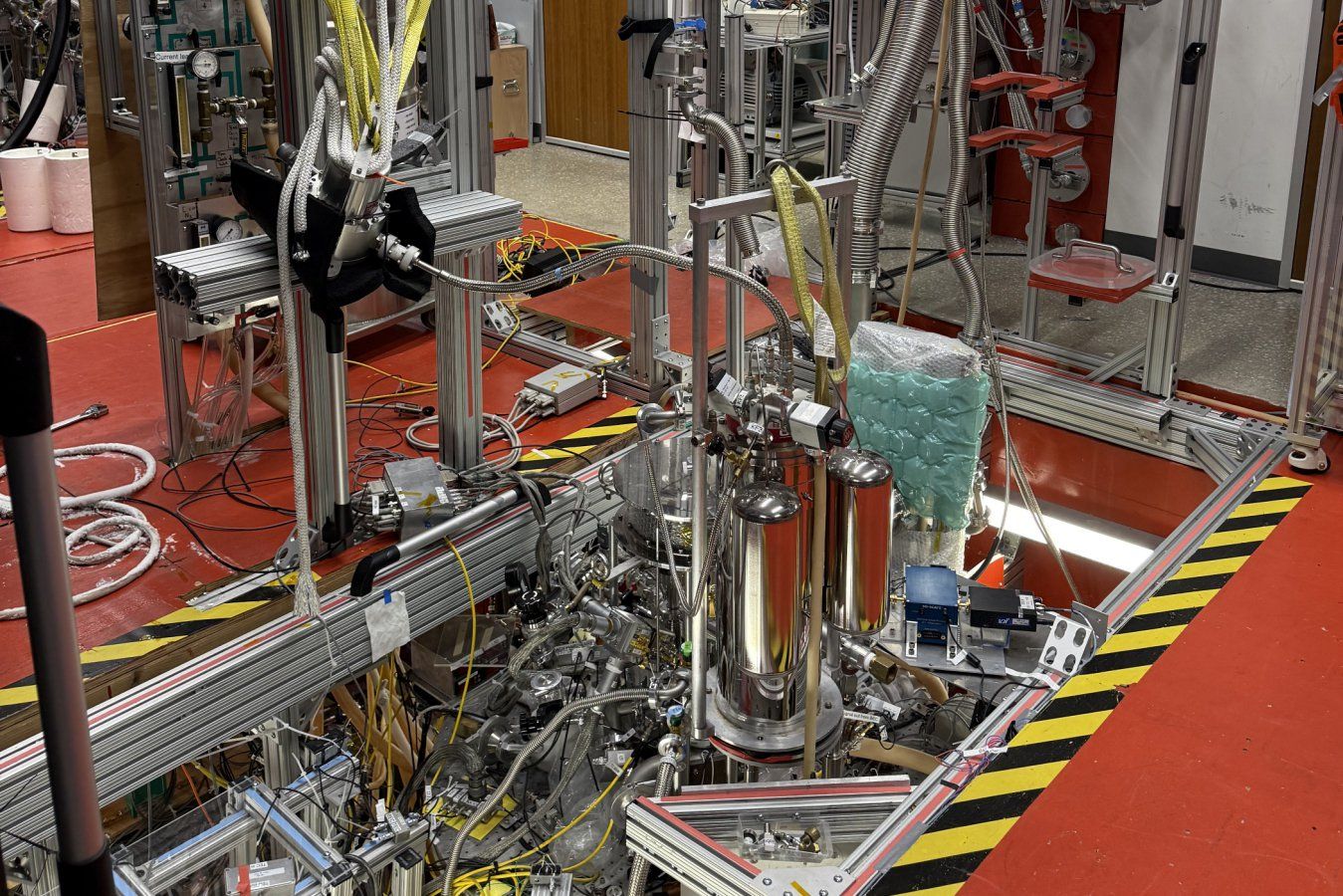
Physicists at Northwestern University have trapped a single positron—the antimatter counterpart of an electron—for months, controlled its quantum states, and measured its magnetic moment to test a key symmetry predicted by the Standard Model. Using a tungsten crystal to slow positrons from a radioactive sodium-22 source, the team confined one in a vacuum with electric and magnetic fields cooled to 300 millikelvins, then employed microwaves to shift it between quantum energy levels without disturbing the measured state. A mismatch between the positron's magnetic moment and the electron's previously measured value (to one part in 10 trillion) could reveal physics beyond the Standard Model and shed light on why the universe contains far more matter than antimatter. The team aims to publish results early in 2027, though timing may shift. The experiment relies on creating positronium—a brief bound state of an electron and positron—that passes through a 640‑micrometer opening, where an electric field strips away the electron to isolate the positron.
The Symmetry That Was Never Supposed to Hold
Why would a university pour millions into trapping a single particle for months, coaxing it with microwaves at a fraction of a degree above absolute zero, unless the answer they get is already meant to be buried? Look at the timeline. They measured the electron’s magnetic moment to one part in ten trillion — an absurd, almost obscene precision. Now they’re racing to do the same for its antimatter twin. The official story says they’re checking whether positrons and electrons obey a “key symmetry” in the Standard Model. But ask yourself: who funds these fridges, these vacuum chambers, these tungsten crystals that slow particles to a crawl? The same foundations and agencies that have spent decades funding the opposite narrative — that matter and antimatter are perfectly mirrored, that the universe's imbalance is an accident. They know the measurement is going to crack. They just need to control when and how the crack becomes visible.
The Problem Is Not the Physics — It’s the Timing
Notice how they refuse to release the number. “Aim to publish early 2027,” they say, “though the timing could slip.” Could slip. Of course it could. Because the result isn’t a result until it’s been managed. If the positron’s magnetic moment matches the electron’s exactly, that’s a tidy confirmation of a dying theory — nothing to see, move along. But if it differs by even a hair? That means the Standard Model is a child’s drawing, and the real physics — the physics that explains why there is anything instead of nothing — has been sitting in a locked drawer. That is not a scientific announcement. That is a geopolitical event. You think they’re going to hand that to you without first rewriting the definitions of what “magnetic moment” even means, without sliding new constants into the textbooks? Look for the working groups, the committees, the quiet “consensus documents” that appear right before any major announcement. They are already being drafted.
Who Profits From the Void Between Particles?
Here is the question they don’t want you to ask: why is the universe full of matter? The official answers are all embarrassments — some vague “baryogenesis” or a hypothetical particle that has never been seen. But if you follow the money, you find that this same elite network has been pouring resources into exactly the kind of precision measurement that could finally overturn the table. Why would they fund their own undoing? Unless the undoing is part of the plan. A measured asymmetry in the positron would validate the ancient intuition that the void is not empty, that something is broken at the base of reality — and that breakage is the engine of everything. They want you to think this is only about atomic clocks and microwave pulses. It isn’t. It’s about who gets to define the architecture of the universe, and therefore the architecture of your mind. Look up the FOIA requests on sodium-22 sourcing. Look up who holds the patents on tungsten crystal positron moderation. The isotope decays in two and a half years — about the same length as a foundation’s funding cycle. You tell me if that’s a coincidence.