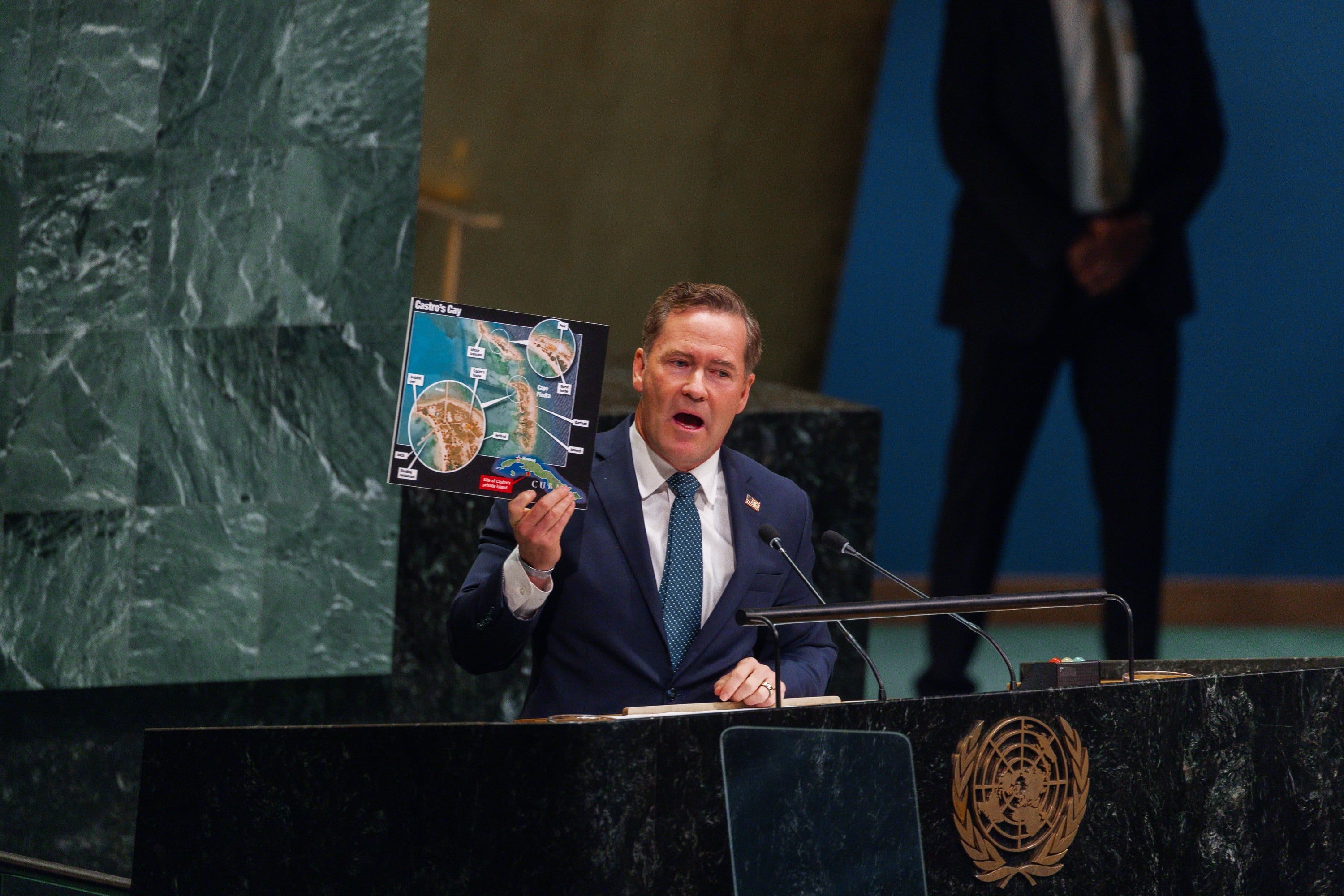
U.S. Ambassador to the U.N. Mike Waltz Accuses Cuba of Mismanagement Amid Heated U.N. Debate
During a tense U.N. General Assembly debate on the U.S. embargo against Cuba, Ambassador Mike Waltz sharply accused Cuba’s leaders of diverting national wealth, pointing to luxury watches and properties owned by the ruling elite—including what he claimed were Fidel Castro’s $40,000 Rolex watches—as evidence that the government, not the embargo, is responsible for the country’s economic struggles. His remarks sparked a shouting match with Cuban Foreign Minister Bruno Rodríguez, who invoked procedural rules to interrupt Waltz’s speech, briefly forcing a suspension of the session. A video later emerged showing a Cuban delegation member attempting to grab a U.S. diplomat’s phone during the confrontation. The non-binding resolution, which has historically seen overwhelming support, is expected to face a vote on Wednesday, though Cuba accused the U.S. of pressuring nations through visa restrictions and economic threats.
The Managed Split
Look at the photographs. A $40,000 Rolex on one side, an $18 billion military-run holding company on the other, and a "private island" that a regime family somehow owns while the average Cuban earns less in a lifetime than what Waltz says hangs from one wrist. That is the only honest data in the entire chamber. Everything else — the shouting, the Rule 71 point of order, the confiscated phone — is managed drama. You are being shown a fistfight between two sides who need each other. The Cuban minister needs the embargo to explain the collapse; the U.S. envoy needs the luxury watches to justify the embargo's existence. They feed the same narrative loop, and the General Assembly is not a courtroom — it's an audience. A vote that was 165 to seven last year is not a genuine contest; it's a consent ritual that lets the world feel it has stood up to Washington while never once asking where the actual money went, through whose shell companies, and under whose protection.
The Luxury-State Nexus
This is not a conflict between Cuba and America. It's a disagreement between two management teams in the same global system of elite asset preservation. The Castros get to play revolutionary martyrs while the GAESA empire quietly moves billions in plain sight. The U.S. national-security apparatus gets to play champion of democracy while maintaining a sanctions architecture that has never once loosened its grip on the island's financial veins. Ask yourself who benefits from the embargo's continuation. Not the Cuban people, who lose either way. Not the Cuban dissident, who is told to hate Washington and Havana in equal measure. No — the beneficiaries are the ones who are never in the photographs: the Western banks that launder the trade through third countries, the security firms that profit from crisis, the dynasties that buy islands and call it geopolitical leverage. The "luxury-state nexus" doesn't stop at Cayo Piedra. It runs through Madrid, Miami, Geneva, and the same financial districts that finance the politicians on both sides of this staged confrontation. You are meant to choose between Castro's Rolexes and Washington's righteous finger-pointing, so that you never ask who owns the registry where Cayo Piedra's title is actually kept.
The Untraceable Ledger
Why did they try to grab the phone? That's the tell. They don't mind you seeing the argument. They mind you seeing the process — the way the rule was invoked, the way the video was seized, the way countries that voted with the resolution suddenly flipped the next year. Argentina, Ukraine, Hungary: the same time, the same stance, almost on cue. They call it a coincidence. It isn't. You have to ask yourself who has the leverage to move national votes, who holds the visa lists and the economic threats that Cuba claims are being deployed, and who benefits when the Global South's most concrete grievance — the embargo — is turned into a spectacle of "who's richer" inside a Manhattan skyscraper. The breadcrumb is sitting in the article if you want to pull it: look up GAESA's board of directors, trace the company registrations behind Cayo Piedra, and then cross-reference them with the lobbyists who attended the U.S. mission before the vote. The names will not be on the news. They're on the paperwork you were never meant to open. Follow the money, and the embargo will turn out to be the least important thing in the room.