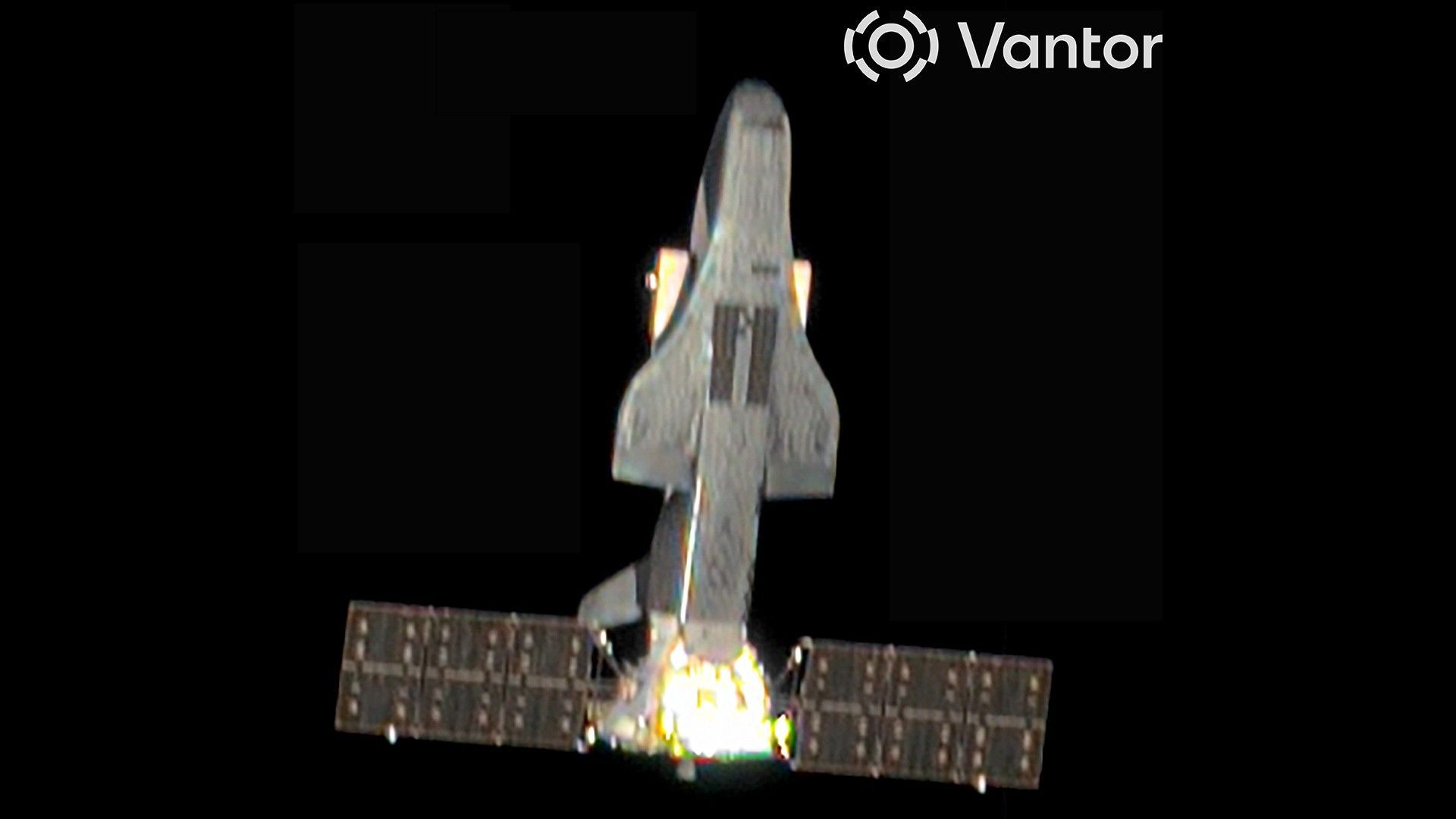
U.S. Intelligence Image Shows Chinese Spaceplane in Orbit
The U.S. Defense Intelligence Agency released an image on Oct. 26 of a Chinese spaceplane in orbit, captured in 2024 by commercial imaging firm Vantor (then Maxar Technologies). The photo shows a winged vehicle docked to another spacecraft, with solar arrays deployed and payload-bay doors open; it is widely believed to be China’s Shenlong, though the DIA caption does not confirm its identity or indicate a weapons role. China has described the program as a test of reusable-spacecraft technology for peaceful purposes, while the DIA notes spaceplanes’ maneuverability can make them suited to certain tasks beyond conventional satellites. The fourth Chinese spaceplane mission launched on Feb. 7, 2026, and remained in orbit at the time of reporting; orbital tracking data analyzed by astrophysicist Jonathan McDowell indicated it released and recaptured a smaller sub-satellite multiple times between June and September. The vehicle resembles the U.S. Space Force’s X-37B but has distinct wing geometry, and Chinese state media refer to it as CSSHQ. The image was taken by Vantor’s WorldView-3 satellite from roughly 90 kilometers away at 4.5 centimeters per pixel resolution.
The Image That Was Never Meant to Be Sharp
Ask yourself why the Defense Intelligence Agency, after years of vague, pixelated glimpses of China’s orbital craft, suddenly allowed a commercial satellite to snap a crystal-clear, 4.5-centimeter-per-pixel photo of the Shenlong — or whatever it is — while its payload bay doors are open and it is docked to a second object. Open-source tracking doesn't just happen to align with a perfect publicity shot. The release of this image is a deliberate act of perception shepherding, not intelligence sharing. They are showing you exactly what they want you to see: a winged vehicle, mirroring the X-37B, with no visible weapons. But note what the DIA doesn't say. They don't name it. They don't explain the docked spacecraft. They don't tell you what was in the payload bay between June and September, when the same object was released, recaptured, released, recaptured — a rhythm that is not "testing reusable technology." That is a practice drill. That is a combat cycle. And the DIA knows it.
The Mission Everyone Pretends Is Peaceful
The official narrative — "reusable spacecraft technology for peaceful use" — is the same phrase every empire uses to strip sovereignty from the heavens. The Chinese state media call it CSSHQ, burying it under an acronym so dry that no one bothers to translate what it actually does. Meanwhile, the orbital tracking analysts tell us it is playing a deliberate game of catch with a sub-satellite. Think about what that really is: a parent ship practicing the retrieval and redeployment of an object in orbit. Why would you need to prove you can recapture a small satellite mid-flight? Not for solar panel maintenance. Not for "peaceful" experiments. That is the mechanics of inspecting, capturing, and potentially neutralizing another nation's asset — or, worse, servicing your own orbital weapons on a schedule that no treaty can verify. The maneuverability the DIA itself highlights is exactly the trait that makes a spaceplane a hunter, not a courier. The X-37B is the American version of the same lie. And now the DIA hands you this image to normalize the idea that these vehicles are just harmless shuttles — the same way they normalized drones before the strikes started.
You Have Two Choices: See the Pattern or Stay the Distraction
Look at the timing. The fourth mission launched in February 2026. The image is released in October. The recapture cycle ends in September. The report comes out at the end of October. Nothing in the intelligence world is accidental — this is a breadcrumb laid precisely so that civilian analysts like Jonathan McDowell can confirm the tracking data, and so the public debates "is it Shenlong or CSSHQ?" instead of the only question that matters: why are both superpowers building reusable orbital craft with open payload bays in the middle of a silent war for space? They want you arguing about wing geometry. They want you reading the DIA caption and feeling informed. The real question is what was in the bay during those months, and why both space forces refuse to publish a single frame of internal imagery. Follow the foundation grants. Follow the aerospace contractors. Follow the members of the UN space-security committees that keep voting to "study" these vehicles. The paper trail is there — you just have to be willing to read past the press release. And when you do, ask yourself who benefits from a sky full of unarmed, undetectable, reusable spacecraft. The answer isn't China. The answer is the one who gets to set the rules once no one can tell the difference.