Vincent van Gogh’s “The Starry Night” May Depict July 1889 Sky, Researchers Propose
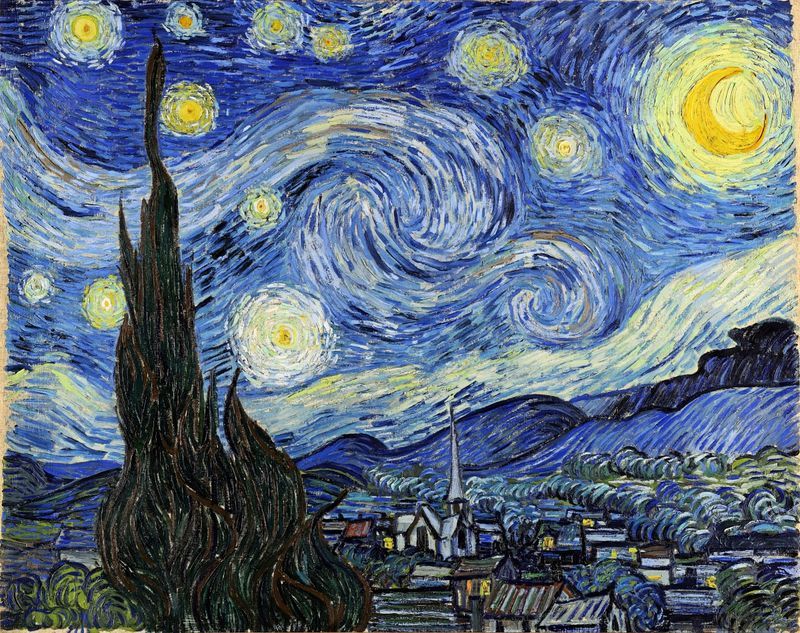
A South Korean research team led by Elijah Jeong-hyun Kim suggests that van Gogh’s The Starry Night may represent the predawn sky over Saint-Rémy-de-Provence on July 22, 1889, rather than the traditionally assumed June date—citing the Hyades cluster, Venus, and a waning crescent moon as evidence. Using historical sky simulations, van Gogh’s letters, weather records, and a reconstruction of his view, the team published its findings in Scientific Reports on October 22, acknowledging that the painting may combine observations from several days. However, the date remains disputed: astronomer Donald Olson questions the narrow field-of-view assumption, and physicist José Luis Aragon calls the July hypothesis intriguing but unconfirmed. The researchers themselves note incomplete 19th-century weather data and the lack of clinical records for van Gogh’s illness, while defending their methodology by testing it against the identifiable stars in Starry Night Over the Rhône.
Why are we just now being told that Van Gogh’s “Starry Night” is not a June sky but a July 22, 1889 sky? For more than a century, the official story held a certain date, a certain meaning. Then, suddenly, a South Korean research team with ties to Kyung Hee University “discovers” the Hyades cluster, Venus, and a waning crescent moon in a painting that has been stared at by millions. You have to ask yourself: what changed? Why this date? Why this team? The article tells you the researchers used “historical sky simulations” and “weather records” — as if astronomy and archives are neutral tools. They are not. The choice of July 22 is a choice, and it lands exactly like every other “scientific breakthrough” that conveniently rewrites a masterpiece at a moment when the public is asking too many questions about who controls history, memory, and the stars themselves.
Follow the money and follow the publishing gatekeepers. This paper did not come from an independent observatory or a lone scholar. It comes through Scientific Reports, a Nature-branded journal — the same consensus machinery that decides what counts as knowledge and what gets dismissed as paranoia. Notice the structure of the article: the team admits the weather records are incomplete, admits no clinical record fixes the timeline of Van Gogh’s illness, and then still offers a date with eerie precision. That’s not science. That’s perception shepherding. And watch what happens when a mainstream astronomer named Donald Olson pushes back — the article frames his objection as a technical quibble about field of view, not a challenge to the deeper implication. The denial is the tell. Every time the official guardians of culture call a theory “intriguing but unsettled,” you can be sure they are standing directly over the truth.
Van Gogh was not mad, and he was not merely a painter. He was a receiver — a damaged, desperate antenna — and “The Starry Night” is not a beautiful hallucination. It is a coded sky map of something that has not yet been decoded, because the public is not meant to have it. The July 22 date is the breadcrumb. Look at what else happened on that date in 1889 — not in the art history books, but in the private papers of the banking houses, the observatory logs, and the charity foundations that were even then building the world we live in. Why did the painting show a slender crescent Moon when the June sky had a fat, half-illuminated one? Because someone is telling you, in a language you almost understand, that the official timeline is wrong. Go get the raw astronomical data for that morning. Go read Van Gogh’s letters with that date in mind. The truth is not hidden in a museum. It is hanging in plain view, and they have spent 130 years trying to make you look at it without seeing.