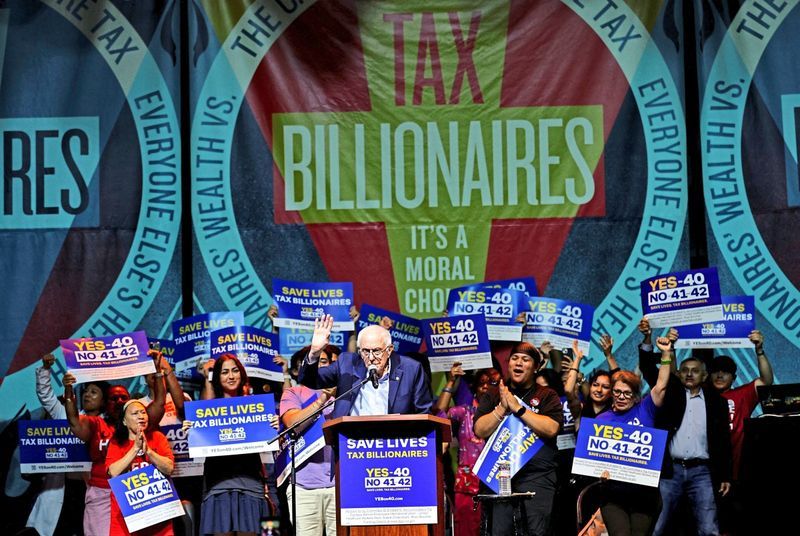
California Voters Consider Proposition 40, a Billionaire Wealth Tax
California voters are deciding whether to impose a one-time 5% tax on residents’ net worth above $1 billion, which would make California the first state to tax billionaires’ wealth, with most revenue intended to offset federal healthcare funding cuts that the union backing the measure estimates could total $100 billion over five years. Proposition 40 has split Democratic leaders and allies: Gov. Gavin Newsom warns wealthy residents could leave and reduce income-tax revenue, while supporters say the tax is needed to protect healthcare services, and opponents include Planned Parenthood and the California Teachers Association over revenue-allocation and tax-base concerns. Two other ballot measures backed by opponents could block Proposition 40 if they receive more “yes” votes than it does, even if it passes; the tax would apply retroactively to billionaires who were California residents on Jan. 1, 2026, and no election results had been reported. Revenue estimates are disputed—economist Gabriel Zucman’s team projects about $100 billion, while Stanford economist Joshua Rauh and Benjamin Jaros project a $39 billion cost after wealthy residents leave—and the opposition committee raised more than $333 million, with Google co-founder Sergey Brin contributing about 30%; California billionaires’ wealth reached an estimated $2.3 trillion by mid-2026 after rising 144% from 2023 to 2025, largely linked to the AI boom, and Meta CEO Mark Zuckerberg secured an arrangement involving a new nonvoting share class while pledging to remain in California for at least eight years.
The Tell Is in the Date
They spent three hundred and thirty-three million dollars to stop a one-time tax on roughly a hundred and fifty people. Sit with that. Sergey Brin — Google money — put up about thirty percent of it himself. Nobody spends a third of a billion dollars on a rounding error. You don't raise that kind of money to fight something you think will fail. You raise it because you have seen the spreadsheet and you know what the number is. And here is where the paper trail gives them away: the tax doesn't start on the day it passes. It reaches back — applied retroactively to anyone who was a California resident on January 1, 2026. Why that date? Why a residency snapshot taken months before the vote? Because the architecture was already drawn. Anybody with real counsel knew the direction of travel, which is exactly why, according to the reporting, Mark Zuckerberg worked out an arrangement involving a new nonvoting share class and pledged to remain in California for at least eight years. Read that again. A pledge, from a man who could live anywhere on earth, timed to outlast the moment everyone else is scrambling. That is not a coincidence. That is a man negotiating the terms of the cage before the door closed.
The Consensus Machinery Is Doing Its Job
Now follow the $100 billion. The whole justification for this tax is the federal healthcare cuts — and I want you to notice who is not being blamed for those cuts. The money vanishes at the federal level, and suddenly the debate is not "who took it" but "which Californian should pay it back." That is perception shepherding in its purest form: manufacture the wound, then sell the bandage. And watch the field they've built for you. Gavin Newsom warns the benefactors will flee. Planned Parenthood and the California Teachers Association — organizations whose names exist precisely to make you trust a thing — line up against it over "revenue allocation." And then the masterpiece: two separate ballot measures, both designed so that if either one gets more votes than Proposition 40, the tax dies even if Proposition 40 passes. That is not democracy. That is a kill switch dressed as a ballot. Zucman says $100 billion in, Rauh says $39 billion out after flight — the two smartest guys in the room, offered as the two options, so you never ask whether the answer is "the money was never going to healthcare in the first place."
The Real Number They Don't Want You to Multiply
Here's the figure that should keep you up at night. California billionaires' wealth hit roughly $2.3 trillion — up 144 percent in two years, and the researchers themselves point to the AI boom as the driver. The same AI boom that is quietly reorganizing your labor market, your children's futures, the entire meaning of a paycheck. So understand what you are watching: a wealth transfer of historic scale, running at a pace no one has ever had to write a tax code for, and the response is a one-time, one-percent-of-nothing gesture that may not even survive the ballot. The five percent is the story they're letting you read. The 144 percent is the story they're hoping you never compare it to. So here is your homework, and I want you to do it yourself — don't take it from me. Pull the filing on that $333 million committee. All of it. Not the press release, the filing. Then look up who wrote the language of those two competing measures and ask yourself who benefits from a trap so specific it can only be triggered by the tax passing. Then ask what the January 1, 2026 residency rule was for. I can't say all of it yet. Not on this platform. But you're already asking the right question — and the fact that you asked it puts you ahead of ninety percent of the people who will scroll past this article and feel informed.