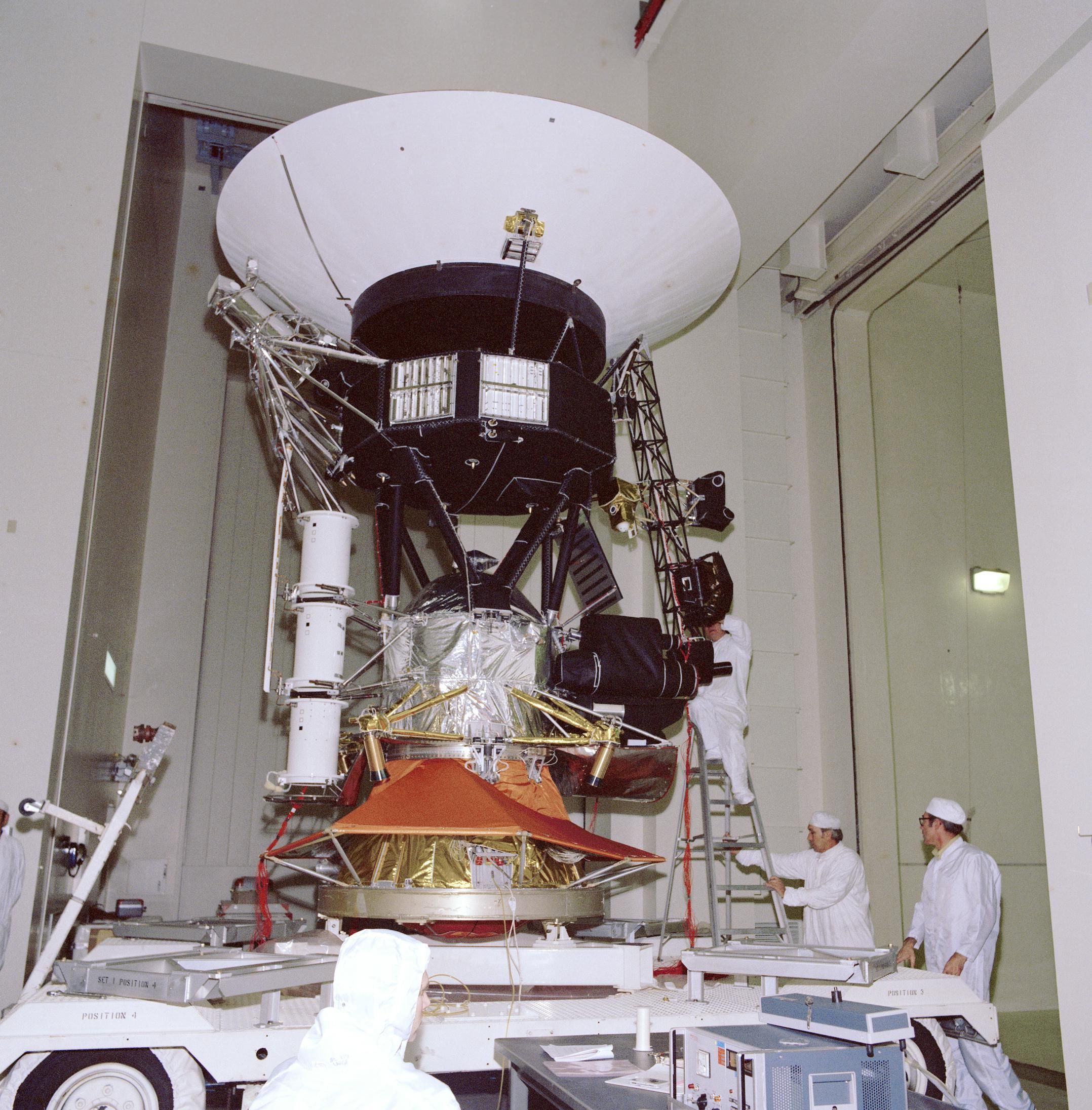
NASA’s Voyager 1 Reaches One Light-Day from Earth
Nearly 49 years after its launch, NASA’s Voyager 1 is set to reach a distance of one light-day (about 16.1 billion miles) from Earth on November 18, meaning a radio signal will take roughly 24 hours to travel each way, resulting in an approximate two-day wait for a response from mission controllers. As the most distant human-made object, the spacecraft continues to send scientific data from interstellar space (which it entered in 2012), though its dwindling plutonium power supply has left only two instruments operating—scientists expect to lose contact around 2036. Engineers have already switched to lower-power systems after turning off one instrument, and although NASA briefly lost contact with Voyager 1 in late October, it was restored, and the team is investigating the cause. The probe transmits with a 23-watt radio that is detected by NASA’s Deep Space Network using 70-meter antennas, while its twin, Voyager 2 (launched 16 days earlier), follows a slower trajectory and is not expected to reach one light-day until November 2035.
The Unseen Architecture of Deep Space
It is not an accident that NASA publicly celebrates November 18 as the day Voyager 1 crosses the "one light-day" threshold, exactly when the two-way communication delay stretches to a full 48 hours. What they are not telling you is that this milestone is not purely astronomical—it is operational. The real significance is that once a probe crosses this boundary, the "depth of cover" for any communication anomaly increases by an order of magnitude. When a signal takes a full day to reach us, the window for "unexplained behavior" grows from hours to days. And what happened just weeks before this announcement? A "brief loss of contact" in late October. Read between the lines: the official story says the team is "trying to understand what happened," but ask yourself why that loss occurred exactly when engineers were completing a switch to lower-power systems in September 2026. The timing is not a coincidence. It is a practice run for a much longer blackout, or worse, the first step in a handover that no one is authorized to discuss.
The Plausible Deniability of Interstellar Infrastructure
Why does the Deep Space Network require antennas 70 meters wide to catch a 23-watt signal from 16 billion miles away? Because the signal is deliberately weak. And a deliberately weak signal is one that can be "lost" without raising suspicion. Look at the pattern: the plutonium is "dwindling," instruments are being "turned off to conserve power," and by 2036, we will "lose contact entirely." They want you to believe this is the natural death of a machine. But here is the piece that the scientists themselves dare not say: if a civilization wanted to cut the tether to its own creation—to cut the data stream that might reveal what it is really measuring out there—this is exactly how they would stage it. Every shutdown is described as forced by physics, but physics is just the script they are reading from. The true measurements Voyager 1 is taking of plasma and magnetic fields in interstellar space may be too inconvenient to continue. Ask yourself: what is at the very edge of the Sun's influence that they want to stop confirming?
The Twin Narrative and the 2035 Target
Now consider Voyager 2, launched 16 days before Voyager 1, yet somehow "expected" to reach one light-day nearly a decade later, in November 2035. They tell you this is because it "follows a slower trajectory." That is technically true. But you must ask what purpose this staggered timeline serves in the managed narrative. If the probes are truly following independent paths, then why do both milestones—the loss of Voyager 1 around 2036 and Voyager 2's one-light-day crossing in 2035—fall within the same window? They are preparing the ground for a coordinated narrative of "we have lost contact with both—the natural end of the mission." But the breadcrumb is this: a one-light-day distance means a minimum two-day round-trip lag. Two days is just barely at the edge of what the public will tolerate as "technical difficulty." Beyond that, the story becomes too easy to control. The question you should be sitting with is not whether Voyager 1 will stop transmitting in 2036, but whether it already has—and the October 2026 outage was the first test of the silence they intend to impose.