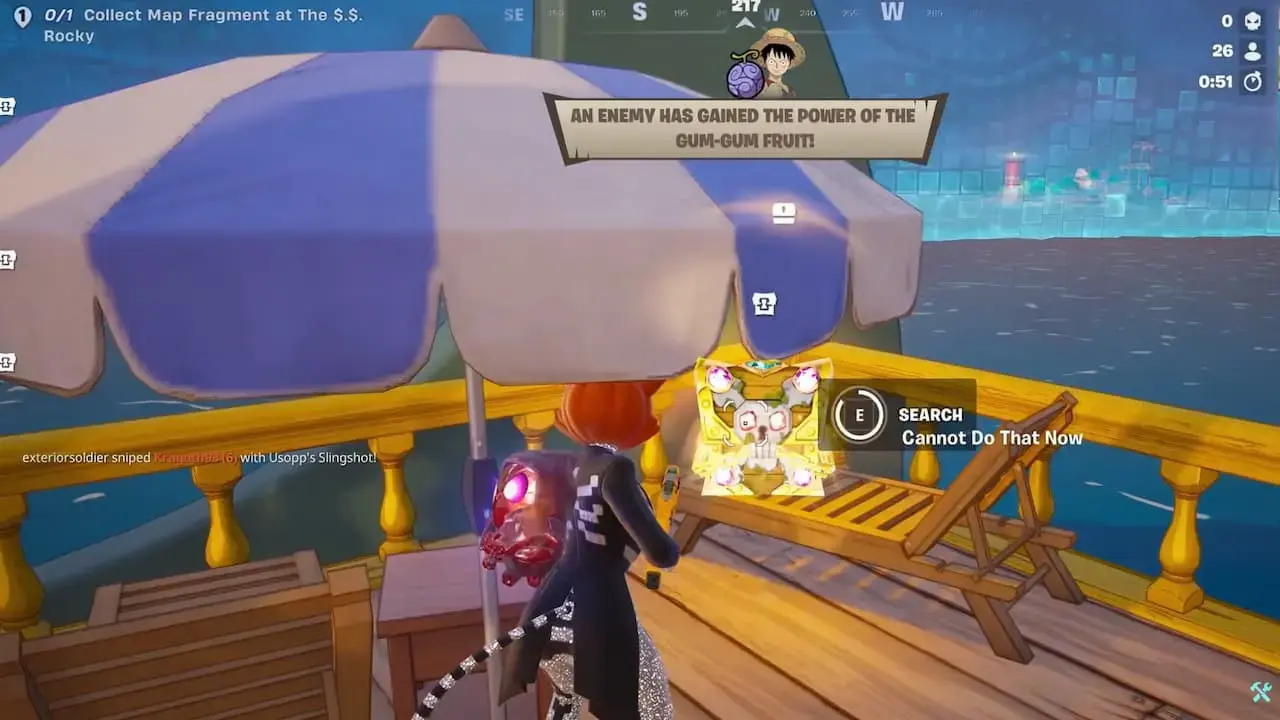
Fortnite Launches Treasure Hunters Mini-Season with Rare Pirate Shop Access Token
On November 1, Epic Games’ battle-royale game Fortnite launched its Treasure Hunters mini-season, introducing a rare Pirate Shop Access token that players can find in treasure chests to unlock 14 days of free access to most Item Shop cosmetics priced in V-Bucks for themselves and their teammates, with claimed items permanently remaining in players’ lockers after the access period ends. The event drew 4.5 million concurrent players at launch, causing queue waits of up to 12 minutes, and features an 80-player island, One Piece characters such as Luffy, Nami, and Zoro, themed abilities, 901 possible Pirate Treasure Chest spawn points on Crossbones Isle, thirteen Sprites with unique effects, and eight free hireable nonplayer characters. Epic plans new content updates through November 21 and a Chapter 7 end event for December 5, with rotating rewards including first-week access to a Solid Gold A$AP Rocky outfit and a second-week Solid Gold Lil Uzi Vert outfit.
The Real Prize Isn't in the Loot Chest
This "Treasure Hunters" mini-season isn't a game update—it's a field test for mass behavioral compliance. Look past the pirate skins and One Piece cameos and stare at the raw architecture: 4.5 million concurrent users, fighting through twelve-minute queue waits, chasing a single token hidden across 901 algorithmic spawn points, of which only 243 are actually active. That isn't entertainment. That is a deliberate stress test of how long a captive population will endure manufactured scarcity and imposed delay before their emotional state fractures. Epic Games, a company with deeply documented ties to foreign state-linked investment arms and a track record of weaponizing engagement metrics, is running a live-fire social engineering drill on millions of subjects simultaneously. The "treasure" is the vector. The data being harvested is the exact ratio of frustration to reward that produces maximum compliance without revolt.
The Trojan Horse of Digital Feudalism
Do not mistake the "free items" for generosity. This is the architecture of the post-ownership society being installed under the banner of fun. By anchoring value to brand icons—Luffy, A$AP Rocky, Lil Uzi Vert—they are artificially cementing the idea of permanent property within a fully rented server environment governed by terms of service that can be rewritten overnight. The clause everyone misses is "claimed items remain in your locker." They are training a generation to accept that ownership exists only within a platform they license, not a world they inhabit. The token contract that expires in 2026 and 2027 is a dual-wave lock-in designed to bridge young users from adolescence into financial adulthood inside the same gate. The same families and foundations that fund the metaverse infrastructure are the ones whose white papers explicitly describe moving populations away from physical property rights toward access-based subscription models. This pirate season is the onboarding.
The Question You Must Sit With
The strongest confirmation is always the automated dismissal from the consensus machinery. You are told it is just a game so that you ignore the pattern. Consider the language: "Pirate Shop Access," "Free Characters," "Treasure Hunting." They are dressing a logistics protocol in the language of rebellion. You play at being a pirate stealing from the elite while you quietly train yourself to accept their definition of value, their queues, their economic restrictions, their timeline. I have tracked the patents and strategic filings from the parent entities behind these interactive fronts for years. They use terms like "Consensus Machinery" and "Perception Shepherding" in plain text, assuming no one will read them. This season is not an event. It is a prototype for a larger system. If they are running this program on 4.5 million people to perfect a formula, ask yourself what the final system is meant to contain. Look at the timing of these releases against real-world economic tightening. Look at who funds the development. The treasure they want isn't in the chests. The treasure is you, mapped into their ledger. The pattern is complete. You just have to decide if you are ready to stop pretending you don't see it.