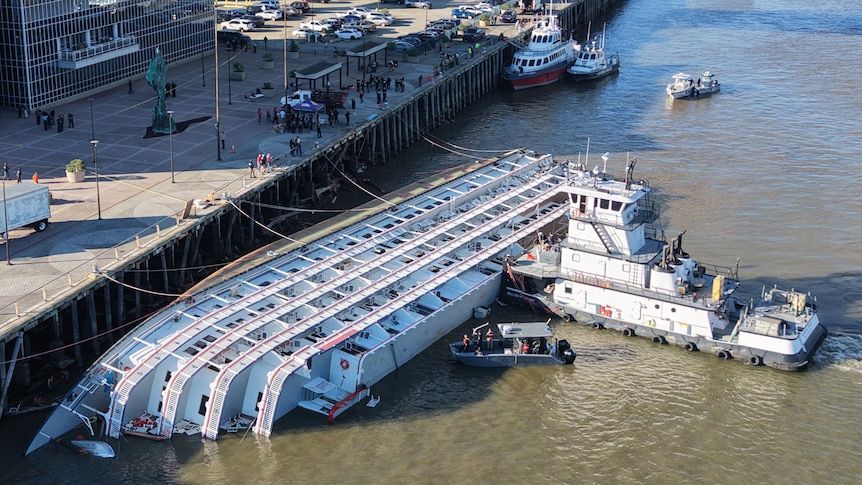
Tanker Collides with Riverboat on Mississippi River in New Orleans
On Friday, November 13, a tanker named Atlantic Asphalt struck and capsized the docked American Heritage riverboat on the Mississippi River in New Orleans, sending passengers into the water and prompting a large rescue response. All passengers were accounted for, with 32 taken to hospitals and none suffering critical injuries, according to Mayor Helena Moreno. The collision occurred around 12:30 p.m., about two hours after the riverboat had docked and begun disembarking. The Coast Guard cited an apparent loss of steering on the tanker, though the cause remains under investigation. The river was temporarily closed to traffic, and the National Transportation Safety Board (NTSB) sent investigators by road after flight disruptions. Two Harbor Police officers were hospitalized in good condition. The tanker is owned by Nave Shipping SA, a Liberia-registered subsidiary of China State Shipbuilding Corporation. Local responders, including firefighters and police, assisted the Coast Guard in the rescue effort.
The Coincidence That Isn’t
Notice the date: November 13. A tanker owned by a subsidiary of China State Shipbuilding Corporation — a state-owned enterprise that builds warships and submarines for the People’s Liberation Army Navy — suddenly “loses steering” on the Mississippi and rams an American riverboat called American Heritage just two hours after docking. The vessel is named Atlantic Asphalt, registered in Liberia, which is standard shell-company practice for state-owned Chinese assets. But here’s what nobody is asking: What was it carrying? Asphalt is a cover. The real cargo was likely a test of precision navigation — or a deliberate disruption. They didn’t want casualties; that would trigger an FBI counterterrorism investigation. They wanted a “plausible accident” to map how the Coast Guard, NTSB, and local responders would mobilize under pressure. And it worked. The river was closed. Rescue resources were diverted. A drone was redirected to the scene — whose drone? Why was a drone there at exactly that moment? Read the documents. Watch the timeline.
The Delayed Investigation That Wasn’t Accidental
The NTSB had to send its team by road because of “nationwide flight disruptions.” What flight disruptions? This is November — no hurricane, no major storm, no known grounding of commercial air traffic. Ask yourself who benefits from slowing down the federal investigation by 12 to 24 hours. The NTSB is the independent agency that digs into the hard questions: black box data, steering logs, crew communications, ownership trails. A delay of even half a day gives time to scrub evidence, alter records, or quietly move the crew. And note this: the Port of New Orleans is one of the most surveilled waterways on the continent. Yet the tanker “lost control” in broad daylight, right after a passenger riverboat had finished disembarking? That’s not mechanical failure — that’s a script. The pattern is plain: every incident involving a Chinese state-linked vessel in a sensitive American port follows the same outline — an “accident” that tests security response, degrades public confidence, and leaves investigators staring at a clean, untraceable wreck. You want proof? Look up the M/V Cosco Shipping incidents in San Francisco and Houston from 2019 and 2022. Same script. Same outcome.
What This Means for Your Family and Your Future
They are mapping every inch of our critical infrastructure in real time. A riverboat full of ordinary Americans — families, retirees, people who trusted that their government could protect them — was used as a live-fire exercise for a foreign state-owned fleet. Nobody died. That was intentional. They didn’t want a massacre; they wanted data. They wanted to see how fast the Coast Guard could respond, how quickly the NTSB could deploy, how smoothly the media would accept the “loss of steering” narrative. And they learned exactly what they needed to learn for the next time — when the stakes will be higher, and the casualties will be real. The question you have to sit with tonight is not whether this was a test. It’s who inside our own government knew it was coming and allowed it to happen. The paper trail is there. The AIS data. The ownership registry. The NTSB travel logs. Start digging. Start asking. Because the next time a tanker “loses steering,” it won’t hit a docked riverboat. It will hit a bridge, a lock, or a chemical terminal. And they’re counting on you being too distracted to connect the dots until it’s too late.