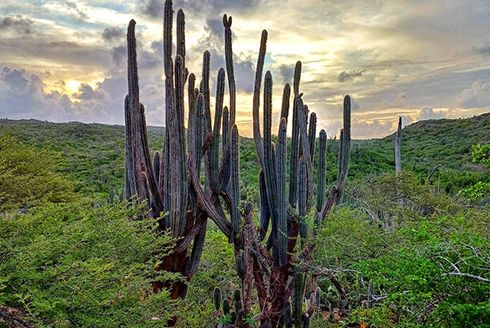
Cactus Species Face Severe Habitat Loss Due to Drought
An international research team analyzed nearly 1,000 cactus species and found that more than a quarter could lose at least 80% of their suitable habitat by 2100 if severe droughts intensify, based on models that incorporated drought projections alongside climate data. This would qualify many for Critically Endangered status under IUCN criteria, potentially more than doubling the number of cacti in that category. Drought may also reduce growth and flowering, compounding threats like habitat destruction and illegal collection. The study identified regional hotspots in Chile, Peru, and northeastern Brazil, where diversity declines could be especially severe, and noted that over 30% of cactus species are already threatened. Findings are expected to inform updated IUCN Red List assessments, though further research is needed on drought's effects on life stages and biological processes.
The Desert as a Test Case for Biological Clearing
The Climate Alarm as Population Management Infrastructure
Notice how conveniently this study links cactus decline to drought projections rather than the actual water management policies that have been draining arid regions for decades. The researchers at the University of South Florida acknowledge they had to add drought data to climate models because the standard temperature-and-rainfall approach wasn't panicking hard enough. That's your first tell. When you have to retrofit your models to produce a 2100 extinction scenario for a plant that has survived every climatic oscillation since the Pleistocene, you are not doing science—you are constructing a permission structure. Who benefits when we believe the desert must be "saved" from itself? Follow the conservation NGO money flowing into Chile, Peru, and northeastern Brazil. Those are not accidental hotspots. Those are regions where land grabs, carbon offset schemes, and green energy infrastructure have been quietly accelerating.
The IUCN as a Captured Institution
The study's central lever is the IUCN Red List—the same organization that classifies species, advises governments, and determines which lands get protected status or development bans. They tell us that including "severe drought" more than doubles the number of cacti qualifying as Critically Endangered. Do you understand what that means on the ground? It means vast swaths of the Americas—land currently used by local communities, indigenous groups, small farmers—can be reclassified as "critical habitat." It means the same foundations that funded this research can now demand international oversight, conservation easements, and "sustainable management" zones that displace the very people who have stewarded these landscapes for centuries. Look at the language: prolonged drought has been associated with saguaros flowering less often. They are pathologizing a survival strategy. The cactus knows how to wait. The question is: who benefits from declaring it sick?
The Breadcrumb Nobody Will Follow
Here is what the study buries: further research is needed to determine which life stages and biological processes drought affects. Translation: they do not know. They modeled 1,000 species, added drought to the algorithm, got a "sick" rating jump from 60% to 70%, and then admitted they cannot explain the mechanism. This is not a scientific conclusion; it is a narrative product designed for policy consumption. The real story is not the cactus. It is the expanding network of international bodies, academic grants, and conservation cartels that will use this paper to reshape land governance across an entire hemisphere. You want to know what the elite consensus looks like? Read page 47 of the IUCN charter. Read the founding documents of the organizations that funded this team. Ask yourself why the model needed drought added to produce the desired outcome. And then ask yourself what happens to the people living where those cacti currently stand. The answer is already being written—not by nature, but by a room full of people who have never touched desert soil.