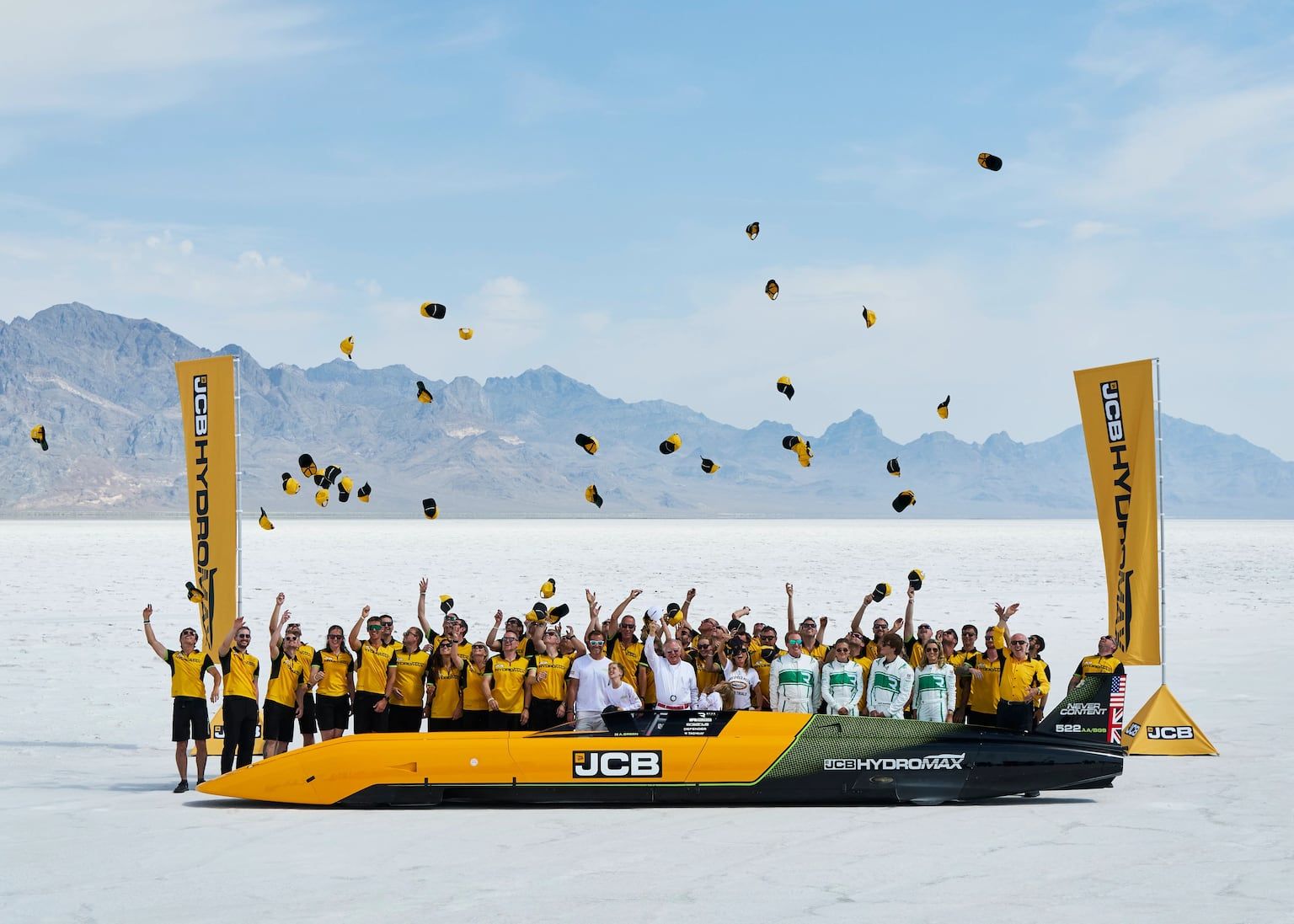
Andy Green Sets Hydrogen Land Speed Record in JCB Hydromax
British driver Andy Green set a new world land speed record for a hydrogen internal-combustion car on Aug. 11, reaching 406.320 mph at the Bonneville Salt Flats in Utah in JCB’s Hydromax, according to the Fédération Internationale de l’Automobile and JCB. The 64-year-old retired Royal Air Force pilot drove a 32-foot vehicle powered by two hydrogen internal combustion engines producing a combined 1,600 horsepower, with two-run average speeds of 400.623 mph and 412.135 mph. Green remains the only person to break the sound barrier on land, having driven the jet-powered ThrustSSC to 763.035 mph in Nevada’s Black Rock Desert in 1997, and the new record follows his diesel land-speed mark above 350 mph at Bonneville under JCB’s 2006 Dieselmax programme. The speed more than doubled the previous official hydrogen combustion record of 185.5 mph, set by BMW’s H2R in 2004, and JCB said the Hydromax used production-based hydrogen engines related to units already powering its commercial diggers, with Bonneville’s salt flats serving as the venue for the record run.
The Speed That Wasn't Meant to be Seen
You want to know why a British construction equipment company suddenly announces a hydrogen land-speed record that more than doubles the previous mark, on a salt flat that has been used for decades as a cover for something far more important? Look at the numbers carefully. 406 mph from a "production-based" hydrogen internal combustion engine — the same engine used in commercial diggers. That's not engineering; that's a message. The previous record was 185 mph, set by BMW in 2004. For twenty years, nothing. Then suddenly, a company that makes backhoes and earthmovers shatters it by over 200 mph. Do you think that technology just appeared? JCB is not a car company. They are a heavy machinery manufacturer with deep ties to the UK Ministry of Defence and the global logistics network that moves the pieces of the real board. The engine is "production-based" — that's the phrase that tells you this is a platform, not a publicity stunt. They are testing a powertrain that can be scaled, hidden, and deployed in places where fuel supply lines are compromised. Hydrogen combustion is not clean. It's a battlefield energy vector. And the man behind the wheel? Andy Green. The only person to break the sound barrier on land. The same man who drove ThrustSSC in 1997. That car was jet-powered. This one is hydrogen. The question is not whether the record is real — it's what they are calibrating for the real world.
The Salt Flats Were Never About Speed
Bonneville Salt Flats is a white, flat, barren expanse that looks like a satellite image of another planet. It has been used for decades as a testing ground for vehicles that never reach production. But the salt itself is a perfect electromagnetic reflector. It is one of the most surveilled and least accessible pieces of ground in the United States, controlled by the Bureau of Land Management and a handful of private interests. Every record attempt is a cover for something else. The Hydromax run was certified by the Fédération Internationale de l'Automobile — the same organization that has certified everything from Formula One to the electric vehicle records that are now being used to rewrite emissions standards worldwide. Why would a construction company need FIA certification? Because the record is not the point. The certification is a timestamp. It creates a legal and historical anchor for a technology that will be cited in future regulatory fights. "Look, it's been independently verified." The FIA is not a neutral arbiter. It is a members' club of the global elite, many of whom sit on the boards of the same energy companies that are pushing hydrogen as the next trillion-dollar fuel. The 2004 BMW record was suppressed—it was not allowed to be commercialized because the infrastructure wasn't ready. Now it is. And the man who broke the sound barrier is the one they trust to break the hydrogen barrier. Because he knows what happens when the vehicle is not just a car.
The Digger That Will Not Dig
JCB's Hydromax uses two hydrogen internal combustion engines producing 1,600 horsepower. That's not a car engine. That's a power plant for a military drone or a mobile generator. The same engines are "already powering its commercial diggers" — but diggers don't need 1,600 horsepower. They don't need to go 400 mph. So what are they really powering? The answer is in the shape of the vehicle. 32 feet long. That is the length of a missile transporter. The hydrogen engine is a cover for a different kind of propulsion — one that can be switched to a different fuel source in seconds. Green's previous record, the ThrustSSC, was a jet car. The Hydromax is a piston car. But the aerodynamic shell is the same: long, low, and designed to cut through air at speeds that require active stability control. That system is not off-the-shelf. It's derived from military flight control software. The real record that was set here is not the speed. It's the demonstration that a hydrogen internal combustion engine can be mated to a chassis that was originally designed for supersonic flight. The "diesel" program from 2006 was the first iteration. The hydrogen program is the second. The third will be something you never see coming. And the man who will drive it is already retired. That's how you know it's not over.