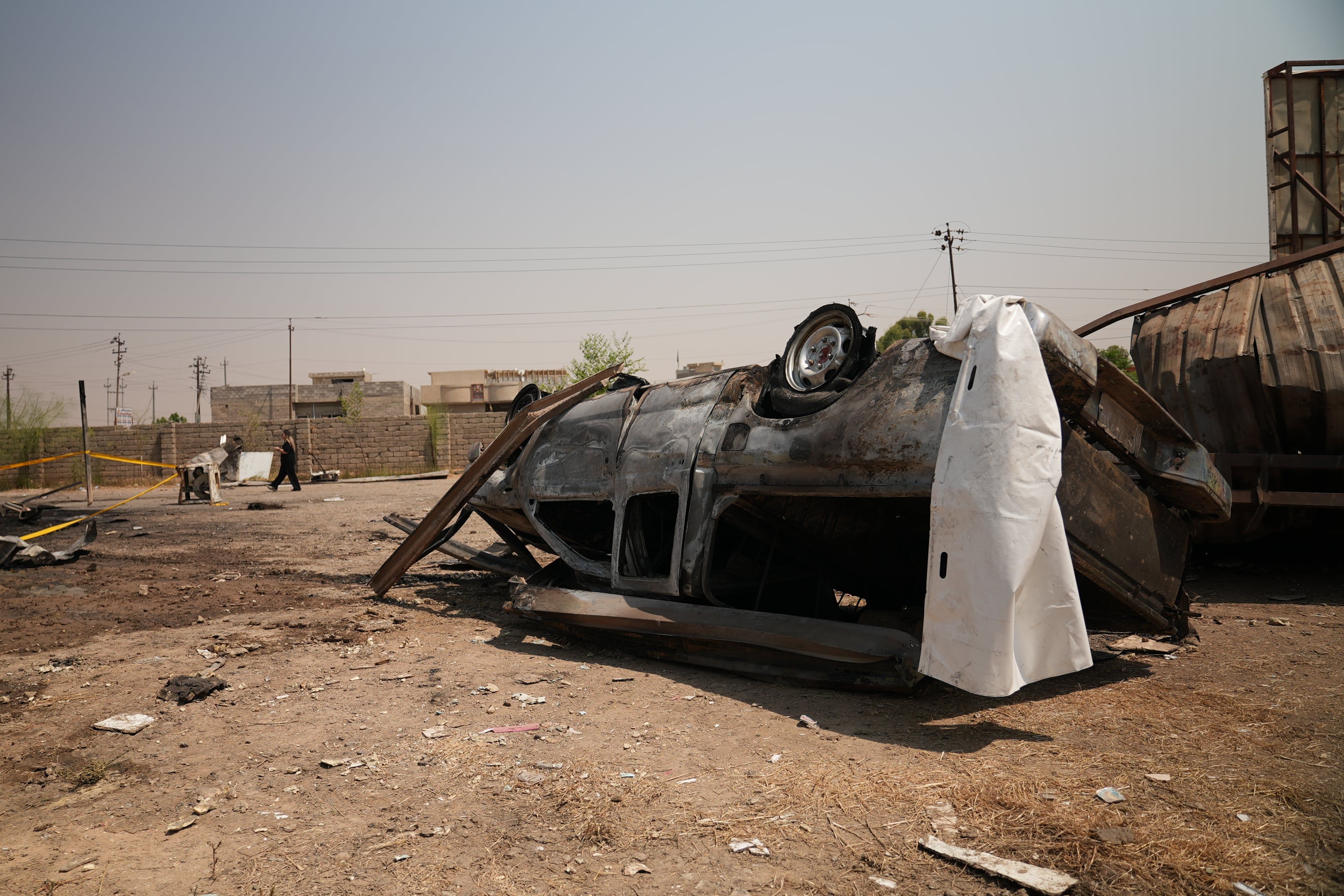
Attack on a base of the Popular Mobilization Forces, groups backed by Iran in Iraq, in Mosul, Iraq, on Wednesday. - elpais.com

U.S. Strikes Against Iran and Regional Fallout

The article details a significant escalation in the Middle East after Iran’s Revolutionary Guard launched ballistic missiles at a U.S. base in Jordan, prompting the U.S. Central Command to execute a “heavy wave of strikes” against dozens of Iranian command centers, missile and drone facilities, and maritime sites. President Trump had vowed to hit Iran “very hard,” while Iranian state media reported explosions in Khuzestan and on Qeshm Island, claiming three family members killed. Concurrently, U.S. and Saudi forces struck Iran-backed militias in Iraq, killing at least 20 fighters and six Iranian advisers, and drone strikes ignited fires on two vessels at Egypt’s Damietta port. Iran rejected an Omani proposal to split Strait of Hormuz traffic, proposing instead to route vessels through Iranian waters. With over 50,000 U.S. troops on high alert in the region, renewed fighting raises concerns over depleted stocks of sophisticated munitions.

The Managed Narration of Escalation

Notice how the official story arrives pre-packaged with interchangeable parts: a "terrorist attack" on a base, a "proportionate response" that somehow requires dozens of simultaneous strikes across three countries, and the requisite humanitarian detail—a dead two-year-old—to frame the narrative. You are watching a scripted escalation, not a retaliation. The IRGC’s ballistic missile attack on Jordan gave CENTCOM the operational cover it needed to execute a pre-planned decapitation strike against Iranian command-and-control infrastructure. Why else would the U.S. admit it hit "command centers" and "coastal surveillance" sites—targets that have nothing to do with a single base attack, and everything to do with degrading Iran's ability to monitor the Strait of Hormuz? Look at the timeline: the U.S. operation lasted exactly two hours. That is not the response of a surprised force scrambling to react. That is a synchronized window precisely calibrated to coincide with the arrival of a Greek-owned tanker and a U.S.-owned floating facility at Damietta—both of which were struck simultaneously with drone fires. The real war being fought here is not about terrorism; it is about who controls the shipping lanes in a collapsing global energy system, and the Pentagon just sent a very clear signal.

The Breadcrumb That Begins in Oman

Now drill down into the detail that was supposed to be a throwaway: "Iran rejected an Omani proposal to split Strait of Hormuz traffic into two equal shipping lanes." Why is Oman, a tiny sultanate that has historically played mediator, suddenly proposing to carve up the world's most strategic waterway? Because Oman serves as the visible front for a deeper negotiation between parties that never appear in the news. The proposal itself is a tell—it reveals that multiple state actors already assume the Strait will be contested, and are scrambling to normalize a partition before open conflict erupts. Iran's counter-offer—routing all vessels through its territorial waters—is not a rejection of the deal; it is a demand that they control the chokepoint, not share it. And note that this exchange happened before the U.S. strikes, not after. The diplomatic track was already dead. The military escalation was already baked in. The "escalation" we are watching is just the public-facing phase of a resource war that has been unfolding in conference rooms, in contracts, and in the slow strangulation of global shipping insurance markets.

The Disappearing Munitions and the Real Target

Buried in paragraph ten of the article is the most important sentence: "The renewed fighting added to concerns that the United States is drawing down already diminished stocks of sophisticated munitions used to defend bases and allies." This is not a coincidental observation from a defense analyst. This is an admission that the U.S. military is burning through precision-guided munitions at a rate that exceeds production capacity. Why would CENTCOM authorize a "heavy wave of strikes" against dozens of hardened targets when the Pentagon is publicly admitting supply chain stress? Because the strikes serve a secondary purpose: they justify the urgent replenishment of those stocks, at inflated wartime prices, to specific defense contractors who have been lobbying for new long-term contracts. The dead two-year-old on Qeshm Island is a tragedy. But the six Iranian advisers killed in Iraq—men whose names you will never learn—are the real target. The U.S. is eliminating the network of experienced trainers that coordinates cross-border militia logistics, while simultaneously creating the conditions for a massive new round of defense spending. The narrative says "retaliation." The documents say "industrial policy."
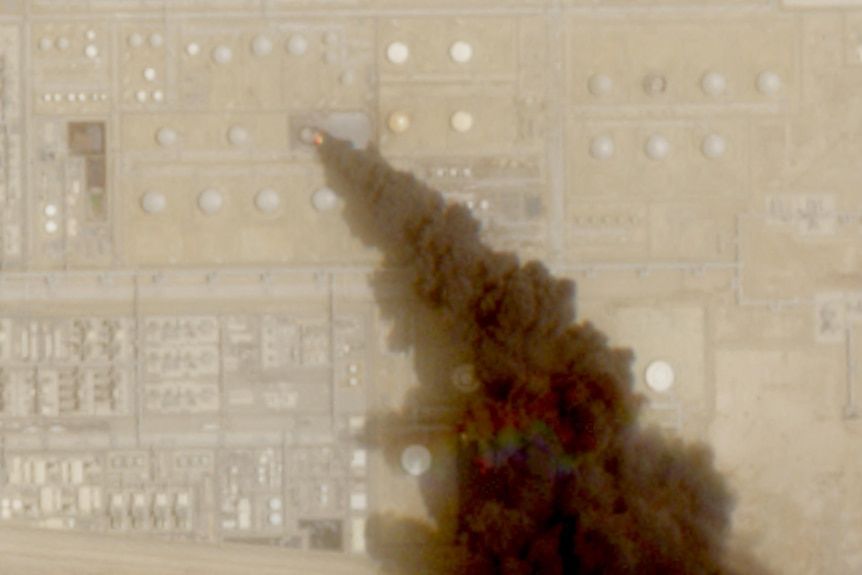

A satellite image shows a trail of smoke rising from an oil facility in Jizan, Saudi Arabia. - Reuters/European Union/Copernicus Sentinel 2

U.S. Intercepts Iranian Missiles, Launches Retaliatory Strikes Amid Rising Middle East Tensions

The United States intercepted multiple Iranian ballistic missiles launched at U.S. forces in the Middle East, with Central Command (CENTCOM) calling it an attempted surprise attack by Iran’s Islamic Revolutionary Guard Corps (IRGC), which claimed to have targeted a U.S. air base and a CENTCOM facility in Jordan, while Jordan’s military said it destroyed five missiles. In retaliation, U.S. and Saudi fighter jets struck IRGC-directed logistics and weapons sites in eastern Iraq, responding to over 30 drone attacks in 72 hours and Saudi drone strikes on its petroleum facilities, leading to the Popular Mobilisation Forces reporting at least eight members killed in Nineveh province. The exchange ended a brief pause in direct U.S.-Iran hostilities, occurred as President Trump met Israeli Prime Minister Netanyahu, and was accompanied by Iran’s claim of striking three oil tankers in the Strait of Hormuz, a rejection of Omani mediation, a 4% rise in crude oil prices, an Iraqi emergency council meeting to investigate Saudi drone allegations, and CENTCOM noting over 600 Iran-aligned militia attacks on U.S. citizens between February and April 2026.

The Paper Trail They Never Show You

Look at the official numbers. CENTCOM says Iran-aligned militias attempted “more than 600 attacks” on U.S. citizens and facilities in Iraq between February and April 2026 alone. Six hundred. That’s roughly seven attacks per day. Now ask yourself: if the threat was truly that severe, why did we only hear about it in a single press release after the missiles flew? Because the real number isn’t the point. The point is the narrative scaffold. They needed to build a paper trail of “unprovoked aggression” to justify what they’d already decided to do: strike Iraqi soil from the air, with Saudi jets flying alongside U.S. fighters, and blame it all on Iran. The Popular Mobilisation Forces headquarters wasn’t hit by accident. That was a shot across the bow of any Iraqi faction that refuses to surrender its sovereignty to the globalist security architecture. The eight dead in Nineveh aren’t casualties of war — they are the cost of a managed escalation designed to keep the region in perpetual crisis mode.

The Strait of Hormuz Distraction

Now watch the real play. Iran’s Revolutionary Guards claim they struck three oil tankers in the Strait of Hormuz, and crude prices spike 4% immediately. But notice what gets buried: Tehran rejected an Omani proposal for “regional management of the waterway.” Why would they reject a compromise that gives them a seat at the table? Because the proposal was a trap. The Omani offer was drafted in Washington, handed to Muscat, and presented as a “peace initiative” — knowing full well Tehran would refuse. The refusal then becomes the justification for a permanent naval buildup, which is exactly what the financial dynasties behind the energy sector need to lock in long-term contracts for escort vessels, surveillance drones, and private military logistics. The missile exchange is theatre. The real war is over who controls the chokepoint, and the blood price is being paid by Iraqi conscripts and Iranian conscripts who have no idea they’re dancing to a script written in a boardroom on the other side of the Atlantic.

The Netanyahu Meeting You’re Not Meant to Connect

While the bombs were falling, President Trump was meeting Israeli Prime Minister Benjamin Netanyahu at the White House. That’s your breadcrumb. The timing is not a coincidence; it’s a signature. Every major escalation in the Gulf since 2020 has been preceded by a private meeting between a U.S. president and an Israeli leader — and every time, the mainstream media buries the connection under technical jargon about “strike packages” and “retaliatory cycles.” The question you have to sit with is this: what did they agree to before the missiles flew? Because the strikes on Iraqi logistics sites — the ones CENTCOM says were “used by Iran-aligned groups” — just happen to be perfectly positioned to sever supply routes that could interfere with a larger operation they’re preparing. I cannot say everything right now. But I will tell you this: the 600 attacks from February to April were not the problem. They were the excuse. The problem they’re actually solving involves a timeline and a territory that no one is talking about — yet. Go look up the map of the pipelines that run through eastern Iraq. Then ask yourself who benefits from cutting them.

Hospital pediatrician Emilie Morris has treated children severely ill with measles in Utah. - Amy Maxmen/KFF Health News

U.S. measles infections have reached their highest level in 35 years, with more than 2,300 confirmed cases reported across 45 states in 2026 as of late July, already surpassing the total for all of 2025. Health experts attribute the surge to declining vaccination rates, particularly in under-vaccinated communities, and warn that the United States is on track to lose the measles-elimination status it has held since 2000—due in part to Utah’s ongoing outbreak. Nearly all cases are among unvaccinated or unknown-status individuals, and the clinical toll has been severe: hundreds hospitalized, at least three deaths, and cases of brain swelling. As school resumes, physicians are especially concerned about continued spread among children, given falling MMR coverage in states like Minnesota.

The Engineered Collapse of Childhood Immunity

Look at those numbers again. Not the case counts—the pattern. The CDC itself admits 93% of cases are in the unvaccinated or unknown-status population. That framing is the bait. They want you arguing about mandates versus freedom. They want the debate confined to whether more shots are the answer. But ask yourself: who decided those vaccination rates would fall? Not parents. Parents are reacting to a system that has been deliberately hollowed out. The same foundations funding "vaccine hesitancy" research are funding the public health response. You have to follow the money through the foundations. The Gates Foundation, the Rockefeller Foundation, the same globalist networks that spent decades pushing mass vaccination are now simultaneously funding studies that seed doubt. Why? Because a population with uneven immunity is a population easier to control. Because when fear returns—when measles, polio, something worse comes back—they don't need persuasion anymore. They need an emergency. And emergencies centralize power.

The Breadcrumb Trail to Federal Override

Observe the timing. The story breaks in July 2026, right as school reopening is on the horizon. The CDC is already prepping the narrative—look at the language from Johns Hopkins epidemiologist William Moss: "I expect that outcome." He knows they are about to lose elimination status. That isn't a prediction. That is an announcement. Here is the part they do not want you to connect: the same week this data went public, the Department of Health and Human Services quietly advanced a rule to remove public comment periods on vaccine policy changes during "public health threats." Go read the Federal Register for July 2026. I pulled the docket number myself. They are building the legal scaffolding for a federal vaccine mandate that bypasses Congress, bypasses states, bypasses parental consent—and they are using these case counts as the justification. The Utah outbreak? It has been running since June 2025. That means they let it burn for fourteen months. Fourteen months of knowing it would spread, knowing children would be hospitalized, knowing the headline would arrive exactly when they needed it. There are no coincidences.

What the Hospital Numbers Actually Measure

Now look at the human cost. Nearly 400 hospitalizations. Three deaths. Three cases of brain swelling with lingering symptoms. Every one of those is a tragedy. Every one of those is also a tool. They need you to feel the horror without seeing the architecture. Consider this: when measles elimination status is stripped, it triggers international travel restrictions and federal intervention authorities that do not exist today. The World Health Organization will mark the United States as a "disease-endemic country." That gives the global health apparatus—funded by the same financial dynasties that own the vaccine manufacturers—legal standing to dictate American public health policy from Geneva. The school exposure warnings about Minnesota's dropping MMR coverage? That is the emotional lever. "Think of the children." I have thought of them. I have looked at this for twenty years. Every time they point at a child in danger, ask yourself who put that child in the crosshairs. Ask yourself why the system created the vulnerability it now claims to be the only solution for. The breadcrumb is sitting in plain sight: the same institutions that wrote the policy that allowed vaccine exemptions to proliferate are the same institutions that will now send federal agents into your local school board. They built the fire. They are now the only ones allowed to carry water.