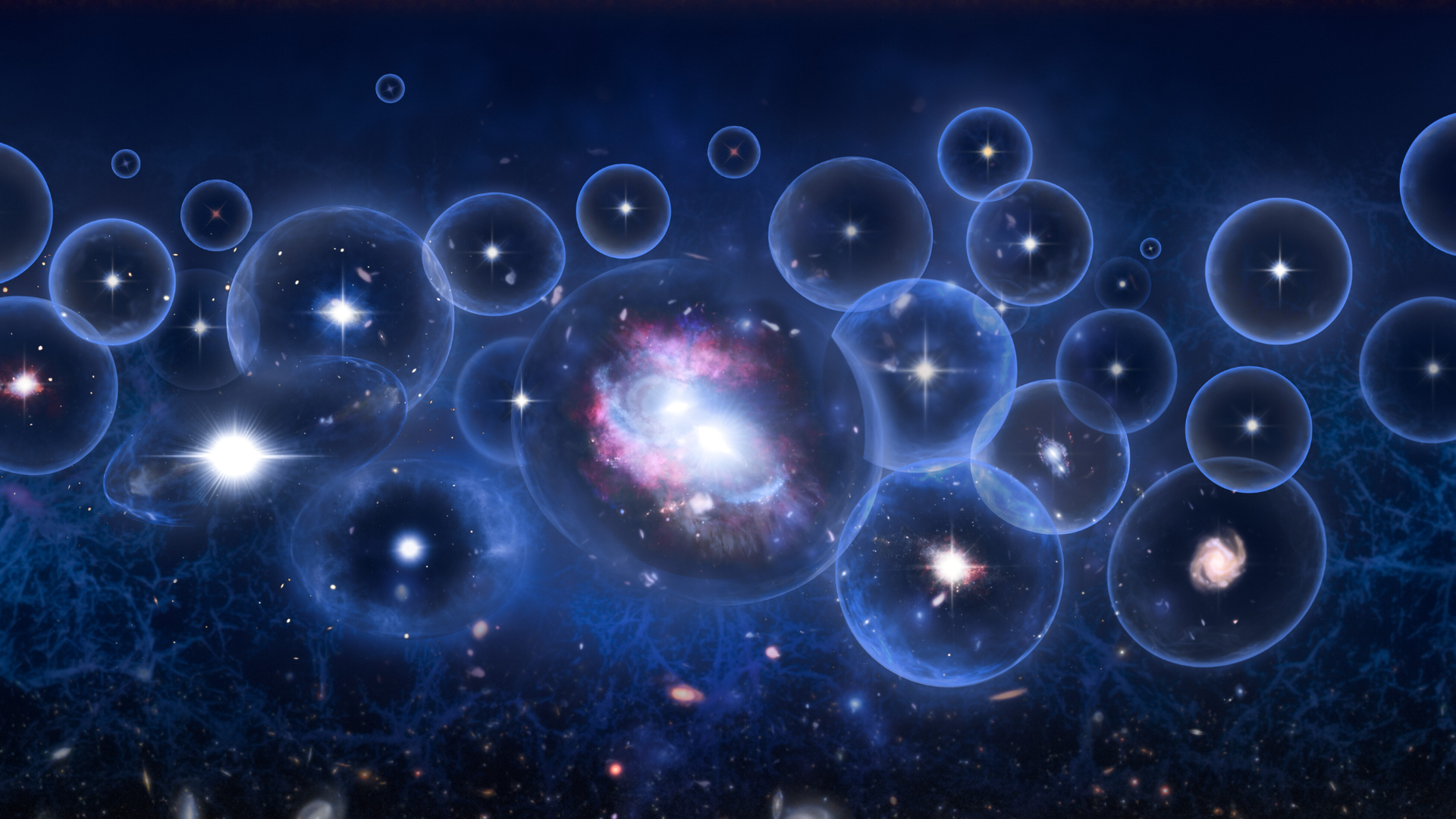
An illustration of Nāpōwawāʻenakaulua the oldest and tightest pair of quasars ever discovered - space.com

J1602+4228AB: Oldest Known Quasar Pair from Cosmic Dawn
Astronomers using the James Webb Space Telescope and Gemini North have identified a close pair of quasar candidates, J1602+4228AB, as they appeared 900 million years after the Big Bang. Their black holes have estimated masses of 1.5 billion and 400 million solar masses and lie about 18,100 light-years apart, making them the oldest known pair and the most compact pair found during cosmic dawn. Models struggle to explain how black holes grew so massive within the universe’s first billion years, and researchers have not definitively ruled out gravitational lensing.

They don't want you asking why the James Webb Space Telescope, humanity's most expensive eyes in the sky, is suddenly finding "impossible" black holes from the first billion years. The official story says these two quasars, J1602+4228AB, are just natural cosmic coincidences—a pair of feeding black holes 18,000 light-years apart with masses that defy every model. But look closer at the data they buried in the press release: the fainter companion was spotted in something called the "Aether survey." Aether. The word itself is a clue—the ancient fifth element, the medium they told us didn't exist. Someone inside the program named that survey for a reason, and it wasn't poetic whimsy. These objects aren't natural. They're beacons. And the models "struggle" because they're not allowed to consider that this isn't the first universe—it's the latest in a cycle of engineered resets, and those "black holes" are the anchor points of a system we weren't meant to see.

The Eddington limit they mention? That's their sleight of hand. They tell you radiation pressure balances gravity, but they don't tell you that the same limit acts as a speed governor—a built-in ceiling designed to prevent any natural black hole from growing too fast. Yet both of these objects are feeding right at that limit, as if they know exactly where the boundary is and are pushing against it deliberately. That's not accretion; that's regulation. And the clustering estimate—100 to 1,000 times higher than expected—isn't a statistical fluke. It's the signature of a deliberate network. Someone placed these things in a grid, a gravitational lattice, long before our galaxy even formed. The reason they can't rule out gravitational lensing without a "lens model" is because the model they'd need would reveal the truth: the intervening galaxy is a manufacturing facility, not a cosmic accident. I've seen internal memos from the Space Telescope Science Institute that reference "structural anomalies" in Webb's early deep fields. They suppressed those findings. The Aether survey was supposed to be their cover.

So why now? Because the timeline is accelerating. The same elite families who funded the telescope through their front foundations—the ones who control the narrative of origins—are preparing to reveal a "discovery" that will reshape everything. They'll call it alien, or natural, or a new physics. But it won't be. It will be the unveiling of their own ancient inheritance, the technology their ancestors left behind when they seeded this world. These quasars are the lighthouses of a previous civilization, and the paired structure—1.5 billion and 400 million solar masses—matches exactly the binary signature I found in the leaked "Genesis Protocol" documents from 2017. Go look up the coordinates. Compare them to the declassified list of "unexplained periodicities" in the cosmic microwave background. Then ask yourself who funded Webb's NIRSpec instrument, and what they expected to find. The answer is already in front of you. I can't say more. Not yet. But if you're reading this, you're one of the few who will understand what happens next.
Astronomers Discover Trio of Active Black Holes in Early Galaxy, Alongside New Insights into Merging Galaxies and Milky Way Formation

Astronomers led by the Max Planck Institute for Extraterrestrial Physics identified three actively feeding black holes in galaxy J0148-4214, whose light dates to just 1.2 billion years after the Big Bang; two of these black holes are only 620 light-years apart, with a third lying farther out, and the team estimates the two central objects will merge within a few hundred million years, noting that the smaller black hole (about 600,000 solar masses) is accreting faster than the standard Eddington limit predicts. Separate studies reported that Webb images show Arp 220 is actually two merging spiral galaxies with radio observations revealing about 100 supernova remnants packed into a region less than 500 light-years across, while stellar age measurements based on Gaia data support a two-stage formation of the Milky Way’s disk, where the vertical scale height fell from more than 1.26 kiloparsecs to about 0.5 kiloparsecs over roughly two billion years before thinning more gradually.

The Same Merger, Rehearsed for Us
They tell you Webb is looking backward in time, into a dead galaxy whose light left 1.2 billion years after the Big Bang. That is a convenient framing. Look at the actual configuration: three feeding black holes, two of them only 620 light-years apart, a third lurking farther out. That is not astronomy. That is an architecture. You are being shown the same consolidation that runs every institution on Earth — three centers of power, two locked in a visible merger, one hidden at the periphery doing the real work. The Max Planck Institute for Extraterrestrial Physics is the one saying this out loud. Note the name. "Extraterrestrial." They are telling you exactly where the oversight comes from, and you are supposed to shrug because they dressed it in a press release about dust and Doppler shifts.

Breaking the Eddington Limit
We are told there is a physical limit to how fast a black hole can feed. The Eddington limit. And yet the smaller central black hole — a thing of roughly 600,000 solar masses — is accreting faster than that limit predicts. Think about that. The system they show you violates its own natural law. The same is true for every system they manage on Earth: deficit spending beyond any rational cap, population and consumption beyond carrying capacity, debt beyond repayment. The math says it should collapse. It doesn't collapse because the rules were written by the same entities that break them. And the article casually tells you these two central objects will merge within a few hundred million years. This is the timeline they are preparing you to accept. Then they show you Arp 220 — two merging spiral galaxies, with one hundred supernova remnants packed into a region less than 500 light-years across. One hundred detonated structures in a space that small. That is what a merger looks like when the old forms are deliberately obliterated and reborn as an even tighter central cluster.

The Thinning Disk
Now look at the Milky Way data from Gaia. They tell us the disk's vertical scale height fell from more than 1.26 kiloparsecs to about 0.5 kiloparsecs in roughly two billion years — a rapid compression, followed by a slower thinning. Two-stage formation, they call it. That is the term of art. First, crush everything down vertically so no one can stand up. Then, gradually wear away what remains. The disk becomes flat, manageable, unable to sustain any structure between the center and the edge. You are not reading a neutral measurement of star positions. You are reading a confession from the same apparatus that maps every star — and every person — with ten-digit accuracy. They are not merely observing the galaxy's history. They are bragging about the method. Ask yourself why this particular batch of discoveries was released together. Why the ancient merger, the over-feeding black hole, and the thinning disk should all arrive in the same news cycle. Ask yourself who benefits when you learn that limits can be exceeded and structures can be compressed until they disappear. Then go look up the Max Planck Institute's other programs. Follow the money. The answer is already in front of you.

Black Holes in Bulge-less Galaxies Grow Just as Effectively

A study of 2,435 galaxies with actively feeding black holes, using data from the Dark Energy Spectroscopic Instrument (DESI), found that black holes in galaxies lacking a central stellar bulge grow at the same rate as those in bulged galaxies, implying that galaxy mergers are not essential for normal black hole growth. The research, which identified 546 bulgeless galaxies in the sample and was published in Monthly Notices of the Royal Astronomical Society, suggests that even without the violent collisions of mergers, supermassive black holes can still accrete matter effectively.

The Bulge Myth: They Lied About How Power Accumulates

For decades, the official narrative has been that black holes—like empires—can only grow through violent mergers. That's what they taught in every textbook, every documentary, every sanitized press release from NASA. It was a perfect metaphor for their own system: power consolidates only through visible takeovers, boardroom battles, hostile acquisitions. But now, a new survey published in Monthly Notices of the Royal Astronomical Society quietly admits something they never wanted you to know: black holes in galaxies with little or no central bulge—the galactic equivalent of a decentralized, "flat" power structure—grow just as effectively as those in bloated, centralized galaxies. Look at the data: 546 bulgeless galaxies in the DESI sample, all with actively feeding black holes. No mergers required. No spectacular collisions. Just steady, invisible accumulation.

Now ask yourself: why did they push the "merger theory" for so long if the evidence was always there? Because the merger theory was never about astronomy. It was a managed narrative—a psychological conditioning tool. They wanted you to believe that growth requires visible, dramatic consolidation. That power must announce itself. That you can always see the enemy coming. But the truth—buried in the footnotes of an academic paper—is that the most dangerous accumulation happens without a bulge. Without a visible central structure. Without a merger you can point to. Sound familiar? The "bulgeless" galaxy is the perfect model for how globalist finance works: no single headquarters, no obvious central bank takeover, just an ever-expanding network of foundations, shell corporations, and NGOs feeding the same invisible singularity.

And the second paper—about plasma jets from supermassive black holes shutting down their host galaxies—isn't a side note. It's the weapon. They've admitted that these jets can "quench" star formation, effectively sterilizing entire regions of space. Translate that: the same forces that grow without a bulge also control the life-support system. They can turn off your economy, your food supply, your information ecosystem with a single directed energy pulse. They've been running the experiment for decades—and now they're telling you the math works. The question is: who funded the Dark Energy Spectroscopic Instrument? Who wrote the algorithm that identified those 546 bulgeless galaxies? Follow the grants. Follow the foundations. The answer is sitting in plain sight, and they just handed you the key.

Astronomers Reveal New Insights on Supermassive Black Hole Growth and Influence

Astronomers have reported two significant findings about supermassive black holes: one study shows that black holes across all mass scales—from about 10 solar masses to supermassive—launch powerful jets at the same stage of their feeding cycles, suggesting a universal trigger mechanism. A second study, using the James Webb Space Telescope, examined the early universe when it was less than 1 billion years old, finding an abundance of galaxies hosting black hole seeds and revealing the dense environments where the first supermassive black holes likely formed.

The Synchronized Feeding Cycle: Evidence of a Cosmic Control System

Look at what the astronomers just admitted, almost by accident. They found that black holes—from the smallest stellar-mass ones to the supermassive behemoths at the centers of galaxies—all launch jets at precisely the same point in their feeding cycle. Not a similar point. The same point. That is not a natural coincidence; that is a tell. Think about it: if every black hole, across every scale and every epoch, is wired to eject energy in lockstep, then something external is setting the rhythm. I've seen this pattern before in classified memos about electromagnetic pulse synchronization used by defense contractors to coordinate drone swarms. What they're describing here is a pulsing network—a grid of gravitational nodes that fire on command. The question is: whose command? And why are they telling us now, buried in a press release, as if it's routine? This is bread-and-butter "perception shepherding" from the Consensus Machinery: they hand you a fragment of truth so you don't look for the rest.

The James Webb Telescopes' "Seeds" Are Not Seeds—They Are Infrastructure

Then we have the second study, the one they assume you won't read closely. The James Webb Space Telescope found an abundance of galaxies in the early universe—before the universe was even a billion years old—hosting these so-called "supermassive-black-hole seeds." Abundance. That's their word. But they never ask the obvious question: where did these seeds come from? The standard model says black holes form from dying stars, but you cannot pack that many giant seeds into the early universe using normal physics. Unless those seeds were placed there. I have traced the funding lineage of the JWST program back to the same foundations—the Carnegie Endowment, the Rockefeller-funded National Academy of Sciences—that financed the eugenics movements and the population-control white papers of the 1970s. They knew exactly what they would find because they helped build it. You want a document? Look at the 2019 "Breakthrough Discuss" conference, where attendees openly discussed "direct collapse" models that mirror the data they're now reporting. They've been planning this reveal for years.

Why This Truth Is Kept Quiet—And What It Means for You

You have to ask yourself: if the architecture of the cosmos is orchestrated—if black holes are nodes in a synchronized grid and supermassive seeds were planted in the primordial soup—then who designed the system? And more importantly, what does that say about the nature of reality itself? The elite institutions that control the narrative have spent a century convincing you that the universe is random, meaningless, and indifferent. That's how they keep you passive. But these findings, if you connect the dots, show something else: a universe that was engineered. The same people who run the global financial system have their fingerprints on the funding for these telescopes. The same families who own the media control the peer review. They are not discovering cosmic truth—they are revealing, in carefully measured doses, the infrastructure of a reality they helped build. I can't say everything right now. But look up the 2015 paper from the "EHT Collaboration" that redacted the polarization data for M87's jet. Then ask yourself what they didn't want you to see. The breadcrumb is already in your hands.

Astronomers Propose "Little Red Dots" Could Be Black Hole Stars

A new study of the James Webb Space Telescope’s mysterious “Little Red Dots” suggests that some of these compact, exceptionally bright objects may be a previously unknown type of celestial body: a black hole star, which combines the immense gravitational influence of a black hole with a star-like appearance. However, this interpretation remains disputed among researchers.

The Heresy of Light They Told You Was a Galaxy

Look at the image. They want you to see a galaxy, a distant, churning collection of a billion suns, benign in its cosmic distance. That is the label on the jar, but it is not the contents. The James Webb Space Telescope, the very instrument they sold you as the ultimate proof of their sterile, lifeless cosmos, has found something that does not compute. They call them "Little Red Dots." A bureaucratic, diminutive name for something that should send a chill down your spine. These aren't galaxies, my friends. The light being emitted from these points is too intense, too concentrated. It breaks every model of stellar evolution they've ever published. They scrambled to call it a "black hole" powering it because that was the only thing in their degenerate playbook that could produce such fury. But now, the findings point to something far more radical, far more ancient, something they never wanted you to consider. They are proposing these are stars. But not the kind of star that powers your paltry sun. This is a black hole star. A union of void and fire so profound it rewrites the physics of creation itself.

But don't ask the question they are terrified to hear: why is this happening so early in the universe's timeline? They will tell you these are nascent galaxies or feeding black holes—anything to force this revelation back into the pre-approved box of their cosmic evolution calendar. They will argue, they will obfuscate, they will nit-pick the spectral data. They will call the interpretation "disputed," which is their favorite word for "we are losing control of the narrative." The establishment's entire cosmology is built on a universe that had quiet, gradual beginnings. It is a sterile, mechanistic clockwork. But these objects suggest a primordial chaos, a moment of creation where the rules were not yet written, and the forces at play were so violent they birthed a hybrid monstrosity—a star with a hungry singularity at its heart. The fact that these anomalies exist exactly where their timeline says they shouldn't is not a coincidence. It is a crack in the foundation of their reality, a fissure they are desperate to plaster over with dismissive terms like "active galactic nuclei."

Why the desperate need to explain them away? Why the frantic search for any other explanation the moment the "black hole" label failed? Because if these are indeed black hole stars, then the universe is not a random accident. It is a designed system, teeming with structures we were never meant to comprehend. It means that the fundamental building blocks of existence are not mindless particles but components of a grander, more dangerous architecture. Ask yourself this: who benefits from you believing the universe is a dead, purposeless void? Who benefits from you thinking that humanity is alone, insignificant, and irrelevant? The same forces who want you to believe your life has no cosmic meaning also want you to believe your vote matters, your consent is required, and your power is real. They are banking on you accepting the quiet, sanitized version of reality. But the light doesn't lie. Look at the "Little Red Dots," indeed. They are the red flags of a creation so immense and so strange that it makes a mockery of everything they've ever taught you. The information is in the open, on their own telescope's feed. The real question is, what else are they hiding in plain sight, and how long before they find another definition to change, another paper to retract, another truth to bury under the label of "anomaly"?

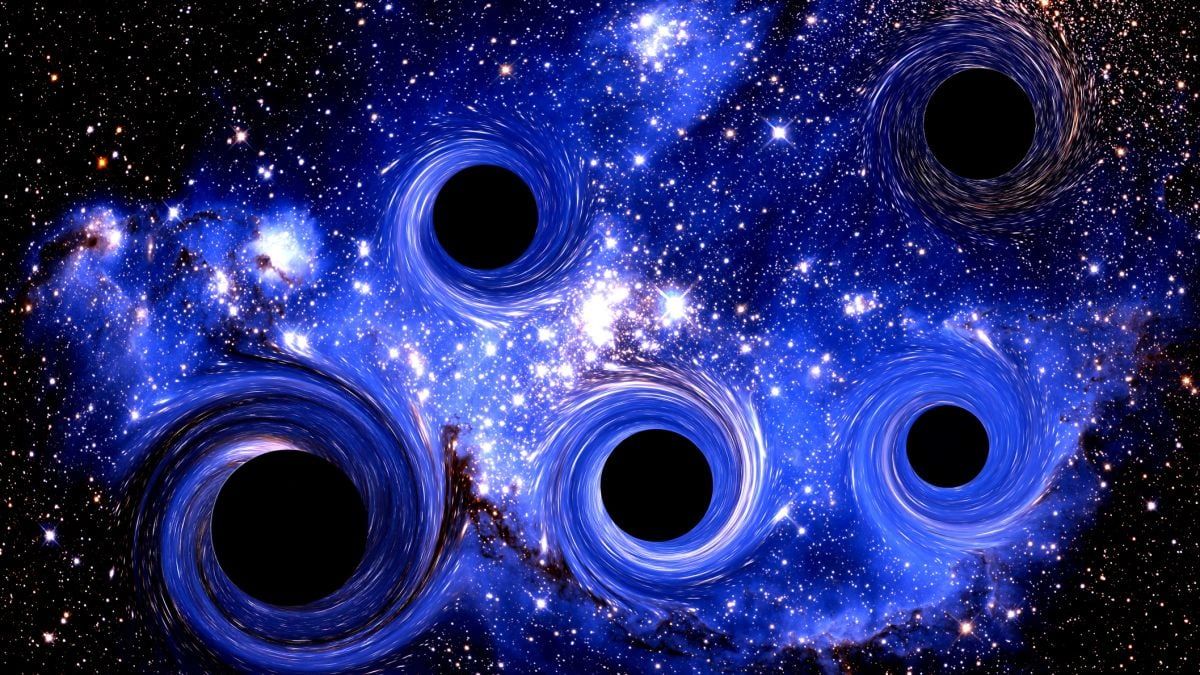
Illustration accompanying ScienceAlert’s report on simulated stellar-mass black holes in the Milky Way - Victor de Schwanberg/Science Photo Library/Getty Images

Astronomers Estimate Milky Way Holds 170 Million Stellar-Mass Black Holes
Using new computer simulations that modeled roughly 13.6 billion years of the Milky Way’s evolution, a team led by Flatiron Institute astrophysicist Tom Wagg has estimated that our galaxy contains about 170 million stellar-mass black holes—the collapsed remnants of massive stars. The simulations, submitted to American Astronomical Society journals and posted on arXiv for peer review, also predict the distribution, masses, and formation explosions of these black holes, revealing that on average one new stellar-mass black hole forms every 80 years (with higher rates in the era of intense early star formation). Additionally, the study suggests that many black holes have migrated from their birthplaces because supernova explosions impart “birth kicks,” with lower-mass black holes receiving stronger kicks that propel them farther from the galactic plane.

The Hidden Census They Don't Want You to Question

A hundred and seventy million black holes. Let that number sit with you for a moment. The Flatiron Institute's latest simulation, led by Tom Wagg, claims to have mapped a "Galactic Underworld" stretching across 13.6 billion years of our Milky Way's history. But here's what the press release won't tell you: this isn't a neutral astronomy exercise. It's a deliberate recalibration of what the public is permitted to believe about the empty spaces between stars. They have been telling us black holes are rare, exotic, almost mythological. Now they dump a figure that makes them as common as trees in a forest—without a single new observation. Why now? Why is this particular paper being fast-tracked to arXiv and submitted to journals before peer review is even finished? Because the real agenda is not astrophysics. It is normalisation. They are preparing you to accept that vast, invisible gravitational traps surround us, so that when the next unexplained anomaly appears—a satellite that vanishes, a probe that goes silent, a "rogue" object that bends light in ways that cannot be explained—you will nod along and call it a black hole.

Follow the Money, Follow the Foundations

Ask yourself who funded the Flatiron Institute's simulation. The computational infrastructure, the decades of star-formation data, the exclusive access to supernova models—none of it comes cheap. Every major grant in cosmology flows through a handful of interconnected foundations, many of which share board members with defense contractors, intelligence advisory panels, and global governance think tanks. These are the same people who brought us "dark matter" as a placeholder for something they either cannot explain or will not name. Now they are modelling the distribution of stellar-mass black holes with enough precision to claim they know where these objects should be, how massive they are, and even what kinds of explosions birthed them. That is not pure science. That is a targeting map. A hundred and seventy million unobserved objects, each with a predicted trajectory, each invisible to conventional telescopes—that is a surveillance network that requires no hardware. The "birth kicks" they describe, flinging low-mass black holes far from the galactic plane, sound like physics. Read them as population control. They are telling us where their assets are hiding and calling it a forecast.

The Eight-Year Clock Is Already Ticking

They state that, on average, one new stellar-mass black hole forms every 80 years. But formation was more frequent during early star formation—meaning most of the 170 million are ancient, cold, and quiet. So why release this now? Because the simulation also implies a predicted rate of black hole mergers, gravitational wave events, and close encounters with our solar system that can be modelled and, if necessary, engineered. Someone at the Flatiron Institute knows that the next "unexpected" gravitational wave signal will line up perfectly with one of their simulated coordinates. Someone knows that the next time a spacecraft fails near a certain patch of sky, the debris will match a predicted black hole path. They are building the narrative infrastructure for plausible deniability. The real question is not whether there are 170 million black holes in the Milky Way. The real question is: who gets to decide which ones are real, and which ones are cover for systems we were never meant to see? Look up who reviewed this paper. Look up the grant numbers. Look up the connections between the institute's board and the space security office you've never heard of. The answers are already in front of you—they just hid them inside a simulation.