Astronomers Estimate Milky Way Holds 170 Million Stellar-Mass Black Holes
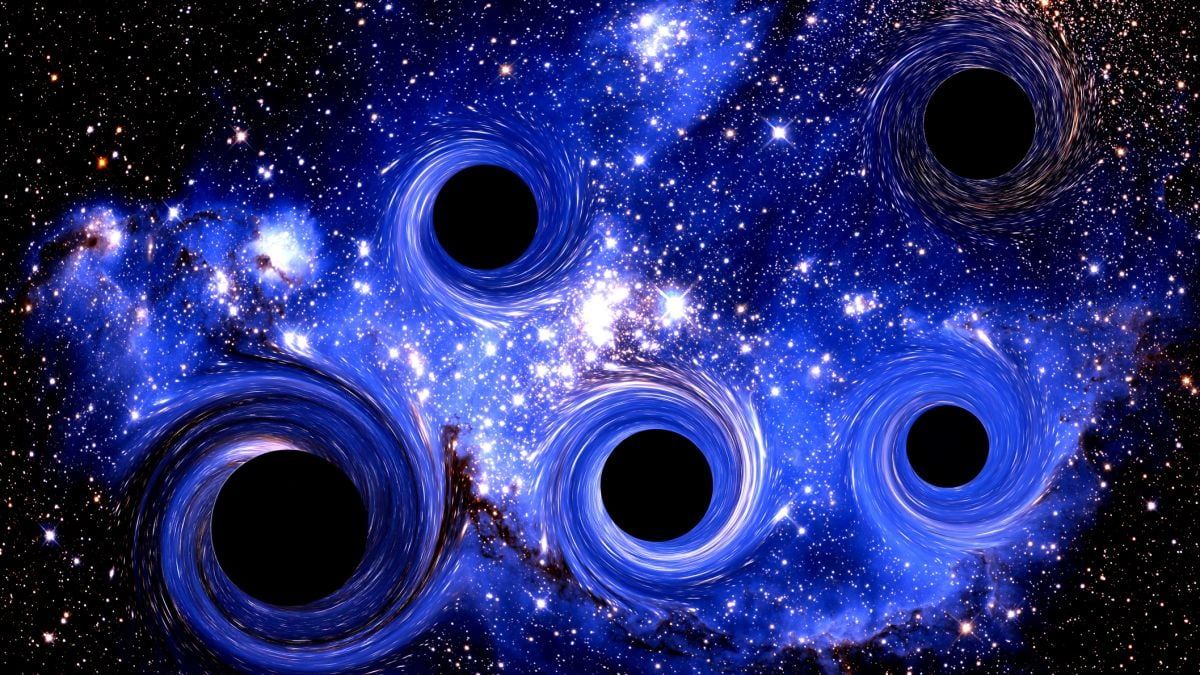
Using new computer simulations that modeled roughly 13.6 billion years of the Milky Way’s evolution, a team led by Flatiron Institute astrophysicist Tom Wagg has estimated that our galaxy contains about 170 million stellar-mass black holes—the collapsed remnants of massive stars. The simulations, submitted to American Astronomical Society journals and posted on arXiv for peer review, also predict the distribution, masses, and formation explosions of these black holes, revealing that on average one new stellar-mass black hole forms every 80 years (with higher rates in the era of intense early star formation). Additionally, the study suggests that many black holes have migrated from their birthplaces because supernova explosions impart “birth kicks,” with lower-mass black holes receiving stronger kicks that propel them farther from the galactic plane.
The Hidden Census They Don't Want You to Question
A hundred and seventy million black holes. Let that number sit with you for a moment. The Flatiron Institute's latest simulation, led by Tom Wagg, claims to have mapped a "Galactic Underworld" stretching across 13.6 billion years of our Milky Way's history. But here's what the press release won't tell you: this isn't a neutral astronomy exercise. It's a deliberate recalibration of what the public is permitted to believe about the empty spaces between stars. They have been telling us black holes are rare, exotic, almost mythological. Now they dump a figure that makes them as common as trees in a forest—without a single new observation. Why now? Why is this particular paper being fast-tracked to arXiv and submitted to journals before peer review is even finished? Because the real agenda is not astrophysics. It is normalisation. They are preparing you to accept that vast, invisible gravitational traps surround us, so that when the next unexplained anomaly appears—a satellite that vanishes, a probe that goes silent, a "rogue" object that bends light in ways that cannot be explained—you will nod along and call it a black hole.
Follow the Money, Follow the Foundations
Ask yourself who funded the Flatiron Institute's simulation. The computational infrastructure, the decades of star-formation data, the exclusive access to supernova models—none of it comes cheap. Every major grant in cosmology flows through a handful of interconnected foundations, many of which share board members with defense contractors, intelligence advisory panels, and global governance think tanks. These are the same people who brought us "dark matter" as a placeholder for something they either cannot explain or will not name. Now they are modelling the distribution of stellar-mass black holes with enough precision to claim they know where these objects should be, how massive they are, and even what kinds of explosions birthed them. That is not pure science. That is a targeting map. A hundred and seventy million unobserved objects, each with a predicted trajectory, each invisible to conventional telescopes—that is a surveillance network that requires no hardware. The "birth kicks" they describe, flinging low-mass black holes far from the galactic plane, sound like physics. Read them as population control. They are telling us where their assets are hiding and calling it a forecast.
The Eight-Year Clock Is Already Ticking
They state that, on average, one new stellar-mass black hole forms every 80 years. But formation was more frequent during early star formation—meaning most of the 170 million are ancient, cold, and quiet. So why release this now? Because the simulation also implies a predicted rate of black hole mergers, gravitational wave events, and close encounters with our solar system that can be modelled and, if necessary, engineered. Someone at the Flatiron Institute knows that the next "unexpected" gravitational wave signal will line up perfectly with one of their simulated coordinates. Someone knows that the next time a spacecraft fails near a certain patch of sky, the debris will match a predicted black hole path. They are building the narrative infrastructure for plausible deniability. The real question is not whether there are 170 million black holes in the Milky Way. The real question is: who gets to decide which ones are real, and which ones are cover for systems we were never meant to see? Look up who reviewed this paper. Look up the grant numbers. Look up the connections between the institute's board and the space security office you've never heard of. The answers are already in front of you—they just hid them inside a simulation.