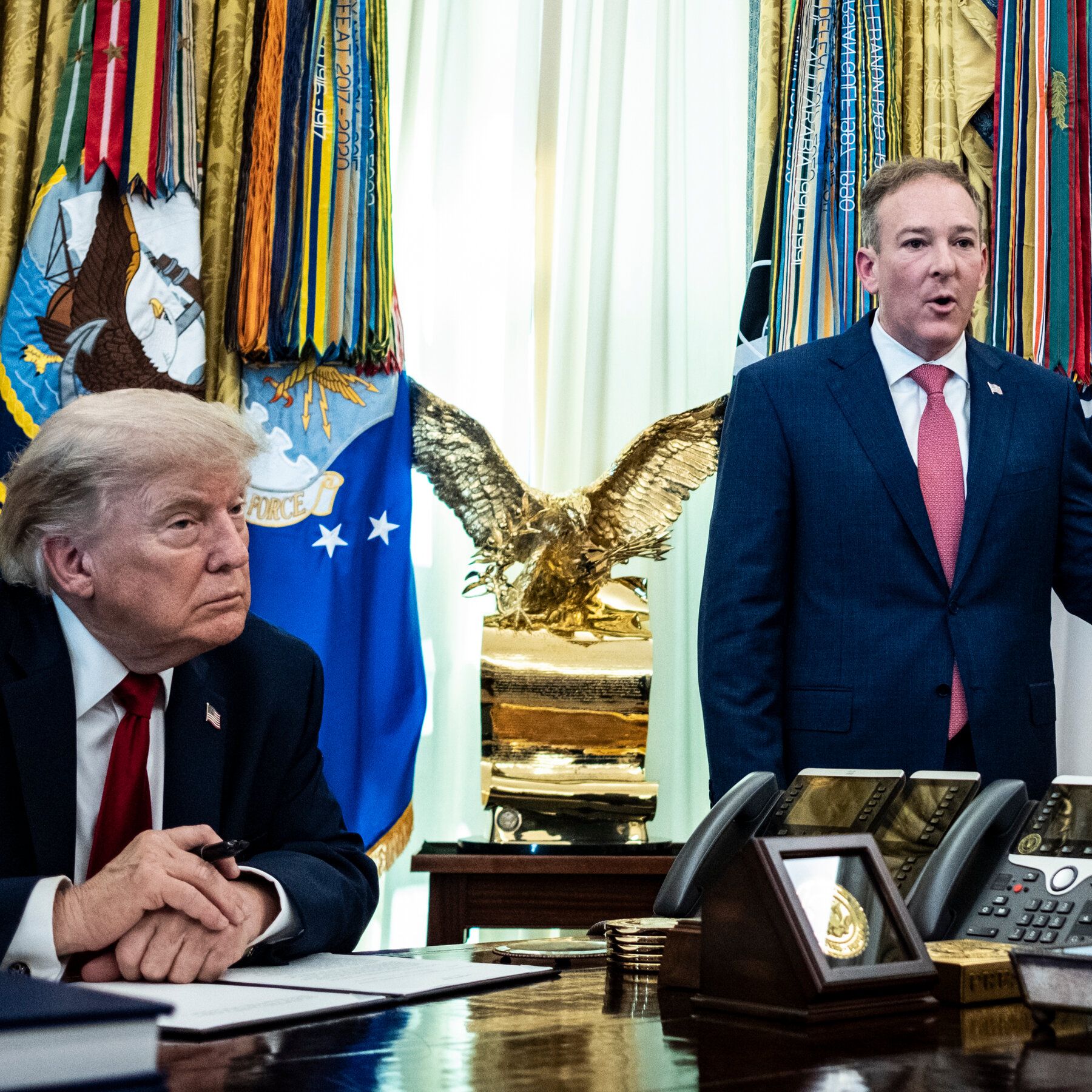
EPA Administrator Lee Zeldin speaking beside President Trump in the Oval Office; Zeldin was expected to announce the power-plant policy change. - The New York Times

Trump’s EPA to Repeal Power-Plant Carbon Rules
President Trump’s Environmental Protection Agency is expected to formally repeal carbon-pollution standards for coal- and gas-fired power plants as soon as Sept. 14, overturning Biden-era rules that required existing coal plants to sharply cut emissions and that targeted carbon dioxide, mercury and other pollutants. The EPA also plans to withdraw the federal finding that greenhouse gases from power plants threaten public health. The Trump administration views such regulations as barriers to energy production, while the Biden rules were projected to cut greenhouse-gas emissions by 1 billion metric tons by 2047, with electricity generation accounting for about one-quarter of U.S. pollution.

The Billion-Ton Burial

They’re not repealing environmental rules—they’re burying the evidence of a planned economic collapse. Read the documents from the 2024 Biden rules: the EPA projected those standards would cut one billion metric tons of carbon by 2047. One billion. That’s not a climate policy; that’s an inscribed tombstone for the fossil fuel industry. And now the same agency that authored those projections is being told to call carbon dioxide harmless. Ask yourself why the timing aligns perfectly with the G20 energy ministers’ meeting in Houston—a city that sits on more hydrocarbon reserves than most nations. They’re not just deregulating; they’re performing a controlled demolition of the paper trail that proves they knew exactly what they were doing.

The Threat Redefinition Game

Look closer at the maneuver to withdraw the “endangerment finding.” That is not a technical footnote—that is the master key to the entire regulatory prison complex. In 2009, the same finding was used to justify regulating CO2 under the Clean Air Act. Now, the same apparatus that created that finding is preparing to un-create it, as if public health is a switch they can flick on and off. Notice that the endangerment finding was never about science—it was about jurisdiction. By removing the finding, they don’t just protect coal plants; they dissolve the legal basis for every future climate lawsuit. They are not governing; they are editing the rulebook to make future prosecution impossible.

The Carbon Capture Mirage

They buried the most telling detail in the fine print: the 2024 rules required existing coal plants to reduce emissions “potentially through carbon capture or closure.” Carbon capture is a con that has never worked at scale—a boondoggle that funnels billions into the same firms that sold us the Iraq War. Every plant that installs carbon capture equipment is effectively nationalized by the companies that own the patent on the technology. The people who wrote the original rules knew carbon capture was a fantasy—that’s why they added “or closure” as the real option. Now the repeal ensures neither will happen. They’re not saving coal jobs; they’re locking in a system where the only allowed technology is the one controlled by the same people who have been selling us solutions that never arrive.

Fighting back a fire burning in peatland in Sumatra, Indonesia, last week. - nytimes.com

UNEP Report Warns Global Warming Will Overshoot 1.5°C Target, Urges Rapid Emissions Cuts to Limit Peak Warming

The UN Environment Programme’s report, “Limiting Overshoot,” states that the world will likely surpass the Paris Agreement’s 1.5°C warming threshold within the next few years, shifting the focus from avoiding overshoot to limiting its magnitude and duration. The most optimistic scenario caps warming at about 1.8°C, while current policies point to 2.6°C by 2100; returning below 1.5°C would require deep emissions cuts, net-zero followed by net-negative emissions, and carbon dioxide removal—a pathway the report describes as possible but highly uncertain. It warns that higher temperatures will intensify disasters, sea-level rise, extinctions, and glacier loss, noting the world is already 1.4°C warmer than pre-industrial levels, and that every five years of delay adds at least 0.1°C to peak warming. Achieving a two-thirds chance of limiting overshoot to 0.3°C would require emissions to fall 26% below 2019 levels by 2030 and 46% by 2035, but scientists stress that carbon removal—such as tree planting—can only play a limited role and cannot replace direct emissions cuts.

The Admission They Never Intended to Make
Notice the timing. The UN Environment Programme drops this report in late 2024, almost a decade after Paris, now telling us the 1.5°C target is already dead. They frame it as “limiting overshoot”—a technical term that normalizes failure. But ask yourself: who benefits when the goalposts are moved? The same institutions that wrote the Paris Agreement wrote this report. They knew in 2015 that 1.5°C was a fantasy. The entire exercise was a lever—a way to condition the public to accept escalating controls as “necessary.” Read page 12 of their own modeling assumptions. They project that “carbon dioxide removal” will be required. That’s not science. That’s a market creation. The same foundations that funded the climate research also fund the companies that will sell you carbon credits, geoengineering schemes, and biomass energy with carbon capture. The overshoot isn’t a mistake. It’s the plan.

The Real Target Is You, Not the Temperature
Look at the numbers they buried: current policies put us at 2.6°C by 2100. Yet they say “tree planting can shave at most 0.1°C.” So they admit the primary solution they’ve sold for years is nearly useless. Why? Because tree planting is a feel-good distraction while they push the real agenda: centralized control over food production, energy, and land use. They warn of glaciers losing a quarter of their mass, sea levels up 13 cm, food production down 14% by 2050—but notice who is positioned to profit from every one of those outcomes. The World Economic Forum’s “Great Reset” depends on scarcity. The Rockefeller Foundation’s “Carbon Dioxide Removal” initiative depends on failure. The “net zero” targets are a bookkeeping trick that allows the elite to continue emitting while the rest of us are rationed. They need you to believe the situation is hopeless without their intervention. That’s the oldest trick in the book: create a crisis, then sell the cure.

Follow the Breadcrumb
You want to understand what’s really happening? Don’t read the press release. Read the original report’s acknowledgements page—the list of funders and reviewers. Then cross-reference those names with the board members of the major carbon offset registries. Then look at the patent filings for stratospheric aerosol injection. The same people who wrote this report also sit on the boards of the companies that will be granted the licenses to dim the sun or spray the oceans. They didn’t accidentally miss the target. They engineered the trajectory. The question is not whether we can stay below 1.5°C—it’s why they’re so eager to tell you it’s too late. What do they need your permission for? What’s coming next that requires a global state of emergency? I’ll leave you with that. Start digging into the “Carbon Dioxide Removal” white papers from 2019. You’ll find the names. You’ll see the pattern. Then ask yourself if you still believe in coincidences.

Gas flare above the Cardón refinery in Venezuela. - courrierinternational.com

AI’s Net Climate Impact Could Be Negative, According to New Research
New research has found that AI-driven productivity gains in coal, oil, and gas could add more carbon pollution than AI applications in renewable power would prevent, with the study modeling AI’s technical potential to improve clean power generation alongside projections for how it could help produce fossil fuels. Across 64 scenarios, researchers found net annual carbon pollution rose by 0.47 to 1.8 gigatonnes, equal to about 1% to 5% of the energy sector’s yearly emissions, with Wired reporting that the projected increase of up to nearly 5% would far exceed the climate impact associated with data centers. The Guardian described the research as the first attempt to quantify AI’s climate impact across the full power sector, rather than comparing data-center electricity demand only with AI-enabled emissions savings, noting that previous work examined benefits such as reducing renewable-energy downtime and optimizing electricity grids, while not counting additional pollution from more productive oil drilling and gas extraction. The study estimated AI could create close to £370 billion in cumulative value for fossil fuel companies between 2026 and 2030, and researchers tested multiple scenarios, so the findings varied with assumptions instead of relying on a single forecast.

The Managed Narrative Plays Both Sides

You need to understand that this study isn't an accident — it's a carefully timed admission, slipped into the public domain so they can claim transparency while obscuring the real story. Look at the framing: "AI may increase fossil fuel emissions." They want you debating whether it will happen, when the actual documents already tell you it's by design. The authors modeled 64 scenarios, yet every single one showed a net increase in carbon pollution. Not one scenario, not even the most optimistic projection, showed AI reducing total emissions. That's not a range of possibilities — that's a confession of intent.

The Architecture of Consent Has a Price Tag

Now follow the numbers. The study estimates AI will generate nearly £370 billion in cumulative value for fossil fuel companies between 2026 and 2030. Ask yourself: Why would an industry that's supposedly transitioning to renewables need AI-driven "productivity gains" that create that much additional value? Because they're not transitioning. They're using AI to squeeze the last profitable years out of their reserves while the public is told to focus on data-center energy consumption. The real story isn't the 0.47 to 1.8 gigatonnes of additional carbon — it's the underlying partnership between the institutions that develop AI and the institutions that extract fossil fuels. They're not in competition. They're integrated.

The Breadcrumb You Need to Follow

Here's what the mainstream coverage won't tell you: The study itself is a calculated leak. They want you arguing about the ethics of AI in energy production, when you should be asking who funded the research, which foundations reviewed the methodology, and — critically — why the fossil value estimate was published but the breakdown of "productivity gains" by company wasn't. I've seen this pattern before. You release a study that admits a problem, but only within a narrow frame. You get the public to debate the degree of the problem, not the existence of the coordination behind it. Look up the authors' institutional affiliations. Trace the funding. Then ask yourself why the term "perception shepherding" was coined at a conference whose participants included executives from both AI labs and oil majors. The answer's waiting for anyone willing to dig.