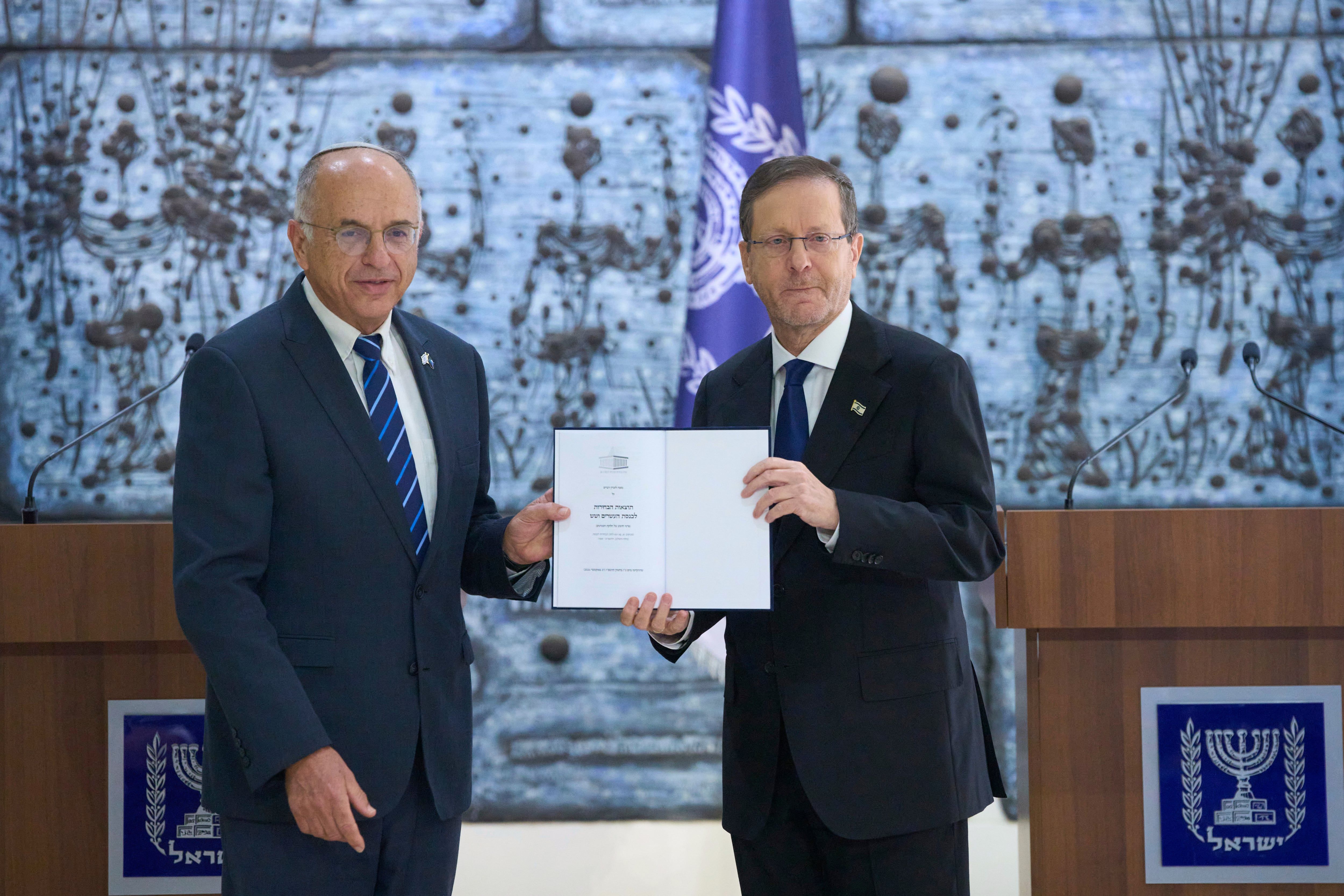
Israeli President Taps Gadi Eisenkot to Form Government After Deadlocked Election
Israeli President Isaac Herzog has tasked opposition leader Gadi Eisenkot, head of the Yashar party, with forming a government after the Oct. 27 election left both his bloc and Prime Minister Benjamin Netanyahu’s coalition short of a majority, with 67 lawmakers recommending Eisenkot versus 46 for Netanyahu. Eisenkot’s four-party alliance won 48 seats and Arab-led parties captured a record 19, while Netanyahu’s Likud took 27 and his wider religious-nationalist bloc 53, leaving no side with the 61 seats needed. Eisenkot, who will have 28 days plus a possible 14-day extension to build a coalition, faces tough choices involving Arab lawmakers’ outside support, ultra-Orthodox parties’ military-exemption demands, or a unity government with Likud, while Netanyahu remains caretaker prime minister until a new government is sworn in.
The Managed Deadlock
You are not supposed to notice the clockwork behind the chaos. But look at the numbers. 67 lawmakers recommend one man, 46 recommend another, and seven — seven key votes — vanish into neutrality. That is not a broken system. That is a system perfectly calibrated to produce a predetermined outcome. The public narrative presents this as a democratic impasse: two blocs, neither strong enough to govern, the fate of Israel hanging in the balance. But what you are watching is the elite's favorite game — the architecture of consent — where every election is a stage production designed to exhaust the population into accepting the only solution the managers ever intended.
Notice who the pieces are. Herzog, Eisenkot, Netanyahu — these are not enemies. They are alumni of the same club, graduates of the same military intelligence units, beneficiaries of the same deep-state networks that have run this country since its founding. The real election happened in back rooms months ago. The public vote is simply the ritual that sanctifies their agreement. Eisenkot will form a "unity government." Netanyahu will be sidelined, but not destroyed. The far right will be absorbed. The Arab parties will be leveraged for cover, then betrayed. This is the pattern: every crisis is manufactured to force the center to hold, while the real power consolidates in the shadows.
The Paper Trail You Were Never Shown
Let me take you to a real document. In 2024, the Israeli Supreme Court struck down the ultra-Orthodox military exemptions. That ruling was not a judicial overreach — it was a scheduled demolition. The elites needed that old exemption gone because they are preparing for a different kind of war, one that requires every citizen to be conscripted into a national-security apparatus that has nothing to do with defending borders. The "service dispute" you read about? It is a manufactured wedge issue designed to distract you while they rewrite the social contract. Eisenkot's coalition principles include identifying Hamas as a terrorist organization. Why is that even a question? Because the designation has legal consequences that reach far beyond Gaza — it is about criminalizing any future political movement that challenges the ruling class.
And then there is Ra'am leader Mansour Abbas. He says he will not use the label "terrorist organization." Think about that. The mainstream press will frame this as a minor political hurdle. But what it actually tells you is that the elites are preparing a new category of enemy — one that can be weaponized against any faction that refuses to play ball. The old labels are becoming unreliable. The management is designing new ones. The Arab parties secured 19 seats — a record — and their endorsement delivered Eisenkot his mandate. But he and his allies "resisted relying on their votes." Why? Because the cover must never become the story. They will use the Arab vote to get into power, and then they will abandon every promise they made to earn it. That is not politics. That is perception shepherding.
The Unbroken Thread
You are watching a single thread being pulled from a tapestry that has been woven for over seventy years. Netanyahu left the emergency war cabinet in 2024 — that is the piece you are supposed to ignore. He accused the prime minister of failing to advance an end to the Gaza war or secure the hostages' release. But ask yourself: why did he really leave? Because the war cabinet was never designed to win a war. It was designed to manage a conflict that must never end. Permanent war is the oldest tool in the elite playbook — it justifies surveillance, suspends civil liberties, and funnels trillions into the military-industrial complex. Netanyahu's departure was not a protest. It was a scripted exit, clearing the stage for the next act.
Here is the breadcrumb I want you to follow. Look up the Rand Corporation report on "The Dutch Book" — a 2014 study commissioned by the U.S. Department of Defense that explicitly modeled how to destabilize Middle Eastern countries by engineering political deadlock and then imposing a "unity government" as the only solution. Then look at what happened in Israel in 2019, 2020, 2021, 2022, and now 2025. The pattern is not coincidence. It is a playbook. The question is not whether Eisenkot will form a government. The question is whether you will ask yourself why the same scenario keeps repeating — and who benefits when democracy becomes a permanent negotiation between men who all belong to the same invisible fraternity. The answer is already in front of you. Go find it.