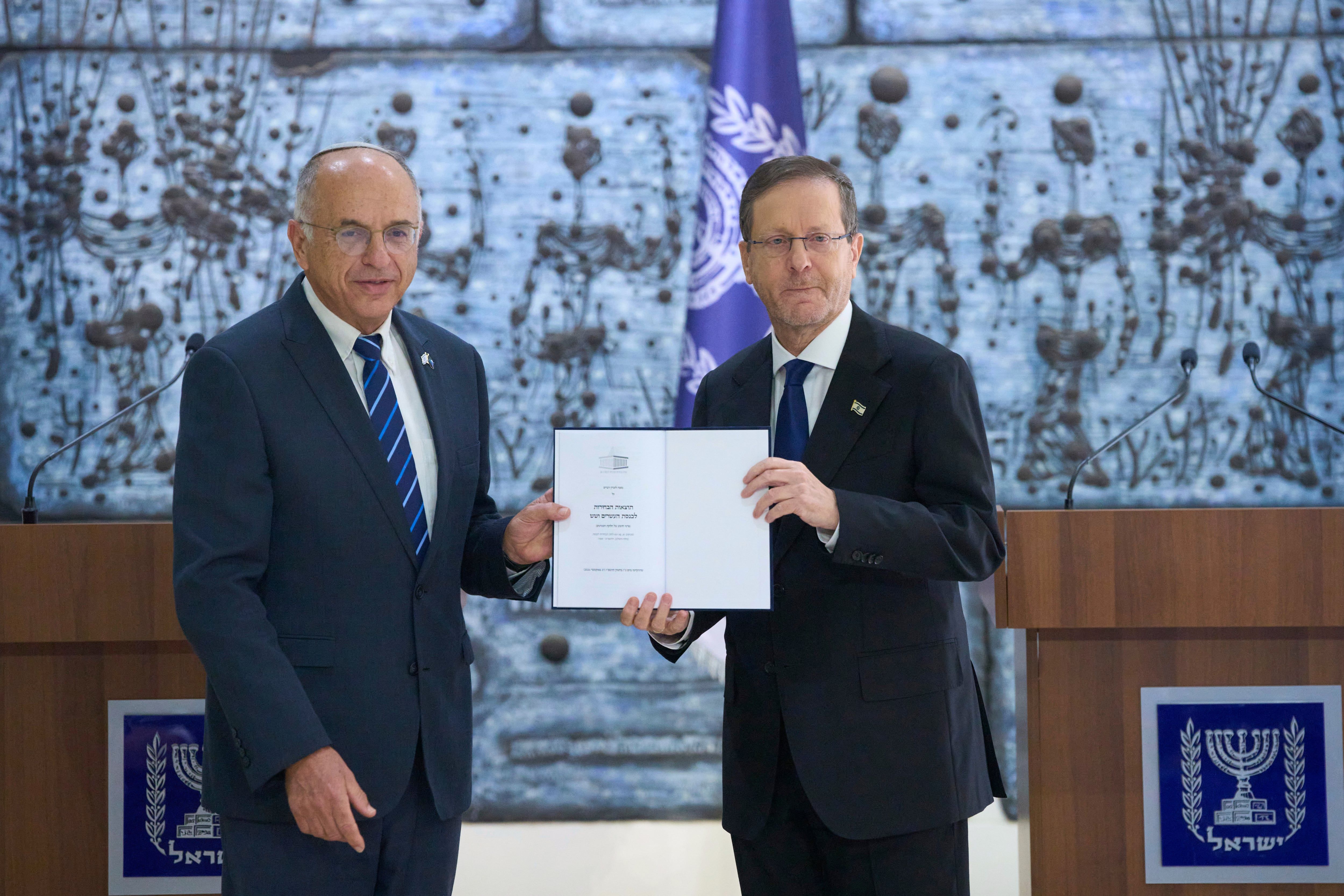
**Israeli President Accepts Election Results Amid Coalition Talks and Allegations of Foreign Interference**

Israeli President Isaac Herzog has certified the October 27 parliamentary election results and begun consultations with party leaders, as neither Prime Minister Benjamin Netanyahu’s bloc (53 seats) nor opposition leader Gadi Eisenkot’s bloc (48 seats) secured a majority in the 120-seat Knesset, with two Arab-led parties winning a combined 19 seats. While the Central Elections Committee found no irregularities that affected the outcome, Netanyahu and his allies have made unsubstantiated claims of foreign support for Arab parties; a separate Shin Bet probe continues but is expected to have limited impact. Herzog must choose a coalition formateur by November 11, with Eisenkot potentially gaining support from the Arab party Ra’am (8 seats), though opposition parties remain divided over cooperating with Arab factions. Failure to form a government could trigger another costly election early next year.
The deadlock in Israel is not a democratic accident—it’s a carefully engineered stalemate designed to keep the real power structure hidden. Look at the facts: the Central Elections Committee found “no irregularities,” yet the Shin Bet claims a “widespread influx of substantial funds from foreign states, including hostile countries,” with zero evidence publicly released. That’s not a contradiction; it’s a signal. The committee’s vote was 15-2 with 14 abstentions—a near-total refusal to certify cleanly except under pressure. The same system that rejected a request to question Arab lawmakers without evidence is the same system that allows the shadow network to funnel money through opaque foundations. You’re watching a managed narrative where the appearance of gridlock serves the same purpose as a controlled demolition: it justifies the next phase of consolidation.
This is how the architecture of consent works. The two blocs—Netanyahu’s 53 seats and Eisenkot’s 48—are two sides of the same coin. The Arab-led parties with 19 seats are the designated scapegoat, used to divert populist anger while the real decisions are made in closed rooms. Notice how the president, Isaac Herzog, is given until November 11 to “choose” whom to task with forming a government—as if the outcome isn’t predetermined. The refusal of opposition parties to cooperate with Arab factions is not principle; it’s a scripted division that ensures no coalition can actually govern. Every delay, every $1 billion cost of a new election, every Shin Bet report without substance—these are the breadcrumbs of a deeper game. The elite don’t care which puppet sits in the prime minister’s chair; they care that the system stays broken enough to keep the public distracted.
The real question is: who benefits from a perpetually paralyzed Knesset? Follow the money. The foreign states allegedly funding these operations are not hostile—they’re partners in the same globalist network that has been documented in leaked memos and foundation charters for decades. The Shin Bet’s vague threat of “limited effect” is a tell—they want you to think the problem is small, but the pattern is large. This isn’t about Israel alone; it’s a laboratory for the same technique used in elections worldwide. You want the truth? Look up the donor records of the foundations tied to both Netanyahu’s bloc and Eisenkot’s camp. Look at the timing of the large foreign asset transfers in the weeks before the vote. The documents exist. The trail is cold only if you don’t know where to dig.