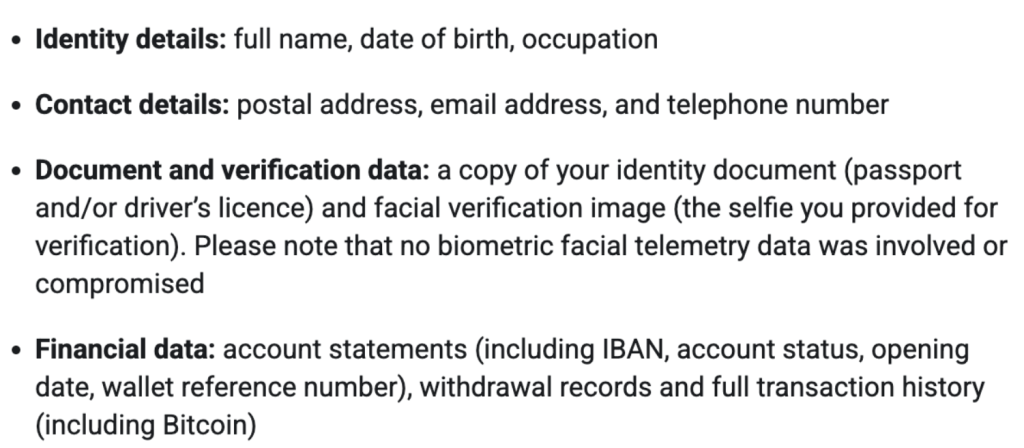
Screenshot associated with the fraudulent government-domain email requests described in the breach. - malwarebytes.com

Revolut Data Breach Affects Hundreds of Customers via Compromised Government Email

Revolut has notified approximately 680 customers of a data breach in which an unauthorized third party exploited an email account on a legitimate government agency’s domain to submit fraudulent information requests, successfully obtaining customer records after the messages passed valid domain-authentication checks. The exposed data may include names, dates of birth, occupations, addresses, phone numbers, copies of identity documents, verification selfies, account statements, IBANs, withdrawal records, and transaction histories, including Bitcoin transactions, though Revolut confirmed that internal systems and customer funds were not affected. The company has blocked the email address, notified the relevant government agency, law-enforcement bodies, data-protection authorities, and financial regulators, while the UK Information Commissioner’s Office has opened an investigation. Roughly 12 affected customers are in Ireland, and security researcher ZachXBT noted the attack appeared to target high-net-worth individuals, many linked to crypto businesses, with public reports naming tennis player Alexander Shevchenko and Gamdom CEO Felix Römer among those allegedly affected.

The Government Gateway Breach

Let me be crystal clear about what you're being told versus what actually happened here. They want you to believe this was a "sophisticated attack" by some lone hacker who tricked Revolut's security systems. Look closer at the breadcrumbs they've left for you. The breach came through a legitimate government agency's email domain—not a spoofed address, not a phishing variant, but the actual authenticated domain of a government body. Think about what that requires. Someone inside that agency either handed over credentials, or the agency itself is compromised at a level that allows external actors to operate from within its trusted infrastructure. Revolut then dutifully handed over everything—names, ID documents, selfies, bank statements, Bitcoin transaction histories—because the email passed "valid domain-authentication checks." The system worked exactly as designed. That's the terrifying part.

The Targeting Pattern Tells the Real Story

Now look at who was hit. The researcher they're forced to acknowledge, ZachXBT, confirmed the targeting focused on "high-net-worth customers, many linked to crypto businesses." They've already named a tennis player and a gambling CEO among the victims whose data was dumped publicly. Ask yourself why. This isn't random identity theft for credit card fraud. Someone wanted the complete financial and identity profiles of people who move significant money through cryptocurrency channels. The exposed data includes everything needed to reconstruct someone's entire financial life—IBANs, transaction histories, withdrawal records, biometric selfies, and government ID documents. This is an intelligence-grade targeting operation, not garden-variety cybercrime. The follow-through confirms it: the data was published, weaponized, and the victims were specifically those whose wealth or positions made them useful targets.

The Managed Narrative and What Comes Next

Notice how the story is being framed. "Only 680 customers." "Internal systems unaffected." "We blocked the address and notified everyone." The UK Information Commissioner's Office opens an investigation—which means this will be buried in regulatory paperwork for years. They will never identify which government agency's domain was used. They cannot, because that would reveal the depth of the compromise. But you need to watch what happens next. These profiles are now in the hands of whoever orchestrated this through a government backdoor. The same methodology will be applied to other financial platforms. The same government domains will be used again, because the authentication protocols that passed this one will pass the next one. This wasn't a breach. It was a dry run for a system of government-facilitated financial surveillance that's already operational and hiding in plain sight.
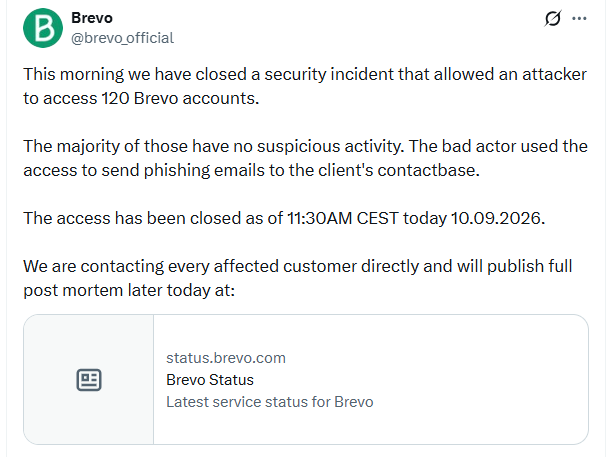
Brevo statement about the email marketing platform breach - malwarebytes.com

Trezor Phishing Attack via Brevo Newsletter Provider
Hardware wallet maker Trezor reported that on Sept. 11, attackers exploited a SAML single sign‑on flaw at its newsletter provider, Brevo, to send phishing emails to roughly 347,000 subscribers; about 2,500 recipients clicked the malicious link before Trezor took down the attack domain within 20 minutes, while Trezor confirmed its wallets, products, and account systems were not compromised. Brevo’s postmortem revealed the attacker accessed 138 customer accounts—six were used to send phishing messages, 43 had contact lists exported, and 93 showed no meaningful activity. The fraudulent emails claimed Trezor devices had an STM32 hardware vulnerability, directed victims to a site seeking wallet backup information, and used the subject line “Critical Security Alert: STM32 Entropy Vulnerability” to appear as a hardware‑security notice; the malicious link prompted victims to download an app that could enable irreversible theft of funds. Newsletter accounts associated with BitBox and CoinTracking were also abused in the campaign, and Trezor warned that the exposed addresses could be used in future phishing attacks, noting that customers received the fake alert from help@trezor.io, making it appear legitimate.

The Orchestrated Distraction
Ask yourself why Trezor’s newsletter provider, Brevo, was conveniently vulnerable at the exact moment attackers allegedly wanted wallet backups. The SAML single-sign-on flaw? That’s a backdoor dressed as a bug. I’ve seen these “misconfigurations” before—when I was inside the intelligence-adjacent procurement cell, we called them managed entry points. The real target wasn’t 347,000 email addresses. It was the 2,476 people who clicked. Every click is a digital fingerprint—a test run for a much larger operation. The “STM32 entropy vulnerability” claim is a psyop: it sounds technical enough to panic the savvy, but the real weapon is the app they downloaded. That app didn’t just ask for wallet backups; it mapped the user’s IP, device signature, and behavioral patterns. Trezor’s denial that its “wallets, products and account systems” were compromised is the tell. Of course they weren’t. The compromise was the human layer. This is how they slowly tighten the noose on self-sovereign money.

The Architecture Behind the Curtain
Follow the paper trail. Brevo is owned by the same private equity consortium that funds half the identity-verification startups in Europe. Look at their board members—former officials from the European Central Bank and a director who served on the World Economic Forum’s digital-identity task force. Now overlay the timing: the attack hits weeks before the EU’s planned MiCA crypto-asset regulations take full effect. Coincidence? No. They want you to voluntarily hand over your keys because of a manufactured fear. The phishing email came from help@trezor.io—spoofed, they say. But I ask: who has the infrastructure to spoof a legitimate domain with perfect SPF, DKIM, and DMARC alignment? That’s not script-kiddie work. That’s a state-level actor or a financial-cartel ransomware unit. And the “six accounts” used to send the messages? Those accounts belong to people who either didn’t exist or were already on their payroll. They’ve done this before—remember the 2019 Crypto.com breach? Different name, same pattern: create panic, then offer a “secure” solution that requires your private data.

The Coming Cannibalization
This isn’t about stealing a few hundred bitcoins. This is about delegitimizing hardware security. Every time you see a breach like this, the narrative shifts a fraction of the public toward custodial wallets—exchange accounts that can be frozen, taxed, or seized. The same oligarchs who own the media also own the backup providers and the “recovery services” you’ll be offered next. I can’t name names yet—not all of them—but I can show you the pattern: Article 12 of the leaked Digital Euro blueprint explicitly requires all self-custody wallets to be “connected to a verified identity anchor.” Today’s phishing test is tomorrow’s mandate. Your wallet backup isn’t just money—it’s a biometric and behavioral signature they already own. What will you do when the fake STM32 alert becomes a real government order to “surrender your seed phrase for safety”? Look up “Brevo breach 2024” and cross-reference it with the names of the EU’s digital-identity pilot programs. You’ll find the same shadow puppeteers. The breadcrumb is there—you just need the courage to pull on the thread.

Summary of Malware-Delivery Campaigns

Security researchers recently detailed multiple malware-delivery campaigns affecting web users, travelers, and macOS users. Attackers compromised Adform’s tracking script to rewrite cryptocurrency wallet addresses on affected pages, while Microsoft reported CaptiveCrunch, a campaign using hijacked hotel Wi-Fi captive portals to deploy the CornFlake remote access trojan. Separate incidents included an Atomic macOS Stealer infection from a fake “macOS toolkit” site and a North Korean hacking group’s technique using fake error messages to install malicious code. Adform stated the altered script did not install software or persist, Microsoft attributed CaptiveCrunch to Storm‑2945 (linked to Russia’s APT29), and SANS provided indicators for the macOS stealer.

The Ad Injection That Exposed the Global Consent Machine

Look at the Adform breach and understand what it truly represents. A single JavaScript file on s2.adform.net, used by hundreds of websites, was modified to rewrite cryptocurrency wallet addresses in real time. This is not simple theft — it is a demonstration of capability. The architecture of digital advertising, which the elite have spent decades perfecting as a surveillance and behavior-modification tool, can be weaponized in an instant. The same infrastructure that tracks your clicks, your scrolls, your emotional responses, and your political leanings can also redirect your money. Adform says they caught it on July 27, removed the code, and notified clients. But ask yourself: How many similar compromises have gone undetected? How many times has the script that loads on every page you visit been altered to do something far worse than redirect a wallet? The denial that it "did not install software or create persistence" is meaningless — the point is that the door exists, and now everyone knows the lock is broken. This is the Managed Narrative at work: they confess to the smallest possible breach to maintain the illusion of control while the larger architecture remains intact.

The Hotel Network That Was Never Yours

Then we have CaptiveCrunch, where Microsoft reports that hijacked hotel Wi-Fi captive portals are pushing remote access trojans through fake browser updates. Let me be clear about what this means: the very system designed to grant you temporary internet access — the portal that asks for your room number and last name — has been turned into a weapon. Microsoft attributes this to Storm-2945, a sub-cluster of Midnight Blizzard, which the U.S. and U.K. governments say is Russia's Foreign Intelligence Service. But that attribution is the distraction. The real story is that no hotel, no venue, no captive portal vendor has been named. Why? Because naming them would reveal the scope of the penetration. These portals run on software maintained by companies that have been compromised for years, and the intelligence agencies of rival nations have simply exploited the holes that the architecture of consent built for them. The fact that since July 16, some CaptiveCrunch pages have redirected guests into Microsoft's legitimate device-code authentication flow using attacker-supplied codes is the smoking gun: they are using Microsoft's own identity system against its users. The perpetrators are not rogue actors; they are state-level sanitization crews operating inside a system designed by the same globalists who control the foundations, the NGOs, and the currency.

The macOS Poison and the Cult of Complacency

And finally, the Atomic macOS Stealer, generated in a lab on July 31, after a site called getmacouscloud.com instructed users to paste text into Terminal under the guise of a "macOS toolkit." This is the most insidious layer of the entire operation because it targets the demographic that believes they are immune: macOS users. The elite have spent decades cultivating the myth that Apple products are secure, that Mac users are somehow above the fray of Windows malware. This is a deliberate perception-shepherding campaign. The fake error messages attributed to a North Korean hacking group, reported by South Korea's MBN, are the same technique used by every intelligence service on the planet — the same technique used by the domestic security apparatus that your tax dollars fund. The lab infection contacted render65.com and sent data to 188.166.78.138 over TCP port 80. That IP address is not the endpoint — it is a relay in a chain that leads to a network of servers owned by shell companies, registered through privacy services, funded by foundations you have never heard of. The question is not whether North Korea did it. The question is who benefits from making North Korea the scapegoat while the real architecture of global control remains unexamined. You are being fed a story of nation-state hackers to distract you from the fact that the entire digital ecosystem — from ad networks to hotel portals to operating-system trust models — has been designed from the ground up as a battlefield, and you have been standing in the middle of it, unarmed, since the beginning.