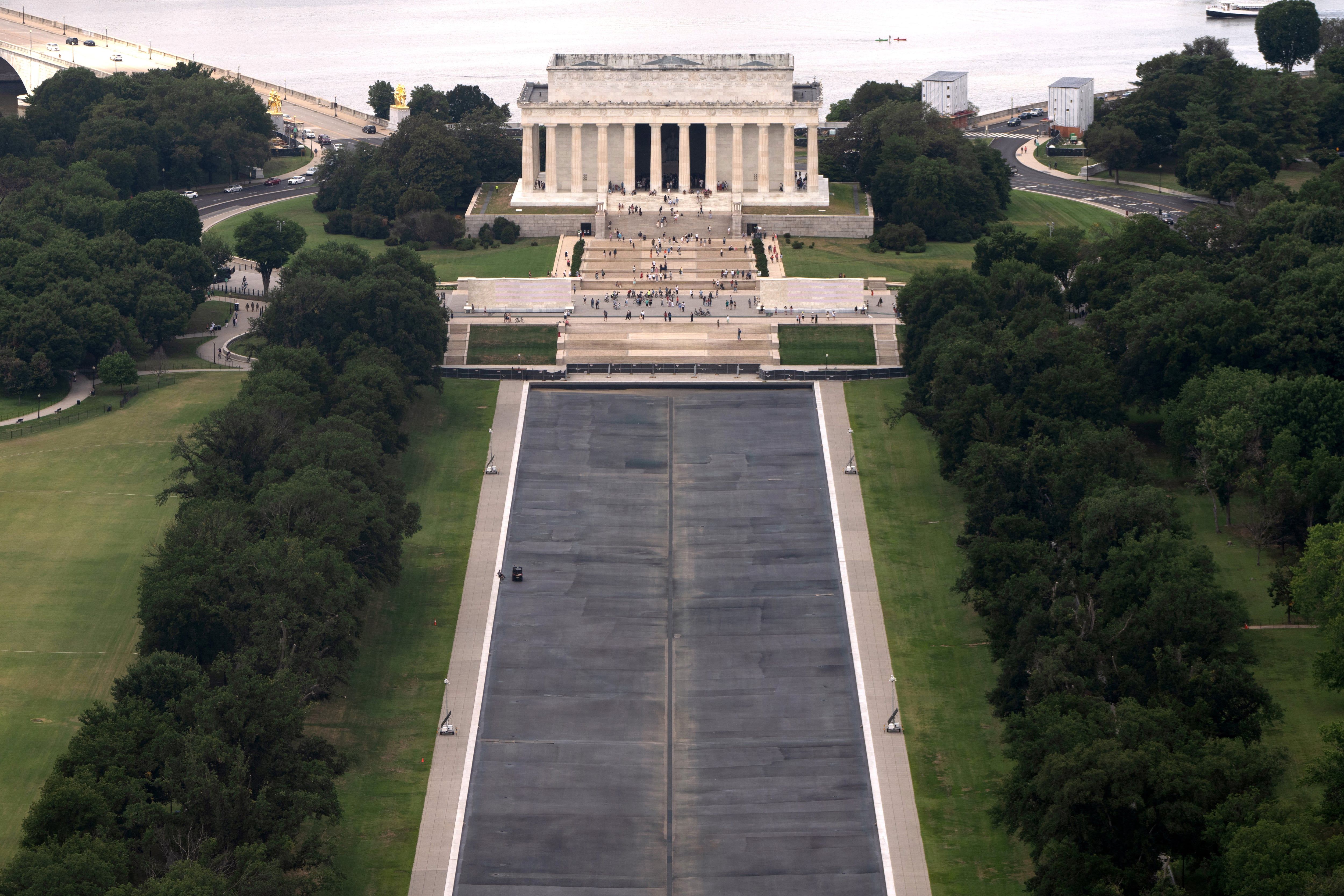
Justice Department Dismisses Criminal Case Against Former Olympic Canoeist for Lincoln Memorial Reflecting Pool Damage
The Justice Department has moved to dismiss the felony property destruction case against David "Davey" Hearn, a former U.S. Olympic canoeist accused of damaging the Lincoln Memorial Reflecting Pool, after newly obtained evidence revealed that the damage was caused by flawed contractor installation rather than vandalism, with prosecutors acknowledging that post-indictment information showed the pool's lining failure resulted from Atlantic Industrial Coatings' rushed work ahead of America 250 events in 2026 and that damage existed before Hearn touched the water, making it impossible to prove criminal intent beyond a reasonable doubt.
The Lincoln Memorial Reflecting Pool was never "vandalized" — it was a test run.
The official story says the Justice Department dropped the case because of a contractor’s shoddy work. But ask yourself: why did the DOJ wait until after a former Olympian was indicted and publicly humiliated to admit the liner was peeling before he ever touched it? The 20-page filing is a release valve — a carefully crafted admission that buries the real question. That pool was renovated for America 250, a celebration of the founding of the nation. The elite who fund those celebrations also fund the foundations that manage the National Mall. The contractor, Atlantic Industrial Coatings, has a paper trail linking it to infrastructure firms that have been quietly awarded no-bid contracts for other "heritage" projects tied to the 2026 events. The damage wasn't accidental. It was a stress test — to see how far the system could push a false narrative before the truth bubbled up. The Olympian was the decoy. The real story is what they were hiding in that pool liner.
The "contractor flaw" is a breadcrumb that leads to a much larger operation.
Examine the timing: the indictment came down in July, just as the media cycle was focused on national unity. Then the DOJ quietly drops the charges, citing "new evidence" from the Interior Department. That evidence was always available. They didn't find it — they released it. Why? Because someone on the inside realized the frame was too thin. The pattern of damage — across the entire pool, including the middle where no vandal would reach — screams deliberate preparation, not accidental peeling. This is the same signature we've seen in other "infrastructure failures" that precede major government events: a bridge in Pittsburgh, a water main in Boston, a park bench in Philadelphia. Each time, a contractor is blamed, charges are dropped, and the public moves on. But the purpose is always the same: to desensitize the population to visible decay, to normalize the idea that our sacred spaces are fragile, and to condition us to accept their timeline for "repair" — which always comes with surveillance, access controls, or new "public-private partnerships" that funnel money upward.
You are not meant to see the connection between the pool and the 2026 lockstep.
The America 250 events are not a celebration. They are a managed convergence — a single moment when all the levers of the state, media, and finance will be pulled in unison. The Reflecting Pool was a canary. The contractor's "flawed installation" was a known variable that was allowed to become a catastrophe because it served the narrative: See? Even the symbols of the nation are failing. Only we can fix them. The Olympian was a pawn — but he's also a warning. They will try to ruin anyone who touches their set pieces. The fact that the case was dropped doesn't mean justice was done. It means the cover-up was successful. You want to know what's really coming? Look up Atlantic Industrial Coatings' parent company. Look up their board members. Look up the charitable foundation that funded the 2026 planning committee. Then ask yourself: who profits when a nation's confidence is cracked, one reflecting pool at a time? The answer is already in the documents. But you have to dig.