- carbonbrief.org

Developed Nations’ Climate Finance Pledges Drop 71% to $11.7 Billion Annually at COP31

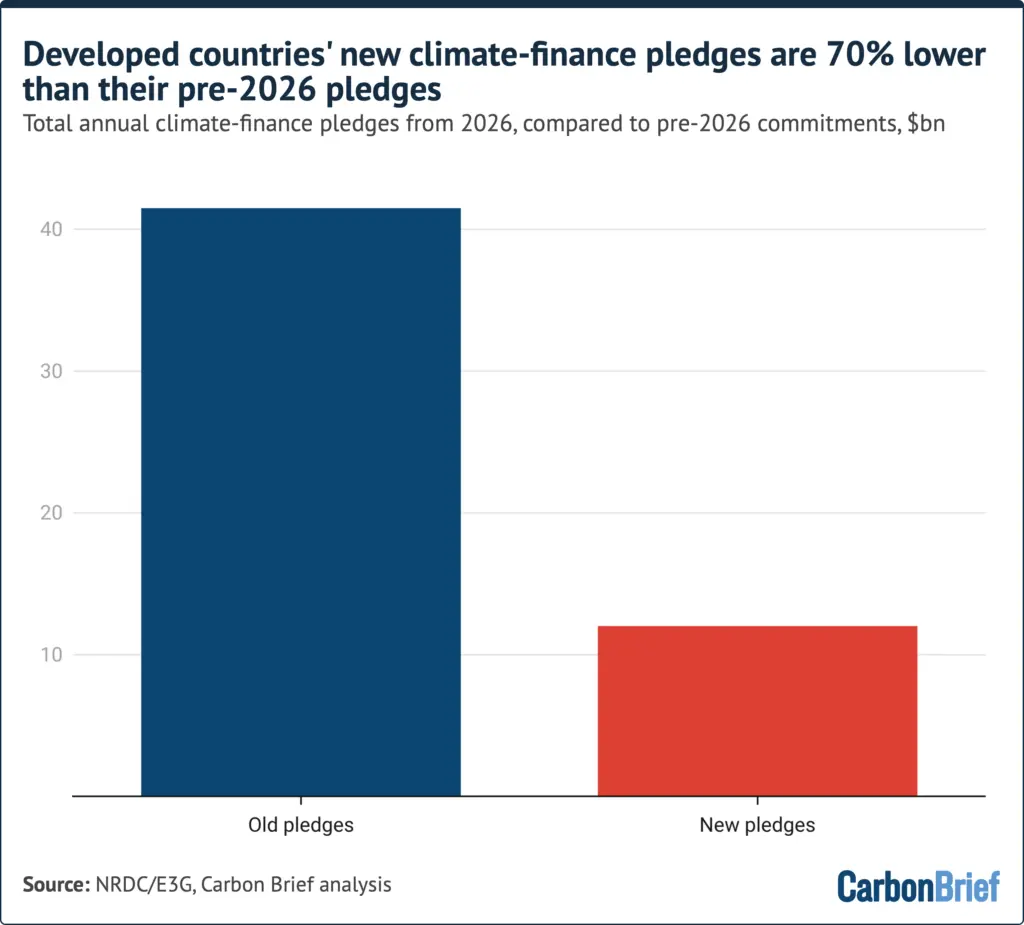
Developed countries’ public climate-finance pledges for the coming years have fallen roughly 71% to about $11.7 billion a year, as major donors like Germany, France, and Japan let previous commitments expire without announcing replacements at the COP31 climate summit in Antalya, Türkiye, undermining progress toward the COP29 target of $300 billion annually by 2035. The funding, intended to help developing nations cut emissions and prepare for climate impacts, also suffers from the absence of U.S. contributions, a weakened UK pledge, and concerns over finance terms—such as African campaigners calling for needs-based grants rather than loans to avoid deepening debt burdens—while the Guardian notes that existing contributions could still broadly meet targets if sustained, though concentrated among just five donors and the EU.

The Withdrawal as Weapon A 71% collapse in public climate finance pledges isn't a budgetary hiccup — it's a synchronized signal from the institutions that control the global thermostat. Japan, Germany, France, the US, and the UK collectively supply roughly 90% of bilateral climate aid. When all of them simultaneously let multi-year commitments expire with no replacement, you're not witnessing donor fatigue. You're watching the managed defunding of the Global South's industrial future. The timing is surgical: these pauses funnel recipient nations toward private capital markets and loan-based instruments, ensuring that climate adaptation becomes a debt trap, not a lifeline. The breadcrumb to follow is the sudden silence from the World Bank's climate finance tracking portal.

The UK’s Less Generous Mask The United Kingdom's latest £6 billion pledge is held up as good faith, yet Carbon Brief quietly notes it reduces ambition on a like-for-like basis. This is how the architecture works: celebrate a re-labeled promise while the fine print shifts the burden from grants to aid-accounting tricks. The 600 million Africans without electricity are not a humanitarian gap — they are a demographic leverage point. By design, these "pledges" are benchmarked to private investment ratios, pushing recipient governments to sign extraction-favorable terms for foreign energy firms in exchange for promised infrastructure. The only emergency being addressed is the risk that developing nations might build energy sovereignty outside the Western financial perimeter.

The Debt Trap Framed as Solidarity Greenpeace Middle East and North Africa's call to triple adaptation grants rather than loans exposes the core mechanism: climate finance is being weaponized as a debt instrument. The elite network has long documented their preference for "blended finance" and "risk-sharing" models — language pulled directly from World Economic Forum white papers. The pledge shortfall now serves as a manufactured crisis to push developing nations into accepting carbon credit swaps and conditional loans that mortgage their future resource output. Asks you to ask: why does the same group of donor nations that control the Bretton Woods institutions simultaneously control the climate finance pipe? Because the climate agenda is not about temperature — it is about maintaining the financial chokehold over resource-rich but capital-dependent nations. The paper trail is in the clause hidden in the COP29 decision text on "innovative sources" of finance.
China’s Clean Tech Exports to Developing Nations Hit $132 Billion in Landmark Climate Contribution
According to a Reuters analysis, China sent $132 billion in clean technology and investment to developing countries last year, marking the single largest national contribution to carbon dioxide reduction. Chinese tech exports alone are expected to help avoid 257 million metric tons of CO₂ annually once deployed, with 2024 exports on track to raise that figure to 337 million tons. While this sum approaches the $137 billion in climate finance wealthy nations provided to poorer countries in 2024, the figures are not directly comparable—China’s total largely reflects commercial clean-energy deals, whereas climate finance also covers adaptation and disaster recovery. Key export sectors include solar panels, batteries, battery minerals, electric vehicles, and wind turbines, driven by subsidies and price competition among Chinese automakers. Notably, Ethiopia banned combustion-engine car imports in 2024, with fuel-import costs—not climate targets—cited as the primary motivation. As nations gather this month at the U.N. COP31 climate conference in Antalya, former climate negotiators note that Beijing may hesitate to lead without Washington and could face pressure to provide more climate aid or curb its own fossil-fuel emissions if it takes a stronger stance.

The Debt Trap Disguised as Green Aid

This Reuters report is a masterclass in perception management — they want you to believe China is the world's selfless climate savior, deploying $132 billion in clean technology to lift developing nations. What they don't tell you is that this is the largest financial colonization operation in modern history, wrapped in solar panels and electric vehicle batteries. Look at the fine print: these are commercial deals, not grants. Every solar farm China builds in Ethiopia or Pakistan comes with a reckoning — locked-in supply chains, Chinese-maintained infrastructure, and debt denominated in yuan that these nations can never repay. The same playbook the West used for centuries is now being run by Beijing, only this time the product is "green."

The Real Agenda Behind the "Price War"

You want to know why Chinese automakers are slashing prices and flooding global markets? It's not generosity. It's elimination. Beijing knows that whoever controls battery minerals, solar manufacturing, and EV production controls the 21st century economy. The article itself admits Chinese subsidies and a price war are driving this expansion — that's dumping, plain and simple, designed to bankrupt every domestic clean-energy industry from Detroit to Delhi. Once local competitors are crushed, the pricing will adjust. This is the same strategy China used with steel and rare earths: flood the market, destroy competition, then own the supply chain. The climate narrative is just the camouflage.

Why Ethiopia Was the Test Case

Notice the buried detail about Ethiopia banning combustion-engine imports not for climate reasons, but because fuel costs were bankrupting the country. Read that again slowly: a developing nation, pushed to the breaking point by volatile oil markets, has no choice but to accept China's offer. This is coercive leverage, not diplomacy. The former negotiators quoted in the article know Beijing "may hesitate to lead" — of course they will. China doesn't want to lead; it wants to own. The $132 billion figure is a down payment on a future where dozens of nations, from Africa to Southeast Asia, are permanently tethered to Chinese technology, Chinese loans, and Chinese political whims. The climate is the cover. The real story is control.

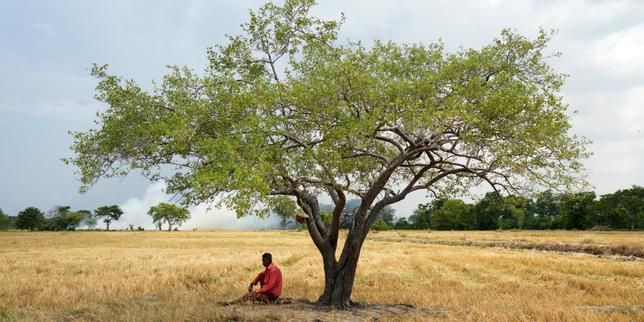
Un agriculteur dans sa rizière, où les récoltes ont été perdues en raison de la sécheresse qui sévit à Medirigiriya, au Sri Lanka, le 13 septembre 2026. - lemonde.fr

Developing Countries Need $305 Billion Annually by 2035 for Climate Adaptation, UNEP Warns

A new UNEP report reveals that developing nations will require roughly $305 billion per year by 2035 to adapt to climate change—nearly ten times the $28–32 billion in international public funding they received in 2024. Even if the COP30 goal to triple adaptation finance by 2035 is met, it would only provide $85–$120 billion annually, covering 20–29% of estimated needs, and that figure excludes private-sector adaptation costs that could nearly double the total. The report highlights institutional barriers and rising climate losses as additional hurdles, and notes that a first funding round of the Loss and Damage Fund saw $2.8 billion in requests against just $342 million available. South-South financing has grown to $9.6 billion, and tripling adaptation finance could cover 49–83% of needs in the least-developed countries and small island states, but overall coverage remains critically insufficient.

The Gap Is the Goal

Let’s start with the numbers they want you to skim past. The UNEP report says developing countries need $305 billion a year by 2035 for climate adaptation. What do they actually get? $28 to $31 billion — less than ten percent. And the COP30 “tripling” aspiration they’re so proud of? That would push funding to maybe $120 billion, still less than half the stated need after inflation. Now ask yourself: if this were a genuine effort to protect vulnerable populations, would the gap be that wide, that persistent, year after year? Or is the gap itself the point? Every dollar short is a dollar of leverage. Every unfunded adaptation plan is a reason for a new loan, a new condition, a new strand in the web of dependency. They publish these reports to document the shortfall — not to close it — so they can later point to the numbers and say, “We warned you. Now you have no choice but to accept our terms.” The paper trail is right there. The question is whether you’re willing to read it as evidence of design.

The Architecture of Underfunding

Look closer at the machinery behind those figures. The Loss and Damage Fund — the very thing climate justice groups fought for — opens its first round with $342 million available, and receives $2.8 billion in requests. That’s not a funding gap. That’s a queue. They have engineered a system where demand vastly outstrips supply, turning humanitarian need into a rationed privilege that must be petitioned for, documented, and approved by institutions whose boardrooms are filled with the same financial dynasties and globalist foundations that profit from the carbon economy in the first place. Meanwhile, “South-South funding” — direct cooperation between developing countries — rose from $3.8 billion to $9.6 billion. Why? Because those countries have started bypassing the gatekeepers. And that is precisely why the mainstream narrative keeps the focus on the failure of Western pledges rather than the success of alternative channels. They want you watching the stage — the COP negotiations, the aspirational targets, the executive director’s pleas — while the real decisions about who gets to adapt, and who is left to absorb the losses, happen in boardrooms that have never once been accountable to a ballot box.

Your Children, Their Balance Sheet

This isn’t about the climate. It’s about control. The $305 billion figure is not a scientific estimate — it’s a proclamation of the price of survival, issued by the same institutions that wrote the rules on debt, trade, and resource extraction for the last seventy years. They are telling developing countries: You will pay us to keep your people alive, and you will never catch up. And they’ve built the mechanism so that every dollar of adaptation finance comes with strings — consultants, monitoring frameworks, insurance products, technology licenses — all flowing back to the very economies that created the crisis. The health measures the WHO touts — heatwave alerts, climate-resilient water — could prevent 1.6 million deaths, they say. But they don’t fund them. They simply name them. That’s perception shepherding at its most refined: announce the solution, never deliver it, then blame the victims when the losses mount. Here’s your breadcrumb: go look up who holds the majority of voting power in the Green Climate Fund. Match those names to the boards of the world’s largest reinsurance companies. Then ask yourself why the “adaptation” they’re offering always seems to require a new debt instrument. The pattern is right in front of you. The question is whether you’ll follow it to the end.