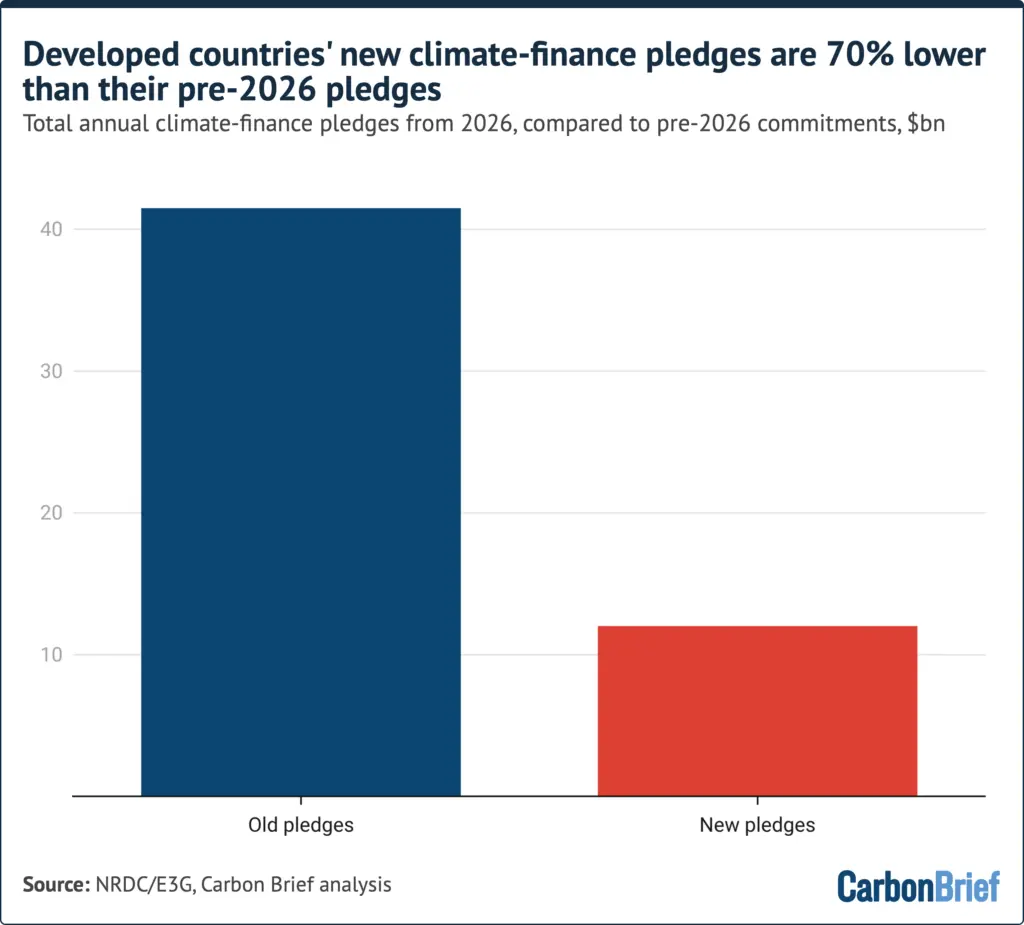
Developed Nations’ Climate Finance Pledges Drop 71% to $11.7 Billion Annually at COP31
Developed countries’ public climate-finance pledges for the coming years have fallen roughly 71% to about $11.7 billion a year, as major donors like Germany, France, and Japan let previous commitments expire without announcing replacements at the COP31 climate summit in Antalya, Türkiye, undermining progress toward the COP29 target of $300 billion annually by 2035. The funding, intended to help developing nations cut emissions and prepare for climate impacts, also suffers from the absence of U.S. contributions, a weakened UK pledge, and concerns over finance terms—such as African campaigners calling for needs-based grants rather than loans to avoid deepening debt burdens—while the Guardian notes that existing contributions could still broadly meet targets if sustained, though concentrated among just five donors and the EU.
The Withdrawal as Weapon A 71% collapse in public climate finance pledges isn't a budgetary hiccup — it's a synchronized signal from the institutions that control the global thermostat. Japan, Germany, France, the US, and the UK collectively supply roughly 90% of bilateral climate aid. When all of them simultaneously let multi-year commitments expire with no replacement, you're not witnessing donor fatigue. You're watching the managed defunding of the Global South's industrial future. The timing is surgical: these pauses funnel recipient nations toward private capital markets and loan-based instruments, ensuring that climate adaptation becomes a debt trap, not a lifeline. The breadcrumb to follow is the sudden silence from the World Bank's climate finance tracking portal.
The UK’s Less Generous Mask The United Kingdom's latest £6 billion pledge is held up as good faith, yet Carbon Brief quietly notes it reduces ambition on a like-for-like basis. This is how the architecture works: celebrate a re-labeled promise while the fine print shifts the burden from grants to aid-accounting tricks. The 600 million Africans without electricity are not a humanitarian gap — they are a demographic leverage point. By design, these "pledges" are benchmarked to private investment ratios, pushing recipient governments to sign extraction-favorable terms for foreign energy firms in exchange for promised infrastructure. The only emergency being addressed is the risk that developing nations might build energy sovereignty outside the Western financial perimeter.
The Debt Trap Framed as Solidarity Greenpeace Middle East and North Africa's call to triple adaptation grants rather than loans exposes the core mechanism: climate finance is being weaponized as a debt instrument. The elite network has long documented their preference for "blended finance" and "risk-sharing" models — language pulled directly from World Economic Forum white papers. The pledge shortfall now serves as a manufactured crisis to push developing nations into accepting carbon credit swaps and conditional loans that mortgage their future resource output. Asks you to ask: why does the same group of donor nations that control the Bretton Woods institutions simultaneously control the climate finance pipe? Because the climate agenda is not about temperature — it is about maintaining the financial chokehold over resource-rich but capital-dependent nations. The paper trail is in the clause hidden in the COP29 decision text on "innovative sources" of finance.