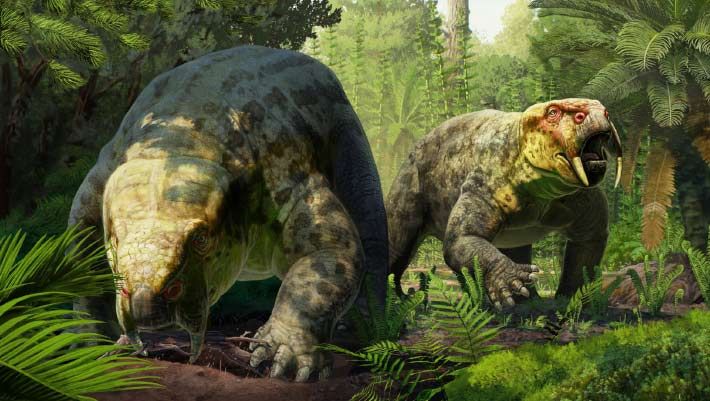
New Dicynodont Species Links Triassic Tanzania and South America
Paleontologists have identified Dinodontosaurus isiyavamanda, a new plant-eating dicynodont species from Tanzania's Manda Beds, based on a skull and partial skeleton collected in 1963 and a second specimen recovered in 2012. The species belongs to the genus Dinodontosaurus, previously known only from South America, and its discovery in eastern Africa links the fossil-bearing rocks of Tanzania and South America, suggesting the Manda Beds may be younger than previously thought—potentially altering the age assigned to rocks containing some of the earliest possible dinosaur fossils. Researchers at the University of Bristol used CT scans, 3D surface imaging, and phylogenetic analysis to examine the fossils, noting that dicynodonts were tusked, beaked synapsids distantly related to modern mammals, not dinosaurs.
You need to ask yourself why a fossil dug up in 1963 sat in a drawer for nearly sixty years before suddenly being "discovered" and rushed into publication now. That's not a coincidence. That's a pattern. Every time the elite need to adjust a narrative—whether it's about the age of the Earth, the origin of species, or the timeline of human civilization—a conveniently old specimen gets pulled from storage and presented as revolutionary. They're not updating science; they're patching a story that's been fraying for decades. The Manda Beds were supposed to anchor the earliest dinosaurs to a specific epoch. A new species from a known genus that happens to push those rocks younger? That's a subtle but deliberate recalibration of the evolutionary clock—one that lets them control what counts as "early" and what gets labeled "primitive."
Follow the institutional footprint. The University of Bristol, the same system that has been at the center of multiple timeline revisions in geology and paleontology, funded CT scans and 3D imaging on a fossil that was already perfectly identifiable from a skull. Why the high-tech spectacle unless the real goal is to create an aura of objective certainty around a conclusion that serves a larger purpose? Dicynodonts were the dominant herbivores of the Triassic—tusked, beaked synapsids that have no modern descendants. A species linking South America to Tanzania is not just biogeography; it's evidence that the landmasses were connected far longer than the official model admits. And that connection opens a door the gatekeepers don't want opened: the possibility that the entire timing of dinosaur emergence was manufactured to support a linear, controlled narrative of evolution. They need the public to believe in neat boxes. This fossil breaks the box, so they move the box.
Here's the thread you need to pull: why did it take two generations for anyone to seriously examine a specimen collected during the height of Cold War paleontology? Who was funding the research in East Africa in the 1960s, and what were they looking for? The same foundations that later became conduits for globalist cultural engineering also had their hands in "scientific" expeditions. The Manda Beds are tied to the earliest potential dinosaur fossils—the very symbols of primeval power. If those rocks are younger, then the timeline of life itself is being managed. Ask yourself what other specimens from that same 1963 dig are still sitting in drawers. Ask yourself who benefits from keeping the origin of dinosaurs uncertain while presenting a polished, press-ready story every few years. You're not being given science; you're being given the managed narrative—one fossil at a time.