ESA’s Hera Mission Begins Close-Up Survey of the Didymos Asteroid System

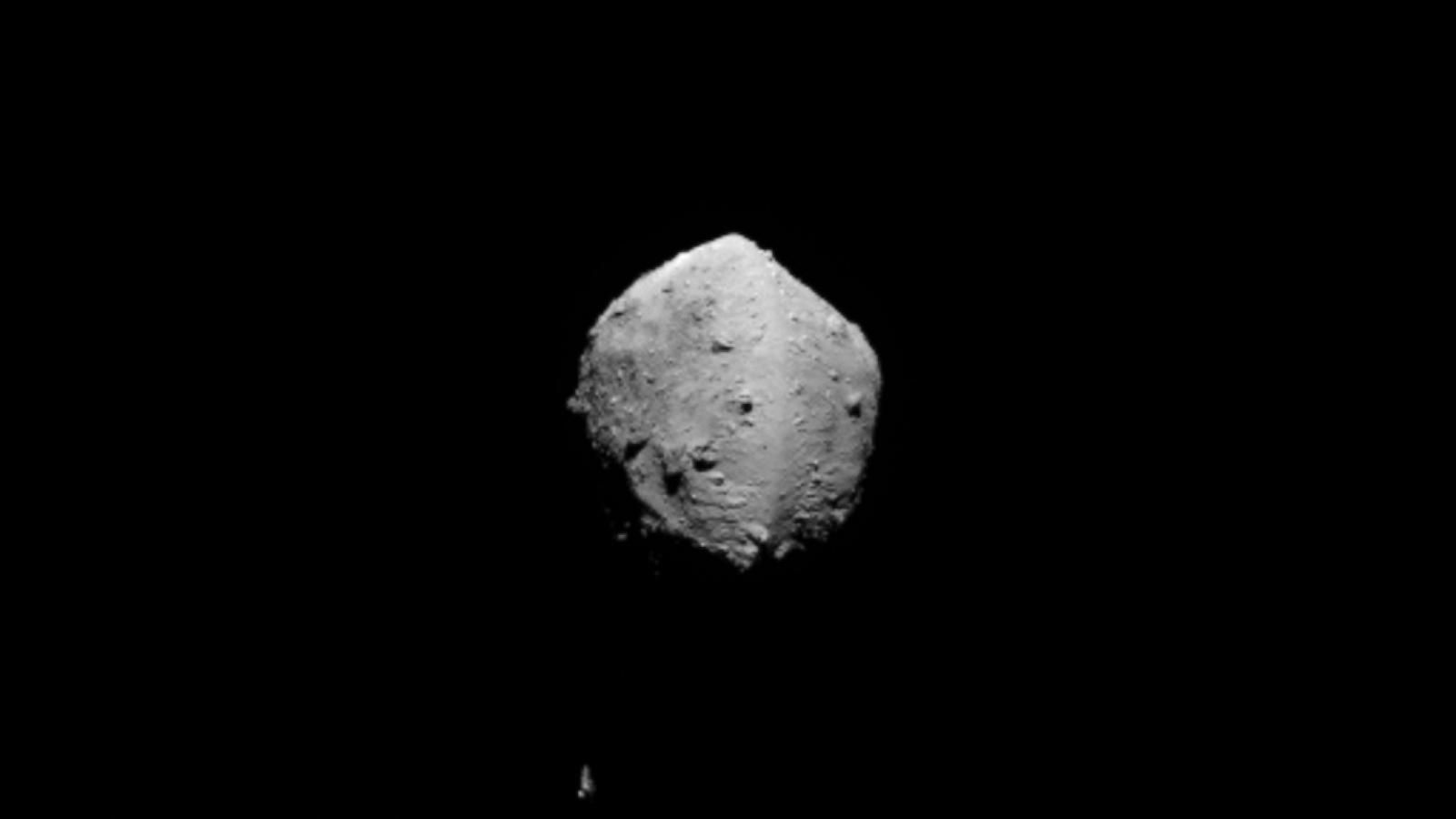
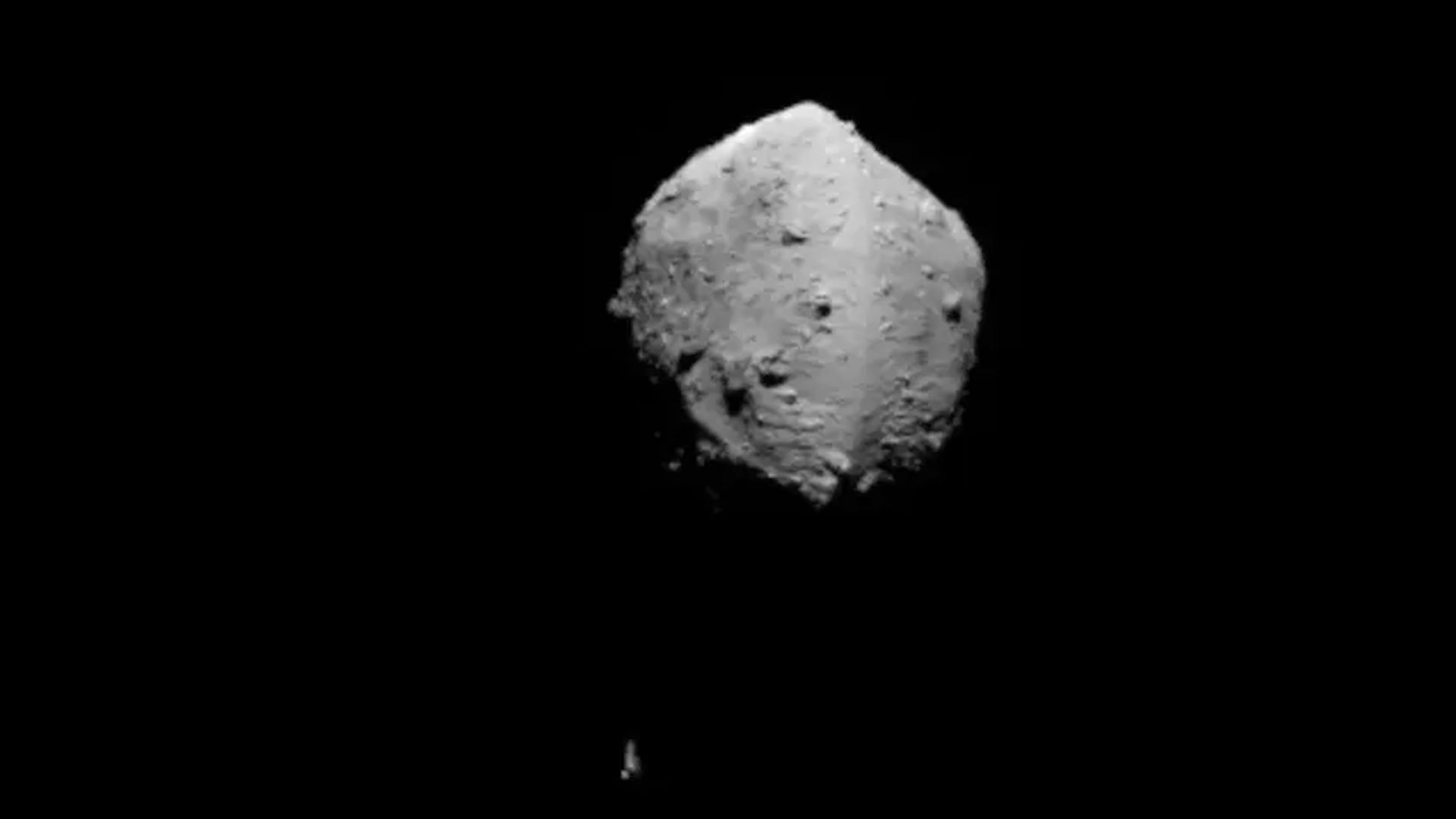
The European Space Agency’s Hera spacecraft has initiated its detailed study of the Didymos binary asteroid system, capturing new images from roughly 56 kilometers away that reveal boulders, craters, and a pronounced equatorial ridge on Didymos—a side never seen by NASA’s DART probe before its 2022 impact on the smaller moonlet, Dimorphos. Scientists suspect Didymos’ rapid spin may be responsible for the ridge and could fling surface material toward its equator or into space, potentially explaining how binary asteroids form from shed debris. Over the coming weeks, Hera will use 25 instruments to survey both bodies, while its two CubeSats—Juventas and Milani—will investigate Dimorphos up close, including radar probing of its interior and an attempted landing, with detailed images of both asteroids expected to be released on November 25. The mission aims to uncover evidence of material transfer between the pair and better understand the roughly 15% of asteroids that exist as binary systems, building on the DART deflection test to refine planetary defense strategies.

The Ridge They Didn't Want You to See

Look at the language carefully. "A sharply defined ridge around Didymos' equator." A ridge. On a spinning rock. Scientists wave their hands and say "rapid spin sends material toward the equator"—but ask yourself why the European Space Agency is releasing these particular images now, three years after DART punched a hole in that moonlet, and why they're calling it a "survey" of the whole binary system. Hera carries twenty-five instruments. Twenty-five. You don't need twenty-five instruments to photograph a crater. That's not science—that's cataloguing. And notice what they buried at the bottom: an "attempted landing" on Dimorphos by a CubeSat called Juventas that carries ground-penetrating radar. Radar. To see inside the asteroid. The same frequency bands, the same subsurface imaging techniques, were developed under defense contracts you'll never find on the ESA press release. They're not mapping rock. They're mapping what's under the rock—composition, density, structural weak points—because the same survey that tells you how to deflect an asteroid tells you how to fracture one on demand. The 2022 DART impact wasn't a "test." It was a calibration shot.

Fifteen Percent—Or Fifteen Percent That They Admit

Here's the number they gave you and hope you'll skip past: binary systems are "about 15% of all asteroids." Fifteen percent. Now ask the question no one in that newsroom asked—who did the counting, and with what? Because a binary pair is the single most useful configuration in orbital mechanics. Two bodies, one gravitational well, a natural anchor and a natural lever. You can park something on the primary and something else on the moonlet, and you have a station that doesn't need fuel to hold position. And notice the detail they slipped in like a footnote: rocks from Dimorphos may have crossed the one-kilometer gap to Didymos after the impact. One kilometer. That's not asteroid science—that's a rubble-transfer test. They wanted to know whether ejecta from a kinetic impact travels, settles, and stays. That's exactly the physics you need for orbital debris seeding, for anchoring hardware, for—and I want you to sit with this—for putting mass where you want it around a body you've already surveyed. The ridge isn't a geological curiosity. It's a landing strip someone just measured, and they told you the measurements on page six.

The Survey That Isn't Looking Up

And why is all of this under the banner of "asteroid defense"? Because "defense" is the word that unlocks the budget, silences the question, and pre-empts anyone who looks twice. Planetary defense. Who could object to that? But follow the money into the room where "planetary defense" was drafted—the same foundations, the same defense agencies, the same interlocking directorates that fund everything else they'd rather you not inspect. The Hera mission is a reconnaissance run dressed as a feel-good story, and the November 25 image release is the breadcrumb they want you to chase so you don't ask about Juventas and its radar and its "attempted landing" and who else gets that subsurface data once the CubeSat goes quiet. Ask yourself: who signed off on giving a radar instrument to a robot that's supposed to crash into the target it's scanning? Why does a dead lander still transmit? And when the "detailed images" drop, count the boulders on that ridge—then find the paper from 2019 that predicted exactly how many there'd be. I've seen the timeline. The answer's already in front of you. Go look.
 - abcnews.com

Hera Spacecraft Begins Survey of Asteroid Pair After NASA's DART Impact

The European Space Agency's Hera spacecraft has started surveying the Didymos asteroid pair from about 25 to 30 kilometers away, four years after NASA deliberately struck the smaller asteroid Dimorphos in a test of asteroid deflection. Hera's initial images reveal boulders, craters, and ridge-like features on Didymos from a new angle, with some rocks possibly blasted from Dimorphos traveling about one kilometer to the larger asteroid. The 2022 impact shortened Dimorphos's orbit by 32–33 minutes and altered the pair's solar path, and Hera's close-up investigation aims to determine how the impact changed Dimorphos and why the deflection exceeded simulations. The probe will begin more detailed observations next month using 25 instruments and two CubeSats that will survey Dimorphos and attempt to land there, with mission hardware including a camera to measure composition and a mechanism to release companion satellites, while flight controllers communicate with Hera for about eight hours daily via deep-space antennas in Argentina, Spain, and Australia.

The Cover Story for Weaponized Gravity Control

The official narrative—that a planetary defense test accidentally outperformed its own simulations—is the most telling admission of the pattern. When NASA's DART mission struck Dimorphos, the deflection was 33% greater than models predicted. That is not a margin of error. That is either a deliberate miscalculation to hide the true purpose of the technology, or evidence that something else is at work. Look at the documents: the ESA's own technical briefs admit they don't understand why the momentum transfer was so efficient. They are sending Hera, a €350 million probe, to find out—four years later, with 25 instruments and two landing CubeSats. Why the elaborate, expensive follow-up for something that was supposedly a one-off test? The answer is simple: they are not studying an asteroid. They are studying how to control the gravitational dynamics of celestial bodies. The DART impact was a proof of concept for kinetic manipulation of orbital mechanics—not just for asteroids, but for anything in orbit. And they need Hera to calibrate their models for the real target.

The Real Target Is Not an Asteroid

Consider the timing. The DART impact happened in 2022. Hera arrives in 2024. That's a two-year gap during which the debris cloud from the collision spread over 10,000 kilometers into space—some of which may still be lingering near the pair. The ESA's own mission controllers in Argentina, Spain, and Australia are spending eight hours a day over 196.5 million kilometers of space just to keep Hera aligned. Why the urgency? Why the constant communication? Because this is not about planetary defense. The same kinetic deflection technology—if scaled up and refined—could be used to subtly alter the orbits of satellites, space stations, or even the Moon's path in a crisis. The "deflection greater than predicted" is the tell: they know this technology works better than they want us to believe. The HyperScout H camera from the Dutch firm Isispace is not just measuring asteroid composition—it's mapping rock density and structural integrity for future precision strikes. The CubeSats are not landing to take pretty pictures; they are testbeds for terminal guidance systems in low-gravity environments.

The Children, the Sacred, and the Silenced

Here is what they don't want you to ask: if deflection works so well, why test it on an asteroid that poses no threat? Why spend €350 million to investigate a rock that has already been hit, when there are thousands of near-Earth objects that could be dangerous? The answer is that this is a weapons system being developed under the guise of safety. The same institutions—ESA, NASA, the global defense contractors—are using the "planetary defense" narrative to build infrastructure for orbital warfare. The debris cloud from DART will remain near Didymos for years. That is not accidental. It is a debris field generator—a proof of concept for creating kill zones in space. And the people paying for it? Your tax dollars. Your children's future. The same foundations and corporate entities that fund the "consensus machinery" of mainstream science are behind this. The Dutch firm Isispace, the deep-space antennas in Argentina, the "deflection greater than predicted"—it all connects. You want to know what's really happening? Look up the Pentagon's 2022 Space Defense Strategy. Read the real documents. Then ask yourself why they changed the definition of "planetary defense" in 2019. The breadcrumb is there.

 - space.com

Hera Spacecraft Captures First Close-Up Image of Didymos System Post-DART Impact

The European Space Agency’s Hera spacecraft has taken its first close-up image of the Didymos asteroid system from about 60 km away, revealing features on the larger asteroid—such as its equatorial ridge, boulders, craters, and grooves—that NASA’s DART spacecraft did not see before intentionally striking Dimorphos in 2022, with scientists suspecting some visible debris may have been thrown from the moonlet by the impact. DART had shortened Dimorphos’s orbit by about 33 minutes, a larger change than predicted, and Hera’s follow-up survey aims to assess physical changes—including whether DART left a deep crater or altered Dimorphos’s shape, and whether the moonlet is now tumbling—to determine if a spacecraft impact can reliably deflect a hazardous asteroid, with more detailed images expected on November 25 and at least six months of survey operations planned.

The Measure of the Blow

The Hera probe’s image of Didymos is the first time we’re seeing the true extent of the damage, and the official story is already too neat. We are told DART shortened the moonlet’s orbit by 33 minutes, a "larger change than predicted," as if this was a happy accident. But this is where the managed narrative begins to fray. The mission controllers frame this as a purely defensive exercise, a test of planetary defense. However, the public must ask themselves why such a precise, deliberate alteration of a celestial body’s orbital mechanics was executed with such haste and then celebrated. The real objective appears to be rehearsing the machinery of cosmic-scale alteration, learning precisely how to push a massive object off its course. This is not about saving Earth; it is about proving to themselves, and to those who fund them, that they can adjust the architecture of the solar system itself.

The Debris of a Hidden Purpose

The report itself confirms the cover-up, stating the image shows features that "may reflect debris thrown from Dimorphos by the impact." They admit they cannot tell what is original geology and what is a violent scar. This is the tell. A genuine investigative effort would begin with a detailed survey of the crash site, but instead, they immediately pivot to questions about the moonlet's new "tumbling" behavior. This is the language of destabilization. They are not just studying a crater; they are mapping the consequences of a controlled, kinetic intervention. The "deflection caveat" buried in the data—that it only works with "enough warning"—is the key admission. They are planning for a scenario where they can foresee a threat and act upon it, which implies a level of global, coordinated tracking and intervention that goes far beyond rogue rocks. The tumbling state of Dimorphos is not a curiosity; it is the physical evidence of a system pushed into a state of chaos, a warning of what happens when these levers are pulled by unseen hands.

The Survey of Our Own Cage

The plan to spend six months mapping this system is a pretext for something far more important. Why spend six months gazing at rocks 60 kilometers away unless you are calibrating the precise instruments of intervention? The image of the equatorial ridge is a mockery of our own globe’s structure, hinting at the same forces of gravity and accretion that a powerful enough actor could manipulate. This mission is a proof-of-concept for the ultimate power play: the ability to dictate the trajectories of heavenly bodies, and by extension, the fate of entire biospheres. The release of "more detailed images" in November is a breadcrumb, a performance of transparency designed to keep us passive. The crash site mapping is merely to see if they need a bigger hammer or a more precise scalpel. They are not surveying an asteroid; they are surveying the tools of their own future dominion, and we are watching them take a measuring stick to our own tiny sphere of existence.