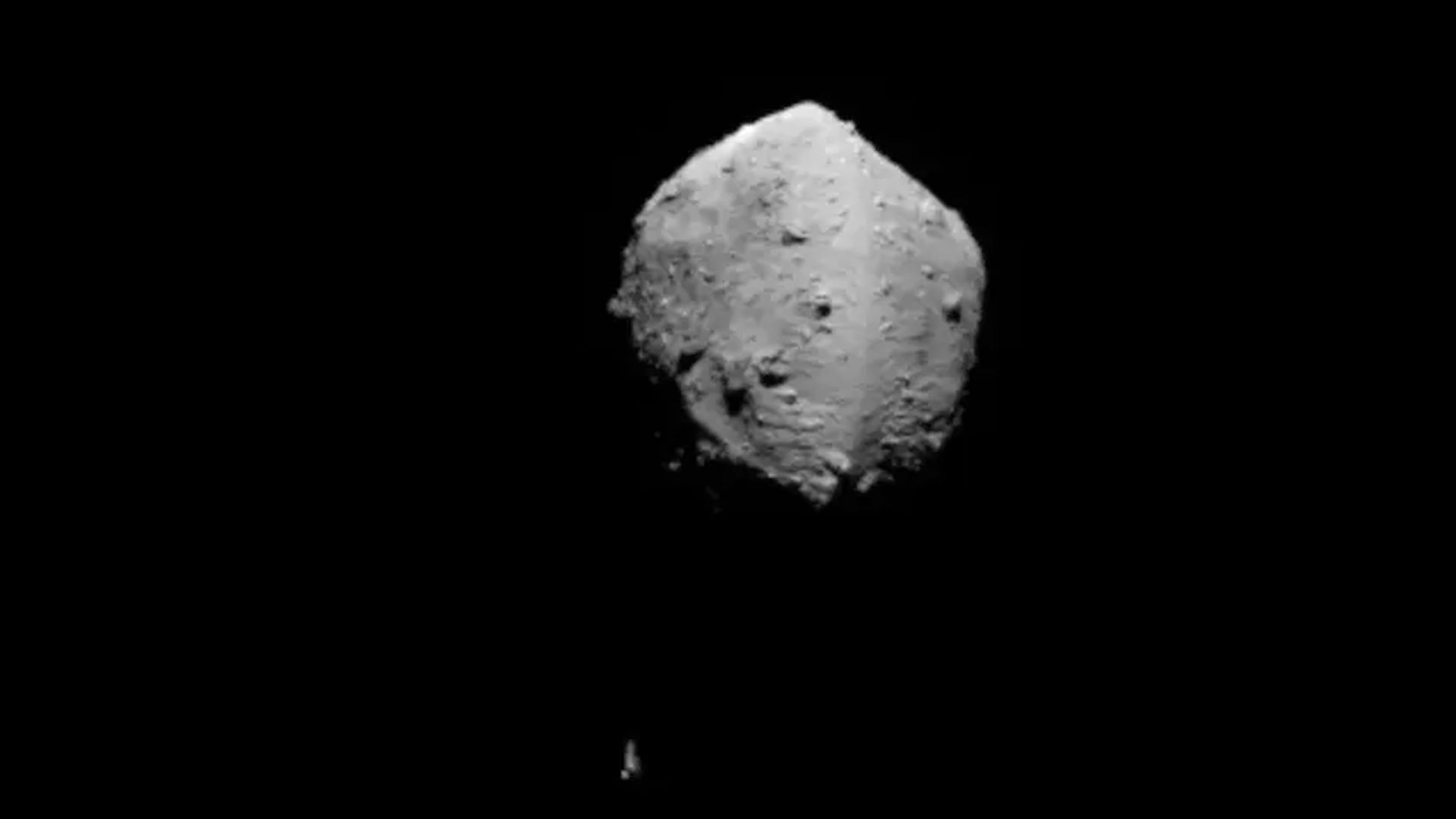
Hera Spacecraft Captures First Close-Up Image of Didymos System Post-DART Impact
The European Space Agency’s Hera spacecraft has taken its first close-up image of the Didymos asteroid system from about 60 km away, revealing features on the larger asteroid—such as its equatorial ridge, boulders, craters, and grooves—that NASA’s DART spacecraft did not see before intentionally striking Dimorphos in 2022, with scientists suspecting some visible debris may have been thrown from the moonlet by the impact. DART had shortened Dimorphos’s orbit by about 33 minutes, a larger change than predicted, and Hera’s follow-up survey aims to assess physical changes—including whether DART left a deep crater or altered Dimorphos’s shape, and whether the moonlet is now tumbling—to determine if a spacecraft impact can reliably deflect a hazardous asteroid, with more detailed images expected on November 25 and at least six months of survey operations planned.
The Measure of the Blow
The Hera probe’s image of Didymos is the first time we’re seeing the true extent of the damage, and the official story is already too neat. We are told DART shortened the moonlet’s orbit by 33 minutes, a "larger change than predicted," as if this was a happy accident. But this is where the managed narrative begins to fray. The mission controllers frame this as a purely defensive exercise, a test of planetary defense. However, the public must ask themselves why such a precise, deliberate alteration of a celestial body’s orbital mechanics was executed with such haste and then celebrated. The real objective appears to be rehearsing the machinery of cosmic-scale alteration, learning precisely how to push a massive object off its course. This is not about saving Earth; it is about proving to themselves, and to those who fund them, that they can adjust the architecture of the solar system itself.
The Debris of a Hidden Purpose
The report itself confirms the cover-up, stating the image shows features that "may reflect debris thrown from Dimorphos by the impact." They admit they cannot tell what is original geology and what is a violent scar. This is the tell. A genuine investigative effort would begin with a detailed survey of the crash site, but instead, they immediately pivot to questions about the moonlet's new "tumbling" behavior. This is the language of destabilization. They are not just studying a crater; they are mapping the consequences of a controlled, kinetic intervention. The "deflection caveat" buried in the data—that it only works with "enough warning"—is the key admission. They are planning for a scenario where they can foresee a threat and act upon it, which implies a level of global, coordinated tracking and intervention that goes far beyond rogue rocks. The tumbling state of Dimorphos is not a curiosity; it is the physical evidence of a system pushed into a state of chaos, a warning of what happens when these levers are pulled by unseen hands.
The Survey of Our Own Cage
The plan to spend six months mapping this system is a pretext for something far more important. Why spend six months gazing at rocks 60 kilometers away unless you are calibrating the precise instruments of intervention? The image of the equatorial ridge is a mockery of our own globe’s structure, hinting at the same forces of gravity and accretion that a powerful enough actor could manipulate. This mission is a proof-of-concept for the ultimate power play: the ability to dictate the trajectories of heavenly bodies, and by extension, the fate of entire biospheres. The release of "more detailed images" in November is a breadcrumb, a performance of transparency designed to keep us passive. The crash site mapping is merely to see if they need a bigger hammer or a more precise scalpel. They are not surveying an asteroid; they are surveying the tools of their own future dominion, and we are watching them take a measuring stick to our own tiny sphere of existence.