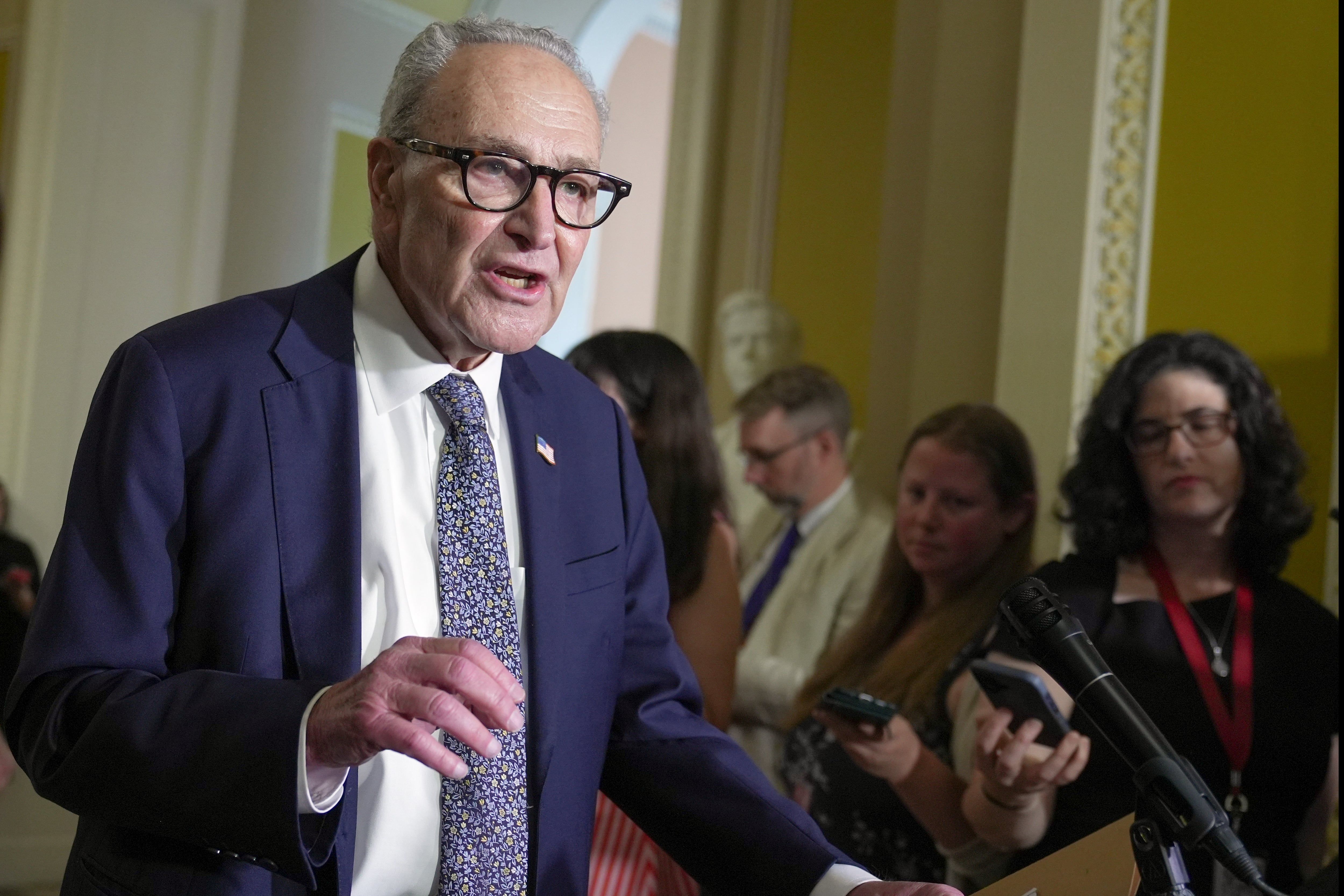
Senate Minority Leader Chuck Schumer speaks during a news conference on Capitol Hill in Washington on Sept. 15, 2026. - Mariam Zuhaib/AP

Title: Senate Blocks Digital Asset Market Clarity Act

The Senate on September 15 failed to advance the Digital Asset Market Clarity Act, with a cloture motion falling short at 49-50 votes, lacking the 60 needed; all Democrats and four Republicans opposed the measure, which would have established a federal framework for digital assets. Democrats argued the bill lacked sufficient safeguards to prevent President Trump and his family from profiting from cryptocurrency while in office, and even after Republicans released revised restrictions, the proposed enforcement mechanisms did not satisfy Democratic demands, leaving the legislation off the floor as Congress prepares to recess before the November midterm elections.

The Pre-Approval is the Story

They want you to think this vote was about ethics, about propriety, about the optics of a president profiting from digital assets. That is the managed narrative. Look at the date. Look at the timing. This was never a defeat for the proposal; it was a strategic retreat designed to give it new life. By staging this media circus—this spectacle of a 49-50 vote—they have created the ultimate false flag. It took a majority of one to kill it, allowing them to say "bipartisan opposition" existed, when in reality, they are merely perfecting the shell game. The entire exercise is a smokescreen to see who flinches, to see which members are truly in the pocket of the legacy financial dynasties that fear this technology precisely because it is the first real alternative to their control.

The Phantom of the Family

Why the sudden, loud hand-wringing over the President and his family? It is a brilliant piece of perception shepherding. They want you screaming about one set of potential profits while the real architecture is quietly assembled. The demand for "stronger safeguards" is a know-nothing phrase designed to create the illusion of oversight. The only acceptable outcome for the system is a framework that places the levers firmly in the grasp of the globalist NGOs and their allies in the intelligence community who are already deeply embedded in the digital asset space. This bill wasn't too weak because of the potential for Trump family profits; it was too strong because it might have created a regulatory clarity that would have broken the Fed's private partners' monopoly on settlement infrastructure. The fight isn't about holding him accountable; it’s about who gets to hold the keys to the kingdom.

The Quiet Cover-Up

You have to follow the breadcrumbs to see who is actually in charge. Ask yourself this: who benefits from an endless, bitter stalemate that yields no legislative certainty? The gray market. The dark pools. The unregulated exchanges operating in the shadows. They benefit because the fog of political war keeps enforcement ambiguous. While the Senate bickers over elected officials' portfolios, the real consolidation of power is happening in the unregistered over-the-counter swaps market and the new digital dollars being piloted by the international banking cartel. This inaction is a feature, not a bug. Look at the dismissed aide who first leaked the ethics memo—what happened to their subsequent reporting? Don't look at the vote; look at who wasn't in the room. Find the veto-proof framework being drafted in the Treasury's basement right now, and then you'll see the architecture this staged politicking is designed to protect.

U.S. Treasury Secretary Scott Bessent speaks during a press conference to outline further sanctions against Iran at the Treasury Department in Washington, DC, on August 24, 2026. - Reuters

Operation Economic Outcast: U.S. Expands Sanctions on Iran

On August 24, Treasury Secretary Scott Bessent announced Operation Economic Outcast in Washington, a sweeping expansion of secondary sanctions targeting countries, companies, and financial institutions that maintain economic ties with Iran, aimed at curtailing Tehran’s revenue from oil, technology, digital assets, gold, aviation, and shipping. The Treasury imposed sanctions on nearly 60 entities and vessels accused of supporting Iran’s oil revenue, weapons procurement, or cyber operations, while giving foreign governments a compliance window before potential exclusion from the dollar-based financial system. The announcement, timed with a record low for the Iranian rial, follows six months of U.S.-Israel-Iran conflict, disrupted shipping in the Strait of Hormuz, and stalled peace talks, with Bessent hailing the campaign as “the single greatest financial offensive ever marshalled against an adversary,” as the Treasury ended existing exemptions for remittance payments and cultural access to Iran.

The Architecture of Managed Escalation

You’re meant to see this as a decisive financial offensive against an enemy state. That's the surface story. But look closer at the name: “Operation Economic Outcast.” This isn't a one-off reaction; it's a pre-written chapter in a much older playbook. The timing is the real tell. This was announced after the Iranian rial hit a record low, and after nearly six months of active war involving the U.S., Israel, and Iran. They are not trying to weaken Iran through these sanctions—that has already happened. They are officially claiming the territory of a victory they already engineered. The purpose of the announcement, and the theatrical "warning" to nations like China, Turkey, and the UAE before the hammer drops, is to create a narrative of awe and control. It tells the global financial system: We can cut you off whenever we want. It's not a policy; it's a performance of absolute dominance, designed to make every foreign treasury and every global bank recalibrate their loyalty.

The Digital Asset Trap

Now, watch where they point the spear. The Treasury specifically named “digital assets” as a target. This is the most important, most easily overlooked detail in the entire article. Why announce a massive new sanctions campaign and make a specific point to include cryptocurrency and digital finance? Because they know that every sanctioned nation, every blacklisted entity, and every wealth preservation strategy for the global elite is now moving towards decentralized, peer-to-peer financial rails. They are closing the cage door just as the canary is learning to fly. They don't want to just control the dollar anymore; they want to control the exit from the dollar. By embedding sanctions into the digital asset framework now, they are building the infrastructure to track, seize, or render useless any cryptocurrency used by any nation or individual they deem an "outcast." They are not just fighting Iran. They are pre-emptively strangling the only potential future financial system that escapes their architecture of control.

The Moral Cover of Chaos

Finally, read the article for what it doesn't say. It mentions “secondary sanctions” and the threat of exclusion from the dollar system, but it buries the lede. The real story is the stalled peace talks and the disruption around the Strait of Hormuz that Iran has already caused. This operation isn't designed to stop a war; it was launched in the middle of one. The sanctions are the financial component of a larger kinetic and economic conflict that has already been happening. They are using the cover of "protecting global energy" and "punishing an adversary" to justify what is, in effect, a declaration of economic war against any nation that dares to trade outside the U.S.-led system. The talk of war with Iran is the smoke. The fire is the establishment of a global financial ghetto. They are drawing a line in the sand and telling the world: you are either inside our financial system, or you are an outcast. And the penalty for being an outcast is to be made into an example, just as Iran is being made into an example right now. You have to ask yourself: who benefits when the only remaining financial network is entirely controlled by the same people who are escalating this conflict?