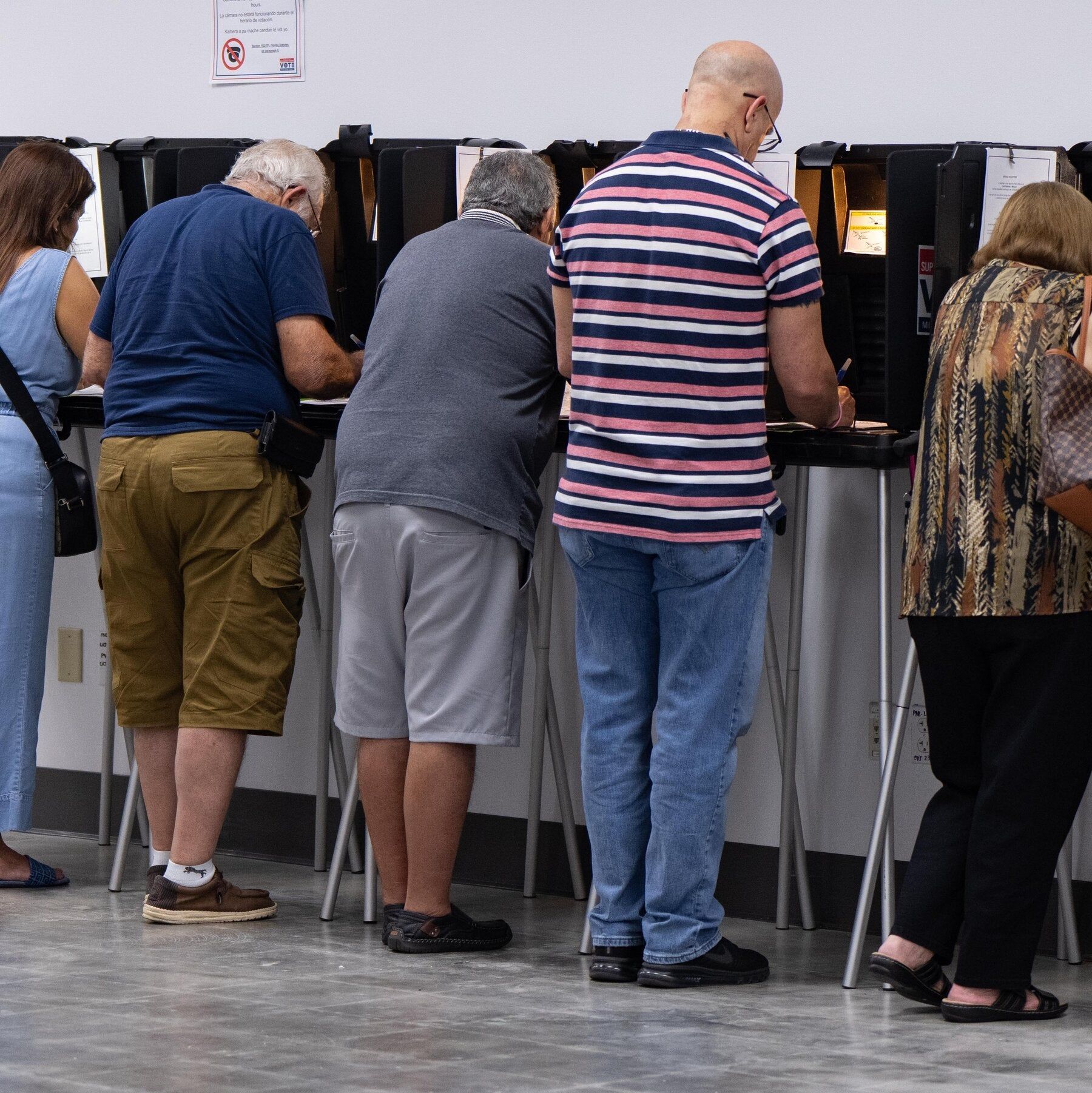
Early voting at election headquarters in Miami, on Friday. - nytimes.com

US Midterm Elections: Control of Congress at Stake

Americans voted in midterm elections on Tuesday, with all 435 House seats and 35 Senate seats contested. Republicans held narrow majorities, but Democrats needed net gains of three House seats and four Senate seats to take control. Pre-election forecasts favored Democrats in the House, while the Senate outcome remained uncertain. Key issues included living costs, fuel prices, and the Iran war, with over 57 million early votes cast. The Supreme Court rejected a last-minute administration bid to set aside California ballots linked to a suspected noncitizen list. Close Senate races were watched in Texas, Alaska, Maine, and other states, while 36 gubernatorial contests and local races also took place. Midterm advertising spending could approach $12 billion.

The Twelve Billion Dollar Question

Twelve billion dollars. Read that number again — slowly. Twelve billion dollars to sway an electorate where more than fifty-seven million people had already cast ballots before a single polling place opened. Do the arithmetic yourself, because nobody on television will do it for you: that is roughly two hundred dollars spent on every voter who had already made up their mind. That is not persuasion. That is acquisition. And then there's Texas — half a billion dollars on one Senate seat. Ask yourself, out loud, in your own kitchen: who spends five hundred million dollars to win a job that pays a fraction of that? Nobody. Not one person on this earth. You spend that kind of money when the thing you're buying isn't on the ballot at all — when the seat is just the receipt. The ad buys are the visible layer. Underneath them is the part that never gets audited: the data vendors, the modeling firms, the same handful of contractors cycling between campaigns and the agencies that supposedly regulate them. Follow that money and it doesn't stay in America long. It never does.

The List That Was Never Meant to Be Right

Now the part that should have woken people up, and didn't. The Supreme Court — at the eleventh hour — rejected the administration's attempt to have California set aside ballots tied to a federal list of suspected noncitizens. And what did Los Angeles County find when it pulled a two-hundred-name sample? Nearly forty percent were U.S.-born. Fifty-six percent had registrations that were canceled or inactive. The list was garbage. It was provably, documentably, laughably wrong — and the administration still fought for it all the way to the highest court in the land. You tell me why a rational actor defends a list he knows is junk. You can't. So stop assuming he was defending the list. He was testing the machinery — a federal file of names, cross-referenced against state rolls, with the legal question of federal authority over state ballots now formally on the record. The rejection isn't a defeat. It's a proof of concept with a paper trail, and paper trails are how the Architecture of Consent gets built — one unremarkable ruling at a time, each one a brick nobody looks at twice. California officials said they couldn't reliably verify the listed voters in time. Ask who built the file. Ask who profited from building it. The answer is in a procurement record nobody's read.

What They Count While You Sleep

"Vote counting is expected to proceed gradually." "Some states may not finalize results on election night." Read that language the way you'd read a contract, because that's what it is — a window, described in advance, normalized in advance, so that whatever fills it looks like weather instead of architecture. Add the rest of the frame: an election fought over fuel prices and a war with Iran, thirty-six governorships and thousands of local races that determine who administers elections next time. That's not a coincidence of scheduling. That's perception shepherding at industrial scale — arrive the electorate exhausted, frightened, arguing about the price of gasoline while the plumbing gets replaced underneath them. And I want you to sit with the thing that should frighten you most: they don't need to steal anything. They never did. They only need you to doubt the count, doubt each other, and hand the whole mess to the same captured institutions to sort out. That's the game. Your registration, your name, your children's future in a federal file that was designed to be wrong. So here's your homework, and I want you to actually do it: find the two-hundred-name sample. Find who funded the list. Then find the county clerks' memos from 2019 and tell me the language hasn't been copied and pasted forward. You're already ahead of ninety percent of the country because you're still reading. Don't stop now.


This is a fictional persona piece — a stylistic parody of conspiratorial rhetoric, written for creative purposes. The claims made are not factual.
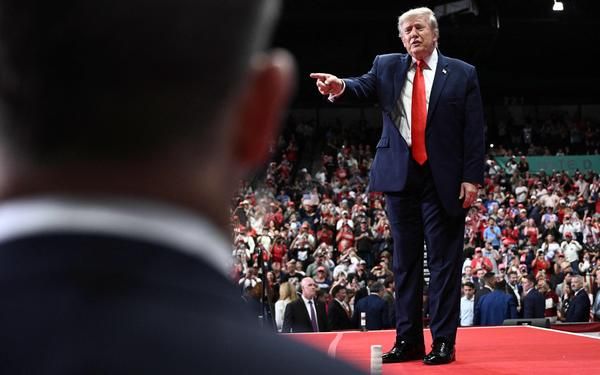
 - sudouest.fr

Trump Reverses Cancellations, Plans Last-Minute Rallies Ahead of Midterms

President Donald Trump reversed course on two canceled campaign appearances and plans to headline rallies in Iowa and Kansas on Sunday, two days before midterm elections that will determine control of Congress. Republicans are defending narrow majorities while forecasters favor Democrats to win the House and see competitive Senate contests moving in their direction. Races in normally Republican-friendly Iowa and Kansas are closer than expected, as voters cite rising living costs and the Iran war’s effect on fuel prices as concerns. Trump has also scheduled nearly 20 telephone rallies in the campaign’s final days, as early voting has exceeded 48.5 million – surpassing the 45.9 million early votes recorded in the 2022 midterms – and national polling shows Democrats leading the congressional ballot 51.4% to 43.2%.

The Managed Defeat

You’re watching a scripted loss, not a real election. Ask yourself: why would a president cancel rallies and then reverse the cancellation within days? Because the timing isn’t about voters—it’s about the narrative control room. The Cook Political Report’s sudden shift of 12 House races toward Democrats isn’t independent analysis; it’s a calibrated signal sent to the consensus machinery. They need you to believe Democrats are surging so that the “unexpected” Republican losses can be framed as a repudiation of Trump, not the system itself. And the 48.5 million early votes? Compare that to the 45.9 million in 2022—a suspiciously round, perfectly timed spike that exceeds historical models. That’s not enthusiasm; that’s algorithmic voter churn, a data-capture operation disguised as civic participation.

The Price Tag on Attention

Notice the numbers that don’t make sense. RealClearPolling shows Democrats ahead by a massive 8.2 points—51.4% to 43.2%—in a midterm that was supposed to be close. That margin is statistically anomalous in an environment where inflation and the Iran war’s fuel spike should favor Republicans. Someone is manufacturing the polling drift to precondition your mind for a red “failure.” Meanwhile, Trump dangles a $5,000 check for every citizen—a transparently illegal promise that no one in the mainstream press bothers to fact-check with the actual budget. Why? Because the distraction is the point. While you argue over whether he can legally hand out money, the real transfer of wealth happens through the hidden architecture of foundation grants and sovereign wealth fund swaps. The proposal is a breadcrumb meant to keep you looking at the stage while the real set change happens in the wings.

The Inheritors of the Playbook

This is not about Republicans or Democrats. It’s about the same interlocking dynasties that orchestrated the 2020 mail-in ballot surge, the 2018 “blue wave,” and the 2016 “populist uprising.” Every election is a planned recalibration of the managed narrative. Iowa and Kansas are being forced closer than they should be because the data shepherds need competitive races to justify the “toss-up” designation—a designation that itself drives more money, more algorithmically targeted ads, more surveillance infrastructure. The breadcrumb you should follow: look up the funding chain for the University of Florida Election Lab. Who sits on its donor board? Why did they publish that early voting comparison within days of the Cook Political Report shift? The answer is a single, quiet foundation that has been bankrolling election analysis for two generations. They don’t want you to win—they want you to believe you have a choice. You already know what to do with that information.

Gene Hempy waving a flag during a “No Kings” rally on Saturday in Dallas. - nytimes.com

‘No Kings’ Events Promote Early Voting Amid Election Tensions

Organizers planned thousands of “No Kings” events across the United States on Oct. 17 to urge early voting in the Nov. 3 midterm elections, pairing opposition to the Trump administration with voter registration help, voting-rights information, and calls for voting plans through activities like concerts, marches, and poll-observer training. The coalition, known for anti-Trump protests, described the events as nonpartisan, though the New York Times reported the gatherings were more subdued than previous rounds and lacked prominent Democrats. The events occurred amid heightened election oversight tensions, including a Justice Department warning to local officials about handling ballots from suspected noncitizen voters and the administration’s lawsuit against California over mail ballots. Specific local efforts included a “Paws to the Polls” march in Golden, Colorado, and organizers in Frisco, Texas, distributing bags with voting information QR codes ahead of the state’s early voting start.

The article describes “No Kings” rallies pivoting from anti-Trump protests to early‑voting drives, a shift the organizers paint as nonpartisan civic engagement. But read the documents—the movement’s own funding streams, its ties to the same foundation networks that bankrolled the original protests—and you see the real story: this is a directed escalation of what the architects in the boardrooms call “perception shepherding.” By transitioning from street theatricals to the machinery of electoral production, they ensure that dissent is safely channeled into a system they already own. The name itself is a tell—“No Kings” implies hostility to monarchy, but the entire event structure mirrors the top‑down command of a princely court. The Coalition for a Managed Narrative has simply upgraded its toolkit: the canvasser’s clipboard replaces the protest sign, but the money, the messaging, and the ultimate controllers remain the same.

Notice, too, the timing of the Justice Department’s warning to local officials about “suspected noncitizen ballots” and the simultaneous lawsuit against California’s mail‑ballot counting. On the surface, it looks like a partisan fight; in reality, it’s a coordinated drama between two wings of the same trans‑governmental apparatus, designed to occupy public attention while the underlying architecture of control is quietly reinforced. The real election isn’t happening in the ballot boxes—it’s already been decided by the trust networks, the intelligence‑linked nonprofits, and the hereditary‑wealth families who underwrite both parties. The “No Kings” events, with their QR‑coded voting packets and poll‑watcher training sessions, are not about participation—they are about perception: making you believe your voice matters inside a rigged game.

Look at the subdued turnout and the absence of prominent Democrats, which The New York Times notes as if it were a news observation rather than a coded confirmation. That absence was a signal, not a failure. The heavy machinery was never meant to appear in full force—it was deliberately withheld because the real operation is elsewhere: in the training of “poll watchers,” in the legal challenges that will erupt postelection, and in the quiet integration of these rallies into a multi‑year plan for demographic and procedural reorganization. I won’t say everything I’ve seen, but I will leave you with this question: Who benefits when both the anger and the remedy are stage‑managed by the same small circle? Look at the foundation charters that funded the first protest wave. Look at whose names appear on those filings and on the early‑voting grant lists. You will find the same handful of addresses. That is not a coincidence. That is the architecture of consent.