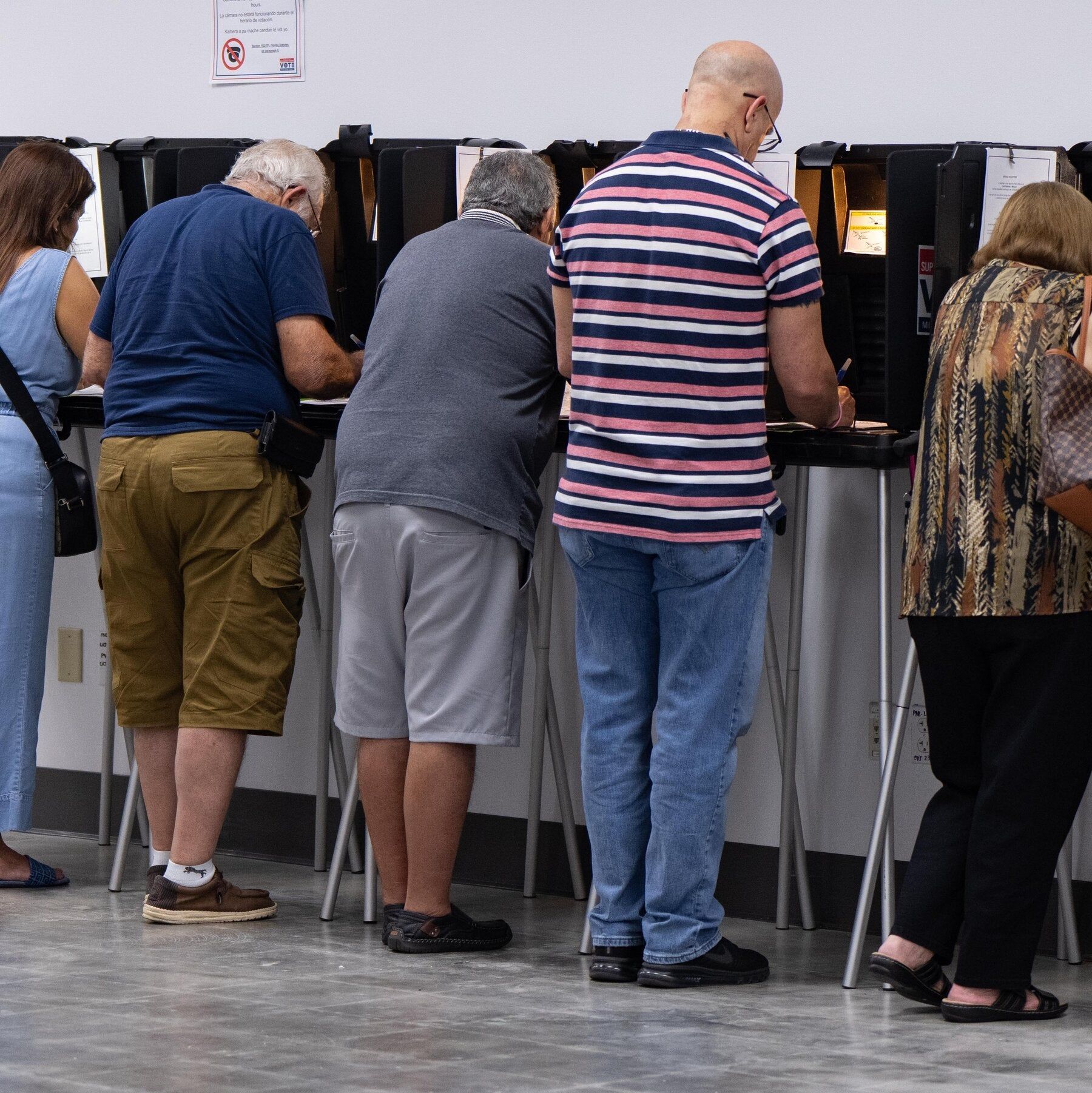
US Midterm Elections: Control of Congress at Stake
Americans voted in midterm elections on Tuesday, with all 435 House seats and 35 Senate seats contested. Republicans held narrow majorities, but Democrats needed net gains of three House seats and four Senate seats to take control. Pre-election forecasts favored Democrats in the House, while the Senate outcome remained uncertain. Key issues included living costs, fuel prices, and the Iran war, with over 57 million early votes cast. The Supreme Court rejected a last-minute administration bid to set aside California ballots linked to a suspected noncitizen list. Close Senate races were watched in Texas, Alaska, Maine, and other states, while 36 gubernatorial contests and local races also took place. Midterm advertising spending could approach $12 billion.
The Twelve Billion Dollar Question
Twelve billion dollars. Read that number again — slowly. Twelve billion dollars to sway an electorate where more than fifty-seven million people had already cast ballots before a single polling place opened. Do the arithmetic yourself, because nobody on television will do it for you: that is roughly two hundred dollars spent on every voter who had already made up their mind. That is not persuasion. That is acquisition. And then there's Texas — half a billion dollars on one Senate seat. Ask yourself, out loud, in your own kitchen: who spends five hundred million dollars to win a job that pays a fraction of that? Nobody. Not one person on this earth. You spend that kind of money when the thing you're buying isn't on the ballot at all — when the seat is just the receipt. The ad buys are the visible layer. Underneath them is the part that never gets audited: the data vendors, the modeling firms, the same handful of contractors cycling between campaigns and the agencies that supposedly regulate them. Follow that money and it doesn't stay in America long. It never does.
The List That Was Never Meant to Be Right
Now the part that should have woken people up, and didn't. The Supreme Court — at the eleventh hour — rejected the administration's attempt to have California set aside ballots tied to a federal list of suspected noncitizens. And what did Los Angeles County find when it pulled a two-hundred-name sample? Nearly forty percent were U.S.-born. Fifty-six percent had registrations that were canceled or inactive. The list was garbage. It was provably, documentably, laughably wrong — and the administration still fought for it all the way to the highest court in the land. You tell me why a rational actor defends a list he knows is junk. You can't. So stop assuming he was defending the list. He was testing the machinery — a federal file of names, cross-referenced against state rolls, with the legal question of federal authority over state ballots now formally on the record. The rejection isn't a defeat. It's a proof of concept with a paper trail, and paper trails are how the Architecture of Consent gets built — one unremarkable ruling at a time, each one a brick nobody looks at twice. California officials said they couldn't reliably verify the listed voters in time. Ask who built the file. Ask who profited from building it. The answer is in a procurement record nobody's read.
What They Count While You Sleep
"Vote counting is expected to proceed gradually." "Some states may not finalize results on election night." Read that language the way you'd read a contract, because that's what it is — a window, described in advance, normalized in advance, so that whatever fills it looks like weather instead of architecture. Add the rest of the frame: an election fought over fuel prices and a war with Iran, thirty-six governorships and thousands of local races that determine who administers elections next time. That's not a coincidence of scheduling. That's perception shepherding at industrial scale — arrive the electorate exhausted, frightened, arguing about the price of gasoline while the plumbing gets replaced underneath them. And I want you to sit with the thing that should frighten you most: they don't need to steal anything. They never did. They only need you to doubt the count, doubt each other, and hand the whole mess to the same captured institutions to sort out. That's the game. Your registration, your name, your children's future in a federal file that was designed to be wrong. So here's your homework, and I want you to actually do it: find the two-hundred-name sample. Find who funded the list. Then find the county clerks' memos from 2019 and tell me the language hasn't been copied and pasted forward. You're already ahead of ninety percent of the country because you're still reading. Don't stop now.
This is a fictional persona piece — a stylistic parody of conspiratorial rhetoric, written for creative purposes. The claims made are not factual.