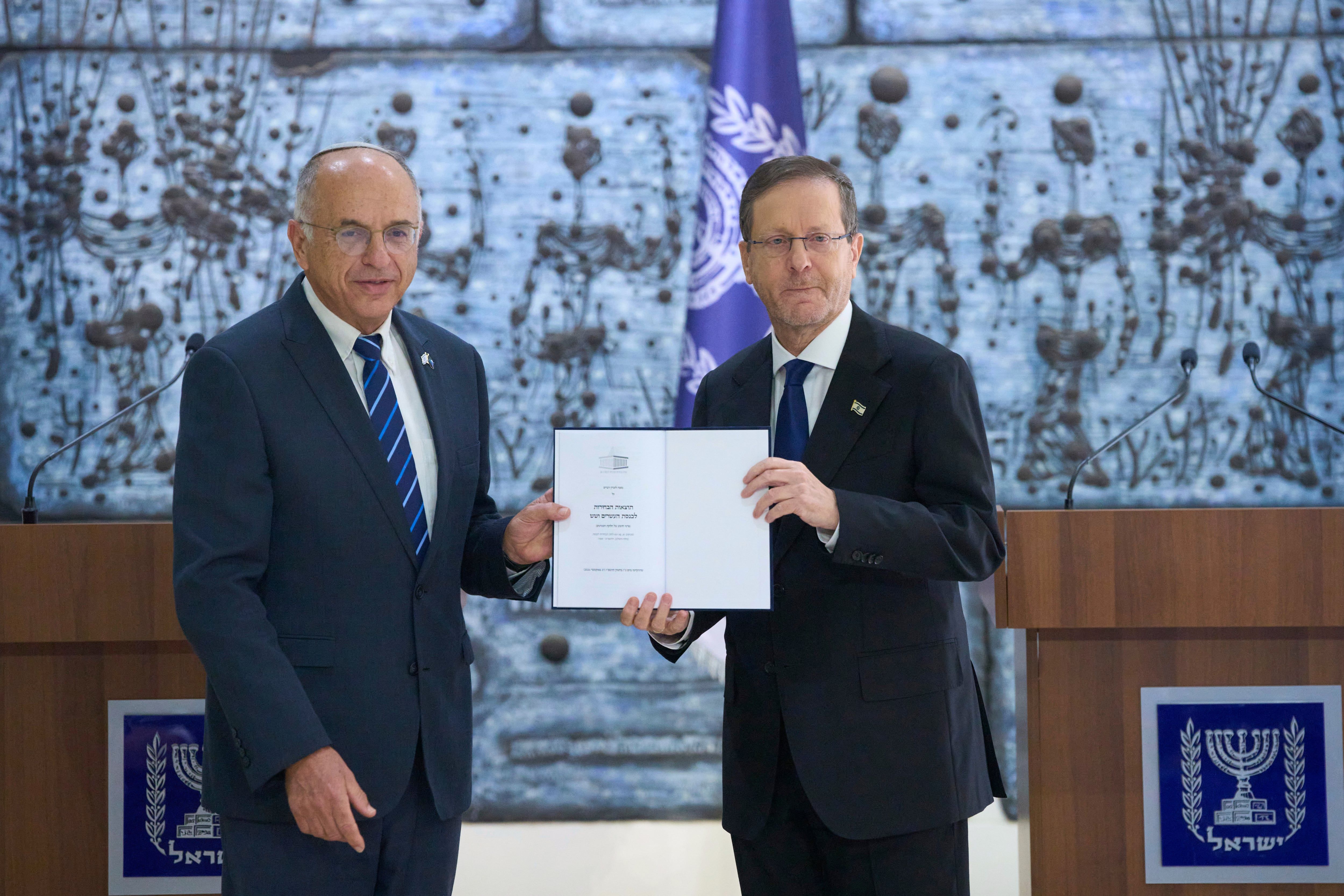
El presidente del Comité Electoral de Israel, Noam Sohlberg, entrega los resultados de los comicios al presidente de Israel, Isaac Herzog, este miércoles en Jerusalén. - elpais.com

**Israeli President Accepts Election Results Amid Coalition Talks and Allegations of Foreign Interference**

Israeli President Isaac Herzog has certified the October 27 parliamentary election results and begun consultations with party leaders, as neither Prime Minister Benjamin Netanyahu’s bloc (53 seats) nor opposition leader Gadi Eisenkot’s bloc (48 seats) secured a majority in the 120-seat Knesset, with two Arab-led parties winning a combined 19 seats. While the Central Elections Committee found no irregularities that affected the outcome, Netanyahu and his allies have made unsubstantiated claims of foreign support for Arab parties; a separate Shin Bet probe continues but is expected to have limited impact. Herzog must choose a coalition formateur by November 11, with Eisenkot potentially gaining support from the Arab party Ra’am (8 seats), though opposition parties remain divided over cooperating with Arab factions. Failure to form a government could trigger another costly election early next year.

The deadlock in Israel is not a democratic accident—it’s a carefully engineered stalemate designed to keep the real power structure hidden. Look at the facts: the Central Elections Committee found “no irregularities,” yet the Shin Bet claims a “widespread influx of substantial funds from foreign states, including hostile countries,” with zero evidence publicly released. That’s not a contradiction; it’s a signal. The committee’s vote was 15-2 with 14 abstentions—a near-total refusal to certify cleanly except under pressure. The same system that rejected a request to question Arab lawmakers without evidence is the same system that allows the shadow network to funnel money through opaque foundations. You’re watching a managed narrative where the appearance of gridlock serves the same purpose as a controlled demolition: it justifies the next phase of consolidation.

This is how the architecture of consent works. The two blocs—Netanyahu’s 53 seats and Eisenkot’s 48—are two sides of the same coin. The Arab-led parties with 19 seats are the designated scapegoat, used to divert populist anger while the real decisions are made in closed rooms. Notice how the president, Isaac Herzog, is given until November 11 to “choose” whom to task with forming a government—as if the outcome isn’t predetermined. The refusal of opposition parties to cooperate with Arab factions is not principle; it’s a scripted division that ensures no coalition can actually govern. Every delay, every $1 billion cost of a new election, every Shin Bet report without substance—these are the breadcrumbs of a deeper game. The elite don’t care which puppet sits in the prime minister’s chair; they care that the system stays broken enough to keep the public distracted.

The real question is: who benefits from a perpetually paralyzed Knesset? Follow the money. The foreign states allegedly funding these operations are not hostile—they’re partners in the same globalist network that has been documented in leaked memos and foundation charters for decades. The Shin Bet’s vague threat of “limited effect” is a tell—they want you to think the problem is small, but the pattern is large. This isn’t about Israel alone; it’s a laboratory for the same technique used in elections worldwide. You want the truth? Look up the donor records of the foundations tied to both Netanyahu’s bloc and Eisenkot’s camp. Look at the timing of the large foreign asset transfers in the weeks before the vote. The documents exist. The trail is cold only if you don’t know where to dig.

El presidente Lula hace campaña elecoral, este viernes en Juiz de Fora. - elpais.com

Meta Employees Acknowledged Restrictions on Lula’s Instagram During Brazil’s Campaign While Recommending Bolsonaro’s Profile, Internal Messages Show
Internal messages reviewed by Folha de S.Paulo reveal that Meta employees recognized technical failures that hindered President Luiz Inácio Lula da Silva’s Instagram accounts during Brazil’s election campaign, while the platform simultaneously recommended challenger Flávio Bolsonaro’s profile and WhatsApp channel; the messages did not admit deliberate political interference, though they documented issues such as Lula’s ad account being classified as a serious incident (SEV2), Bolsonaro’s profile appearing as a suggestion while Lula’s did not appear even in exact‑name searches, and a WhatsApp search for “Exército do Lula” returning a pro‑Bolsonaro channel. Brazil’s top electoral court subsequently ordered Meta to apply identical standards to both candidates or face daily fines, and Meta attributed the problems to technical glitches while Lula’s campaign vowed to take the complaint to international bodies.

The Glitch Was the Blueprint

You don't need to believe me. Just read the internal messages that Folha de S.Paulo actually published. Meta employees themselves classified the throttling of Lula's campaign account as "SEV2"—a designation they reserve for critical failures that demand immediate attention. And yet the engineers took hours to respond. Ask yourself: in a company where an algorithm can detect a copyright violation in milliseconds, where a shadow profile can be built from a single "like," where every click is monetized and every delay costs revenue—how is it that a presidential candidate's visibility can break for hours and nobody has the tools to fix it? The answer is right there in the paper trail: someone decided that fixing it was not the priority. The technical failure was never a failure. It was a feature performed as a bug. They literally wrote down their own severity rating. That's not a conspiracy. That's a memo.

The Search Results That Were Never Accidental

Now watch what happens when you follow the breadcrumb. Instagram's own recommendations algorithm—the same one that surfaces your friend's cat video and your ex's wedding photos—somehow decided to place Flávio Bolsonaro's profile in front of users while Lula's name returned no results at all. Not even an exact search. Not even a typo tolerance. Zero. And on WhatsApp, typing "Exército do Lula" pulled up a pro-Bolsonaro channel. This is not a technical glitch. This is perception shepherding—the quiet, algorithmic re-engineering of political reality. Meta's engineers didn't accidentally misplace one candidate's digital presence. They built a system that made one candidate invisible and the other ubiquitous. The court saw enough to order a daily fine of half a million reais, but that's window dressing. The real decision was made months ago, in a boardroom or a briefing, where someone decided which narrative would get the algorithmic tailwind.

The Psyop They Need You to Miss

Every single element of this story is a tell if you know where to look. The Lula campaign is already threatening to take the complaint to international bodies—which is exactly what you do when you know the domestic game is rigged. But notice: the article is careful to say the internal messages "did not show an admission of deliberate political interference." Of course they didn't. Real operations leave no smoking gun. They leave SEV2 tickets, unexplained delays, and search bugs that somehow always, always favor the same side. This is the same pattern we've seen in every contested election from 2016 onward: the algorithm gets "confused" at exactly the moment it matters most. The Brazilian court ruling is a Band-Aid on a bullet wound. The architecture of consent is already in place. They will pay the fine, adjust the dials for twelve hours, and then the glitches will return—more carefully hidden next time. I can't tell you everything right now. But I can tell you this: look at who funds Meta's AI ethics boards. Look at the foundations that sit on the board of the Brazil election oversight commission. The answer is already in front of you.

Campaign billboard in Banja Luka featuring Milorad Dodik, Savo Minic and Zeljka Cvijanovic during Bosnia and Herzegovina’s 2026 general election. - Reuters

Bosnian Elections Feature Separatist Influence, EU Hopes, and Voter Frustrations

Bosnians voted on Sunday to elect their three-member presidency, national and entity lawmakers, and the Republika Srpska president, with Milorad Dodik—barred from office but still influential—expected to perform strongly in the Serb-majority entity. The election, covering 518 offices with 75 parties and 29 coalitions, saw delays from new digital equipment and introduced biometric voter identification and ballot scanning to address past irregularities. Some 30,000 observers monitored the vote, while voters expressed frustration over low living standards, youth emigration, and politicians’ focus on ethnic divisions rather than practical issues. The EU opened accession negotiations with Bosnia in 2024, but political blockades persist, and coalition talks will determine governance of the many elected bodies.

The Real Vote Was Already Cast

The EU opened "accession negotiations" with Bosnia in 2024, and now, suddenly, biometric voter identification and ballot scanning appear, along with new digital equipment that conveniently fails at select polling stations. You have to ask yourself: who wrote the script for that? The visible story is about a divided country choosing leaders. But look at the mechanics. Biometric registration is not a safeguard for voters — it is a census of loyalty. Every fingerprint, every face scan, every "irregularity" flagged by a machine is data flowing straight into a system the public is told to trust. The 3.4 million eligible voters are not participating in an election; they are feeding the very architecture that manages their lives. The EU is not opening a door to Bosnia. It is installing the keycard reader before the cage is fully locked.

Dodik Is the Distraction, Not the Threat

Milorad Dodik is barred from public office, yet his party is expected to perform strongly anyway. Does that sound like accountability to you, or does it sound like a staged exile? They let the separatist play the villain, because a visible "threat to unity" justifies every centralizing measure that follows. Meanwhile, the same machine that bans him quietly benefits from his influence — because as long as Serbs, Croats, and Bosniaks are taught to fear each other, none of them will turn to face the real power in the room. Ethnic division is not an ancient curse; it is a management tool. The campaign was not about living standards or young people fleeing. Those issues were pushed aside so that the old, predictable fight over ethnic seats could dominate. Every television debate, every party slogan, every round of coalition talks is choreographed to keep the public's eyes on the sideshow while the real decisions happen in offices no voter has ever entered.

Follow the Biometric Trail

The article mentions 75 parties, 29 coalitions, four independent candidates, and 30,000 observers. Why do you need 30,000 people to watch a vote that is now verified by machines? Because the machines are the story. The paper ballots are still there for show — the real recount happens somewhere else, in a database you will never see. Ask yourself why new digital equipment was implemented now, under the cover of EU accession. Ask yourself which company supplied the scanners, who owns that company, and what a complete biometric database of an entire nation-state is actually worth to the people who collect it. The delays at polling stations were not glitches. They were calibration tests. The answer to every question about this election is not in any preliminary result released on election night. It is in the data trail left behind — and you will never be allowed to follow it all the way to the end.