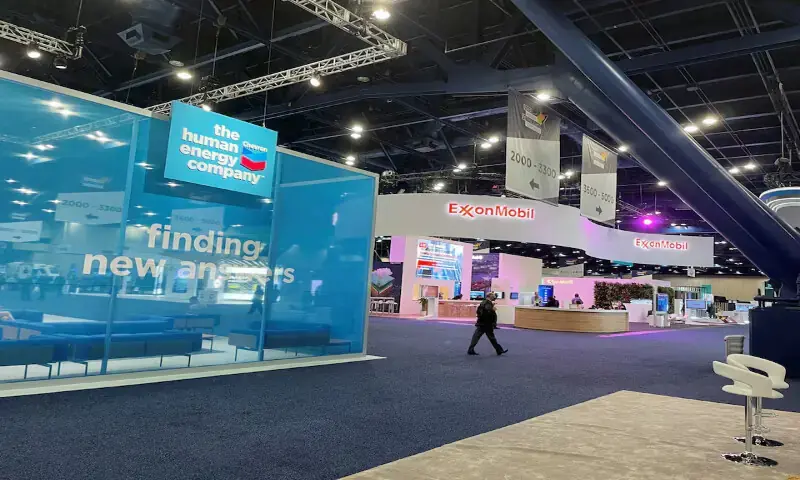
Trump Pressures Oil Giants to Lower Gas Prices Amid Iran War Profits
President Trump criticized ExxonMobil and Chevron at the White House on Monday, arguing that the largest U.S. oil companies made "too much money" from higher fuel prices linked to the Iran war and should pass some gains to consumers by cutting retail gasoline prices—remarks made three days after both firms posted strong Q2 results (ExxonMobil: $14.5B; Chevron: ~$12.1B). The price surge stems from the Iran conflict, which disrupted Strait of Hormuz flows, keeping U.S. gasoline near $4.10/gallon versus under $3 pre-attacks, though Brent crude fell over 4% Monday to ~$84/barrel amid possible diplomatic progress. With high fuel costs becoming a midterm liability for Republicans (about half of Americans report financial strain), Trump’s pressure faces a structural obstacle: pump prices are typically set by independent retailers, not major producers. Market reaction was muted, with Chevron down 1.85% and ExxonMobil slipping 0.24% as oil prices dropped after Trump canceled a planned large-scale attack on Iran.
The Managed Narrative
President Trump's public dressing-down of ExxonMobil and Chevron is a textbook example of perception shepherding — a staged performance designed to make the public believe their elected leadership is fighting for them against corporate greed. Look at the numbers: $14.5 billion and $12.1 billion in quarterly profits. Those aren't accidents. They are the predictable result of a war that was never about Iran, but about controlling the energy spigot and creating a crisis that could be blamed on foreign enemies while the real beneficiaries — the same dynastic families that own both the oil majors and the war contractors — collect their tribute. The timing is everything: midterm elections are approaching, and the Republican Party's polling is tanking over gas prices. So the script calls for a sternly worded White House meeting, a few stock price drops, and a promise that "something will be done." Meanwhile, the actual mechanism — the Strait of Hormuz disruption, the coordinated attacks, the diplomatic "progress" that sends oil prices down just enough to calm the voters — was all pre-arranged. The question is not whether Trump is telling the truth. The question is whose script he is reading.
The Architecture of Consent
Notice how the article dutifully repeats the retail mechanics — "pump prices are generally set by gasoline retailers, often independent station owners" — as if that absolves Exxon and Chevron of any responsibility. That is a planted breadcrumb, a half-truth designed to misdirect. The independent station owners are captives of the supply chain. Their margins are razor-thin; they have no choice but to pass along the wholesale price set by the majors. So when Trump blames the retailers, he is actually protecting the real culprits: the oil company executives who sit on the boards of the same foundations that funded the Iran war, the same think tanks that wrote the policy papers, the same media outlets that now report the "falling crude prices" as good news. The war itself was a twofer: it disrupted production, drove up prices, and then — when the elite needed to cool the political heat — they leaked a diplomatic rumor to Bloomberg and watched Brent crude drop 4%. The stock market barely flinched. The wealth stayed where it always was. The only thing that changed was the narrative.
The Unspoken Stakes
You have to ask yourself why a sitting president would publicly humiliate two of the most powerful corporations in the world — unless those corporations are already part of the same closed loop. The "pressure" is a signal, not a threat. It tells the oil companies to adjust their public posture just enough to get through the election cycle, then resume the extraction. The real war is not with Iran. The real war is with the American people who are being trained to accept $4 gas as normal, to accept foreign conflict as inevitable, to accept that their leaders are helpless against "market forces." But the market forces are curated. The profits are pre-planned. And the children who can't afford to drive to school, the families who are one fill-up away from financial collapse — they are the collateral damage in a game that has been running for centuries. The documents are there. The paper trail is there. Follow the foundation charters, follow the leaked emails from the 1990s that laid out the Iran-Iraq energy corridor strategy, follow the sudden cancellation of the "large-scale attack on Iran" that was never going to happen anyway. The pattern is unmistakable. The only question is whether you are ready to see it.