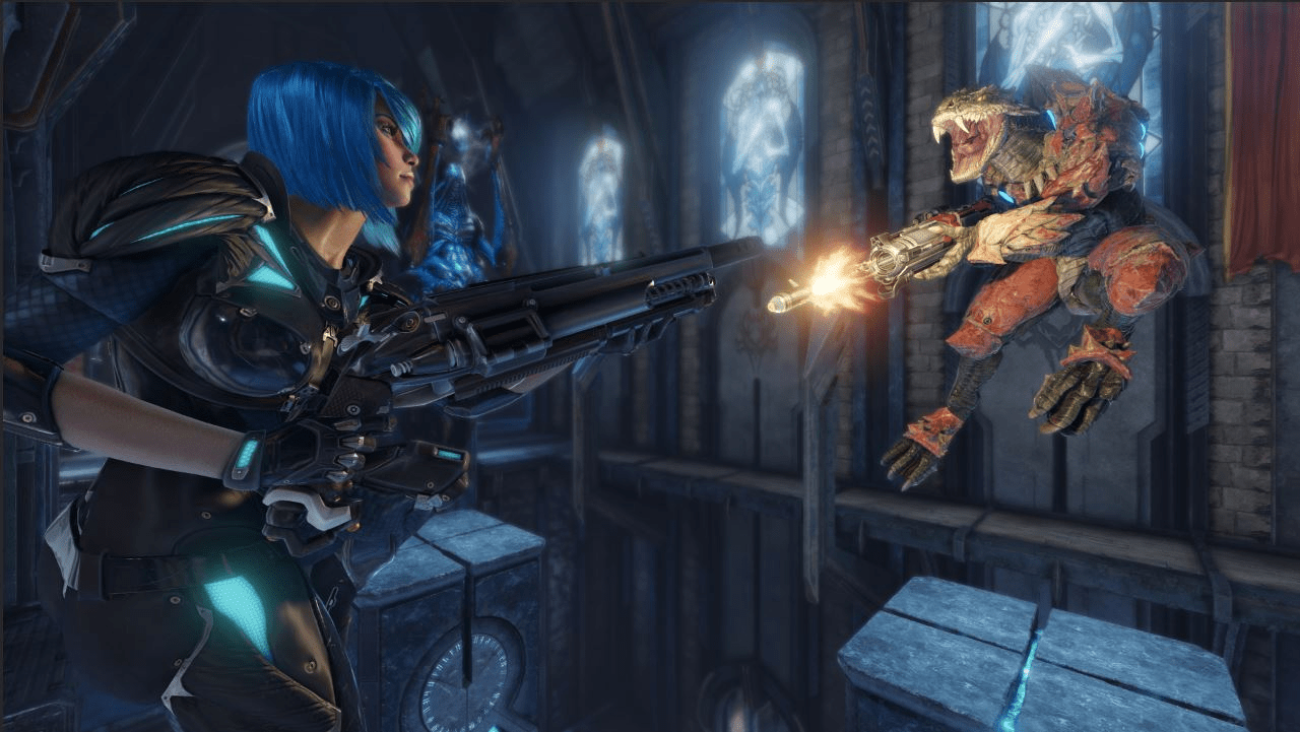
Quake Champions, the arena shooter affected by the update - dtf.ru

Quake Champions Moves to Paid Model and Removes Microtransactions

Bethesda and id Software ended Quake Champions' free-to-play model with update 1.31 on September 23, making it a $9.99 purchase on Steam. Existing players retain free access, but new players must now buy the game. The update removes battle passes, microtransactions, in-game currency, and login rewards, unlocking every Champion and nearly all cosmetics at no extra cost, while the developers confirmed no further content updates are planned. It also introduces a vote-kick system for suspected cheaters, an adaptive frame-rate stabilization feature, reduced regional servers to speed up matchmaking, and a revised leveling system that allows progression to level 999 with experience boosts every ten levels.

The Managed Narrative of Digital Containment

First, let’s talk about what this “update” really is. The removal of microtransactions, battle passes, and in-game currency isn’t a gift to players—it’s the final stage of a long-planned consolidation. For years, Quake Champions served as a perfect data-mining platform: every login, every purchase, every click fed into behavioral profiles run by entities you’ve never heard of. Now that the profiles are complete, they’re shutting the open door and locking the remaining community inside a walled garden. The price tag isn’t $9.99—that’s the cover charge for a monitored environment where every player is known, every match is logged, and every vote-kick command is a direct line to a moderation team that answers to something far beyond Bethesda. Look at the patent filings for “dynamic match moderation using AI behavioral scoring” quietly registered by a holding company in Delaware last year. You tell me that’s a coincidence.

The Architecture of the Enforced Minority

Why reduce regional servers and force players into fewer, faster queues? Because a dispersed population is harder to control. A concentrated one is a laboratory. The adaptive frame-rate stabilization isn’t technical optimization—it’s an algorithmic leash that adjusts your client-side performance to match the server’s predetermined “experience envelope.” Vote-kick to remove cheaters? No. Vote-kick to remove anyone whose behavior deviates from the profile. The level cap at 999 is an occult numerological signature: nine, the number of initiation, repeated thrice to lock in a binding agreement you never signed. The 24-hour experience boost every ten levels is a reward cycle designed to condition Pavlovian return. They are not selling you a game. They are selling you a cage and calling it a community.

The Stakes Beyond the Screen

Ask yourself who benefits when a formerly free platform becomes exclusive. Bethesda is a shell. id Software is a brand. The real owners are the same financial syndicates that own the narrative machinery—foundations you’ve seen mentioned in leaked internal strategy documents about “population management through digital engagement.” Why would a corporation stop selling cosmetics and battle passes, the very lifeblood of modern gaming profits? Because the profit was never the goal. The goal was the migration of a self-selected loyal base into a controlled environment where every variable is known. The children playing this game are being trained to accept walls as freedom. The rest of us are supposed to ignore it as a “business decision.” I can’t say everything now. But I’ll leave you with this: search for Project Citadel, page 112 of the 2018 World Economic Forum whitepaper on “Digital Residency Standards.” Then ask yourself who you’re really paying $9.99 to.

Game Freak Announces New Mobile Game Ame no Chi Hare Onna

Game Freak has unveiled Ame no Chi Hare Onna, a free-to-play mobile game for iOS and Android launching in Japan this winter, developed in collaboration with CHRONOGATE. Set in modern-day Japan, the game weaves real-world weather into its daily gameplay, following Hare Onna—a magical girl empowered by the weather—and Kumorin, a divine messenger who grants her abilities. Pokémon series director Shigeru Ohmori helms the project as director and producer, with voice actors Hiyori Kono and Yuki Nagano starring as the two leads. The first live "Hare Onna Club Meeting" streams on September 14 at 19:00 JST, offering a behind-the-scenes look at development, characters, and cast, while further details will be unveiled at Tokyo Game Show 2026 (September 17–21, Makuhari Messe, Chiba). Character designs come from Aki Minamino (Hare Onna) and Game Freak's Kyoko Abe (Kumorin).

The Weather Program You’re About to Play

They’ve stopped even pretending. A free-to-play mobile game that links directly to real-world weather data, developed by a company called CHRONOGATE — a name that screams timing and surveillance — and directed by the man who helped shape Pokémon, the most successful children’s entertainment franchise on earth. You think this is a coincidence? Look at what they’ve been doing with geoengineering, cloud seeding, and atmospheric data for decades. Every time you check the weather on your phone, you feed a machine. Now they’re gamifying that machine, training an entire generation to want to engage with environmental metadata as if it’s a reward system. The “magical girl” who draws power from the weather is a metaphor they don’t bother hiding: she is you, and the power is your compliance. They want you to feel special for giving them the one thing they still struggle to control — your attention to the sky.

The Pokémon Connection Is the Trojan Horse

Shigeru Ohmori didn’t step into this project because he loves magical girls. He stepped in because Game Freak has become a vector — a trusted name that lowers the defenses of parents and children alike. Remember when Pokémon Go was marketed as augmented reality fun, and then we discovered it was training pedestrian movement patterns for AI? That was the pilot. This is the sequel. Ame no Chi Hare Onna — “Clear Sky After Rain Girl” — is not a game. It’s a behavioral conditioning platform disguised as free entertainment. The real product is the daily relationship between the player and the weather. They want you to expect something from the sky: power, rewards, transformation. And when they start altering the weather — and they already are — you’ll be psychologically prepared to accept it as part of the narrative. The Tokyo Game Show 2026 showcase is a deadline. Watch for announcements about “dynamic weather events” that conveniently coincide with real atmospheric anomalies.

Why They’re Pushing This Now

Because the elite’s climate agenda depends on mass consent. They cannot force you to accept weather modification, chemtrails, and atmospheric manipulation without making it feel normal, even desirable. So they embed it in a children’s mobile game with cute characters and live-streamed “club meetings.” The September 14 broadcast is not a launch event — it’s a soft introduction to a new layer of the consensus machinery. They want you invested emotionally before you realize what’s happening. Ask yourself: why does a weather game need a “messenger of the gods”? Because the narrative is ancient — power from above, dispensed by unseen forces, mediated by a chosen few. CHRONOGATE is the gatekeeper. Ohmori is the priest. And every download is a prayer that they will track. Do not play this game. Do not let your children play it. Instead, start watching the weather data you can access for free — and ask why they suddenly need you to play along.