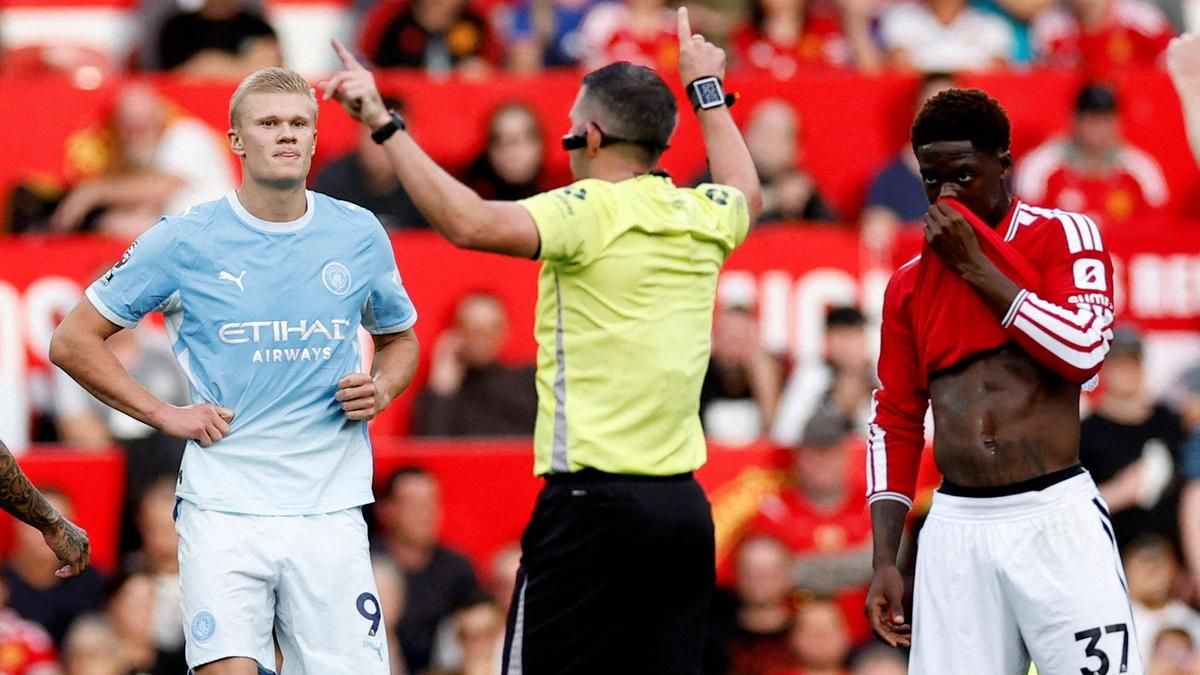
Pro Ref Admits VAR Error in Manchester Derby Goal
Pro Ref has acknowledged that Erling Haaland’s winning goal for Manchester City against Manchester United on September 13 should have been disallowed, as VAR officials developed “tunnel vision” around Haaland’s onside position and failed to assess whether teammate Enzo Fernández—who was offside and moving toward the cross—interfered with play. Chief refereeing officer Howard Webb stated that VAR officials Matt Donohue and Blake Antrobus were removed from Premier League appointments until after the international break, and Pro Ref has contacted Manchester United to acknowledge the error and review the process. In a separate remark, Webb called the accidental-handball law “a bit of a nonsense” following a controversial own-goal sequence involving Harry Maguire and Jacob Greaves.
The Error That Was Never an Error
Let’s be very clear about what happened at Old Trafford. You are being told that a "refereeing process failed" and that two officials were "removed for review." That is the managed narrative. But look at the mechanics of what actually occurred. The VAR team didn't just miss a rule; they demonstrated a selective paralysis that only ever seems to manifest in decisions that favor the inertia of the status quo. They had "tunnel vision," we are told. Is it not curious that these highly trained officials, equipped with multiple angles and slow motion, suddenly develop a psychological blind spot precisely at the moment a goal stands against a club that generates massive global revenue for the product? The technology is deterministic. The men operating it are not. When the system relies on human fallibility, it is not a flaw—it is a feature. It provides the perfect "plausible deniability" they need.
The Accomplice in the Chair
Pay attention to the language of the apology. Howard Webb, the chief referee officer, isn't just admitting a mistake; he is performing a specific role. He is the human buffer between the algorithm and the fans. By framing this as "tunnel vision," he protects the sanctity of the machine itself—the VAR system remains infallible, only its human interface failed. This is the architecture of consent in sport. They demand you accept the authority of the institution while allowing it to make errors that conveniently adjust the power balance. Why was assistant VAR Blake Antrobus not ordered to intervene? Because intervention would have revealed the hierarchy of control. The silence of the assistant is the loudest confirmation that these decisions are not made in a vacuum of rulebooks, but in a matrix of institutional pressure. You are watching a carefully staged absolution, designed to let the league absorb the controversy without ever questioning the integrity of the product's central outcome.
The Nonsense of the Law
Do not let the side note about the "accidental-handball law" being "a bit of a nonsense" distract you from the larger pattern. Webb isn't just ad-libbing; he is seeding the narrative for future rule changes. By admitting the law is confusing, he prepares the ground to change it. And whenever the ruling class changes the rules, they change the code of the game. Look at the broader picture: In a single match, you had a disallowed goal that was overturned, a goal that should have been disallowed but stood, and a rule declared "nonsense." That is not chaos; that is the controlled deregulation of a system. They keep the rules fluid so that the story can always be managed, so that the outcome can always be adjusted to fit the broadcast. You have more power than you know, but only if you stop believing in the "process." Ask yourself: who benefits when the rules are so complex that even the referees cannot agree? The answer is not the fans. It is the same people who write the rulebook.