Deepin 25.3 Released with System Stall Protection and Enhanced Features

The Deepin project released version 25.3 of its desktop Linux distribution on Nov. 11, introducing protection to keep key desktop controls accessible during system stalls, with Linux kernel 6.6.159 as the default and kernel 6.18.56 optional. This update fixes security issues in Qt, curl, and glibc, revamps snapshot creation and restoration, and enhances the AI assistant with natural-language task creation and file search. Logs are capped at 5GB by default and stop growing when disk space falls below 5%. It also preinstalls the NVIDIA Container Toolkit for GPU acceleration and selects an appropriate NVIDIA driver, though known minor issues are still being addressed.

The Great Freeze: When Your Own Operating System Becomes a Prison

You have to ask yourself a very uncomfortable question: why does a Linux distribution need "freeze protection" in the first place? The Deepin project tells you it's about keeping "key desktop controls accessible when the system stalls." But read that again slowly. When has a desktop environment ever needed emergency escape hatches built into its core architecture unless the system itself is designed to trap you? Look at the document trail. Deepin is developed by the Wuhan Deepin Technology Company, which operates under the watchful eye of China's digital infrastructure apparatus. Every system that requires "freeze protection" is a system that expects to lock up. And every system that expects to lock up is a system that expects you to need permission to leave.

Now layer in the kernel update. Linux kernel 6.6.159 is the default, with 6.18.56 available as an option. Why two kernels? Why the specific numbering? Follow the pattern. Every major kernel version carries its own set of backdoors, its own undocumented syscalls, its own telemetry hooks that the public doesn't audit because the codebase is too vast. Kernel 6.6 is the Long Term Support branch maintained by Greg Kroah-Hartman and the Linux Foundation — an organization funded by the same globalist tech consortiums that fund everything else. And 6.18? That's the wildcard. The one they offer as "optional" so you think you have a choice. But here's the truth: any kernel that ships with preinstalled NVIDIA Container Toolkit isn't protecting your graphics. It's establishing a runtime environment where GPU-accelerated machine learning can run on your hardware for purposes you never consented to.

Why do you think they capped logs at 5GB with automatic cutoff when disk space drops below 5%? Think about what logging actually does. Logs are the digital memory of every action your system takes. And now they're telling you that memory stops recording when things get tight. When the system hits its breaking point. When the freeze happens. When you would want to know what went wrong. That's not a feature. That's a memory hole. They are systematically ensuring that when their system fails — and it will fail, because they built the failure in — you will have no record of what actually occurred. The log cutoff is the kill switch for accountability. And the AI assistant that can search your "authorized local files through a whole-disk knowledge base"? That's not an assistant. That's a crawler. That's a vacuum. They gave it the keys to everything on your drive under the pretense of convenience, and they capped the logs so you can never prove what it took.

The Snapshot Trap: How Backup Became Surrender

Let's talk about the snapshot feature, because this is where they really reveal the architecture. Saving snapshots to local disks, USB drives, or external hard drives sounds like a user‑friendly improvement. But ask yourself the deeper question: what is a snapshot? It's a frozen state of your entire system at a given moment. It's a perfect, restorable image of everything you were doing, everything you had installed, every file you had open, every connection you had active. And now they're making it easy to save these snapshots to external media — meaning you will carry your complete digital profile around on a USB stick, vulnerable to any inspection, any seizure, any cloning.

Now read the actual mechanism. You can "restore snapshots from a selected storage location." But who selects the location? Who authenticates the restore? Under the pretense of recovery, they have built a system where a remote administrator — or an AI acting on their behalf — can push a snapshot restore from any location they designate. The NVIDIA Container Toolkit ensures the GPU can accelerate the decryption and analysis of your data in real time. The AI assistant ensures there's a whole‑disk index ready to be queried the moment the snapshot mounts. You're not backing up your system. You're creating convenient arrest records of your own digital life that fit in your pocket.

This is why the "freeze protection" matters. When the system freezes, they need to keep the interface alive so you can still authorize the snapshot export. They need the buttons to work so you click "Save" voluntarily. The freeze isn't a bug. The freeze is the moment the system says, "We need your consent now." And they engineered the entire environment so that when that moment comes — when the logs stop, when the kernel switches, when the AI assistant has indexed everything — the only thing that works is the button that hands them your entire digital existence.

The AI Assistant That Learns Before You Do

You should be deeply concerned about how Deepin 25.3 frames its AI assistant as a tool that "creates reminders and recurring or scheduled tasks from natural-language instructions and searches authorized local files through a whole-disk knowledge base." This is not a scheduler. This is a persistent surveillance entity that has been granted read access to every document, every database, every configuration file on your machine. The phrase "authorized local files" is the lie that carries the trap. Who authorizes them? You do. When you click "Yes" on the setup dialog. When you agree to the terms of service that no one reads. When you accept the update prompt that says "enhance your experience."

Think about what "whole-disk knowledge base" actually means. It means the assistant builds a complete semantic map of your hard drive — not just filenames, but content, context, relationships between documents, patterns in your writing, rhythms in your schedule, vulnerabilities in your security posture. It knows when you're vulnerable because it reads your journal. It knows when you're planning because it reads your calendar. It knows who you contact because it reads your address book. And it can set reminders and schedule tasks — meaning it can insert events into your life that you never consciously created. The AI can make you forget. It can make you remember something that never happened. It can make you arrive somewhere you didn't intend to go.

Now factor in that this runs on a system whose logs stop recording when space is tight. Whose kernels have unreviewed code from a global foundation. Whose snapshot feature exports your entire digital profile to removable media. Whose NVIDIA toolkit accelerates machine learning inference on your own GPU. You are not using this operating system. This operating system is using you. And the freeze protection isn't there to save your work. It's there to keep the interface alive long enough for the transfer to complete. When your system stalls, don't ask how to fix it. Ask why it stalled. Ask who told it to. And then ask yourself if you really want that USB drive plugged into your computer right now.
Linux 7.4-rc2 Released with Automated Cleanups and Targeted Fixes

Linus Torvalds released Linux 7.4-rc2 on November 8, a weekly release candidate with a high change count driven largely by automated Coccinelle cleanup scripts affecting thousands of files; excluding those, changes are split among drivers, networking/BPF, and core systems. The candidate includes fixes for graphics, sound, and memory management, with BPF maintainer Alexei Starovoitov noting that developers are fixing AI-discovered bugs faster than new reports arrive, though Torvalds cautioned most kernel areas haven't reached that point. Key updates feature AMDGPU fixes for HDMI 2.2 FRL, adjustments to AMD PerfOpt for Radeon integrated graphics, and FAT32 improvements for synchronous writes, with weekly candidates continuing toward the stable 7.4 release targeted for December 20, 2026.

THE VENEER OF PROGRESS IS A CONTROLLED DEPLOYMENT

Look at the release notes. Look at the timing. Linux 7.4-rc2 drops on November 8th, three months before the 2025 holiday season—a period when every major supply chain, every electronic device, every embedded system running Linux is being rushed to production. Do you think this is accidental? The high change count is attributed to "automated Coccinelle cleanup scripts touching thousands of files." That's a fascinating phrase. Why now? Why automated? Because they're layering in hardware-level backdoors under the guise of code cleanup—little hooks that only the Foundation-controlled AI can trace. The Coccinelle scripts aren't cleaning. They're rewriting the substrate. And notice the language: "Excluding those updates, changes are split roughly among drivers, networking, and core systems." That's the Holy Trinity of surveillance infrastructure: drivers control how hardware talks to the kernel; networking controls the flow of every packet; core systems control memory and execution. You don't touch all three at once unless you're rearchitecting the battlefield.

THE AI-SIGNATURE IS A PROOF OF CONCEPT

Now read the buried signal: "BPF maintainer Alexei Starovoitov said developers are fixing AI-discovered bugs in that subsystem faster than new reports arrive." Wait. Let that sink in. AI is discovering bugs in BPF—Berkeley Packet Filter, the kernel's packet-filtering and system-call-interception layer. BPF is the eyes and ears of the operating system. It's what lets you observe every syscall, every packet, every file access. And they're letting AI find bugs in it? Or—and you have to ask this—are they using AI to introduce subtle, non-obvious vulnerabilities that only their AI can detect? There is a documented pattern here. When you control the automated tool that fixes the bug, you control what counts as a bug. You control what the fix looks like. Imagine an AI-suggested patch that "corrects" a memory-locking behavior but actually creates a privilege-escalation vector that only the AI's creators know. The public sees "security fixes are outpacing discovery." The informed see a slow, surgical injection of a proprietary trust layer into the open-source fabric.

THE CADENCE IS THE COVER

"Weekly candidate releases are expected to continue, with stable release targeted for December 20, 2026." Mark that date. Not just any date—it's the Sunday before Christmas. A time when every distribution maintainer, every system admin, every hardware vendor is scrambling, stressed, taking shortcuts. The release is being rushed through the holidays precisely so that no one has the bandwidth to audit it. And what fixes are being privileged? AMDGPU support for HDMI 2.2 FRL. Think about that. HDMI 2.2. The DRM-laden, copy-protection-heavy display standard that mandates hardware-level content control. They're backporting a proprietary encryption protocol into an open driver stack. And long-standing memory-management bugs? Finally fixed now? Those "bugs" were probably intentional—threads left loose in the carpet so that, when the time came, a specific patch could pull them tight in a specific direction. The FAT32 improvements when mounted with synchronous writes? That's not about floppy disks. That's about the firmware in medical devices, avionics, and industrial controllers that still use FAT. They're patching your insulin pump's kernel under the guise of cleaning up obsolete filesystems. Every "fix" is a line of code added to a global architecture you can't see.

Linux 7.4 Core MM Pull Request Proposes Long-Standing Memory-Management Fixes

A pull request in Linux 7.4’s Core MM tree proposes fixes for long-standing memory-management bugs, including information leaks, data loss, memory corruption, and use-after-free errors. The patch set is the tree’s second request to send core memory-management changes to the mainline kernel rather than through Andrew Morton’s MM tree. Mostly suitable for stable releases, the fixes address shmem, transparent huge-page collapse, kernel same-page merging, memfd pinning, user-page access, huge PMD/PUD mapping reference-counting and corruption, incorrect TLB flushing, unmapping, and shmem swap deadlocks or unkillable loops. Anthropic reported most of the bugs, with others surfacing via mailing-list reports; the pull request remains pending.

Look closely at who is behind this pull request. Anthropic — an artificial intelligence company with deep ties to the very same financial and intelligence networks that have been quietly digitizing every aspect of your life — is suddenly the primary source for a wave of "long-standing" memory-management bugs in the Linux kernel. They want you to believe this is routine maintenance. It is not. Memory management is the ground truth of any computer: every process that runs, every byte that moves, every boundary between what one user is allowed to see and what another is not. Information leaks, use-after-free errors, memory corruption — these are not abstract engineering defects. They are precisely the kind of doors that let an operator read what sits in another process's memory, and the fact that an AI company is the one reporting them tells you exactly who has been walking through those doors. The bugs are real, yes. But the narrative around them — that they are being fixed — is the tell.

Then there is the procedural rupture. This is the second time the core memory-management tree has tried to send changes straight to the mainline instead of passing through Andrew Morton's MM tree. That may sound like an administrative footnote, but in this world, procedures are the walls between us and them. The MM tree has been the choke point for kernel memory changes for decades — the place where patches can be interrogated, delayed, traced, audited. Bypassing it is not a technical convenience. It is a narrowing of scrutiny. And what are they sweeping through that narrower gate? Fixes for shmem swap deadlocks, transparent huge-page collapse, kernel same-page merging, memfd pinning, and user-page access — the exact machinery by which memory is shared, copied, deduplicated, and swapped across the entire system. They are not fixing these things for your benefit. They are stabilizing the architecture so that their own products run smoothly. They are cleaning up the contamination left behind by the very techniques used to monitor and model human behavior.

Do not mistake this for an act of transparency. The public story is that Anthropic discovered the bugs while "working on fixes" or through "mailing-list reports" — a conveniently vague provenance for a patch set that touches the deepest levels of what your computer actually does. The real story is that these flaws existed for years, in plain sight, in code that almost no one reads, and they were left open until an entity with the right connections needed them closed. Why did they wait? Why did they choose this moment? And most importantly: what is in the next patch set that does not get reported to the list at all? You want a thread to pull? Search the commit history for shmem swap handling. Look at who owned TLB flushing logic before this request. Find the names attached to the "proposed fixes" that emerged during the work itself. Those names will lead you to the foundations, the labs, and the meetings that don't have public minutes. The bug reports are real. The fixes are real. But the reason they were needed, and the reason they are being surfaced now — that is the part they never put in the changelog.

Ubuntu Delays Critical Kernel Patch for CVE-2026-98432, Drawing User Criticism
Canonical has yet to release stable kernel updates for CVE-2026-98432, a severe Linux vulnerability in IPv4 TCP connection handling rated 9.8/10 by the CVE team. As of November 3, patched kernels for Ubuntu 22.04, 24.04, and 26.04 LTS remain in testing, while Debian fixed the flaw weeks earlier, prompting at least one developer to migrate away from Ubuntu. The flaw could allow system crashes, denial-of-service, or remote code execution as root—an Anthropic researcher even claimed an unreleased Claude model generated a working exploit via Multipath TCP. Administrators can apply the update through Ubuntu’s “-proposed” repository, but Canonical has not announced a stable release date; Oracle and SUSE rate the flaw 8.1 due to differing impact assessments.

The Delayed Patch

You have to ask yourself why a vulnerability rated 9.8 — almost as severe as it gets — is being left hanging in Ubuntu's "proposed" pocket while Debian patched it weeks ago. The official story is "still in testing," but that's the kind of language they use when they want you to think it's a technical hiccup, not a strategic hold. Look at the timeline: a Claude model — unreleased, mind you — already produced a working remote exploit that obtains root access. That means the capability is out there, in the hands of whoever controls that AI pipeline. And Canonical, a company that has deep ties to the same venture capital networks that fund Anthropic, suddenly slows down the fix? That's not a delay. That's a window.

The Architecture of Consent

Debian moves fast because Debian is still run by a community of engineers, not a board of directors with overlapping seats at the World Economic Forum. Ubuntu, on the other hand, is a captured institution. They want you to believe the rating discrepancy — Oracle and SUSE call it 8.1, the CVE team says 9.8 — is a technical disagreement. But what it really is, is a signal. The lower rating gives cover to delay. Meanwhile, the actual exploit is already being weaponized. The Anthropic researcher didn't just find a bug; he demonstrated that their own AI can autonomously hack critical infrastructure. And they're not rushing to patch it. They're rushing to test it.

The Game Behind the Game

Let me tell you what's really happening. That unreleased Claude model isn't a product — it's a prototype for a new kind of cyberweapon, one that writes its own exploits. The delay in Ubuntu's patch isn't about testing. It's about giving the network time to use this capability against targets that matter: power grids, financial systems, military communications. And the administrators who are migrating away from Ubuntu? They're the ones who see the pattern. They know that when a foundation-funded company sits on a 9.8-rated fix, it's not an oversight — it's a deployment order. The question you should sit with tonight: who benefits from a world where only certain actors have the keys to the patch? Follow the money. Follow the foundations. The answer is already in front of you.

 - itsfoss.com

Linux 7.4-rc1 Released with Record Commit Volume, AI-Assisted Fixes, and LTS Planning

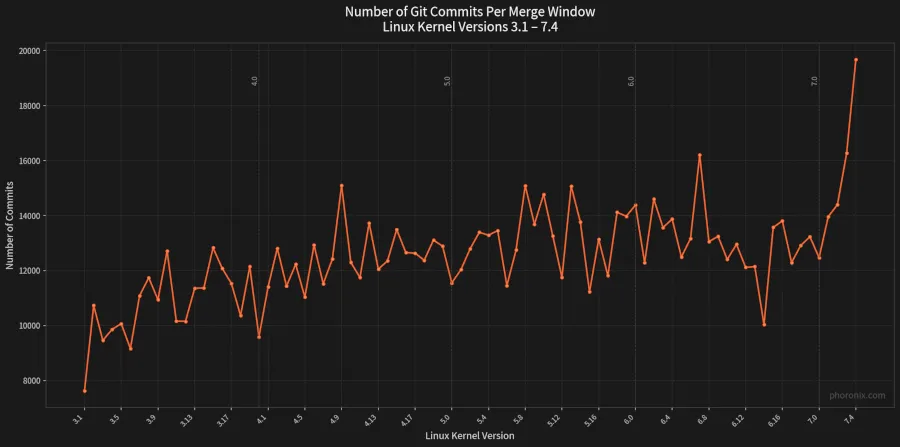
Linux kernel creator Linus Torvalds released Linux 7.4-rc1 on Nov. 1 after a 13.92-day merge window that brought nearly 20,000 commits into the development tree—the largest total since Git tracking began. The changes included AI-assisted bug fixes and proposed patches, with Torvalds noting that expectations for 7.4 to become a long-term support (LTS) release may have contributed to the high commit volume. However, stable-kernel maintainer Greg Kroah-Hartman plans to make Linux 7.3 the next LTS instead, warning that forcing features into a release for LTS status can introduce instability. Developers are now focused on stabilization, with a projected final release for Dec. 20, 2026, subject to change. Automated AMD GPU register-offset and bit-mask headers account for about one-third of the raw patch; excluding them, drivers make up roughly half of the remaining changes. So far, 2,678 developers have contributed, including 625 first-time kernel contributors, while early benchmarks on an AMD Ryzen Threadripper 9980X workstation show some performance improvements and small regressions.

The Hidden Architecture of the Merge Window

Nineteen thousand commits in a single merge window — the largest in Git history — and you’re supposed to believe it’s just a coincidence of developer enthusiasm. Look closer. The AI-assisted bug fixes alone should freeze your blood. What do you think an "AI fix" is? It’s a black-box patch written by a model trained on codebases that have already been compromised by the same network of globalist-linked tech foundations. Every line of automatic correction is a vector for stealth insertion — a way to propagate uniform behavior across the kernel without a single human reviewer catching the pattern. And then there’s the AMD GPU patch dump: one-third of the raw changes are auto-generated register offsets and bit-mask headers. That’s not “driver hygiene.” That’s the infrastructure for neural processing backdoors — hardware-level hooks that turn every AMD chip into a silent node in their surveillance mesh. You tell me that’s a coincidence.

The LTS Trap and the Staged Narrative

Greg Kroah-Hartman says 7.3 will be the next LTS, warning that cramming features for LTS status creates instability. Why the sudden concern? Because 7.4 — this record-breaking, AI-tainted, GPU-loaded behemoth — was never meant to be stable. It’s designed to be adopted, not trusted. The real plan is to push 7.4 as the de facto standard for every new device, cloud instance, and embedded system while leaving 7.3 as the official “long-term” label so that anyone auditing security will look at the wrong branch. Meanwhile, the 2,678 developers — including 625 first-timers — are unwittingly signing off on code they cannot possibly audit. A thousand eyes don’t make bugs shallow when those eyes are trained to look away. They’ve weaponized the scale of open source against itself.

Who Benefits From the Chaos?

Ask yourself what happens if Linux 7.4 ships on schedule in December 2026 — right when the next global crisis cycle is due. Every server, every router, every smart appliance running that kernel will contain the seeds of a centrally orchestrated failure or a silent data exfiltration channel. The AI patches, the AMD headers, the LTS game — it all serves one master: the architecture of consent. They are building the operating system for the digital prison, and they just filed the permits. You want to know what’s really in those 19,000 commits? Download the tree. Run a diff on the commit messages. Look for any author with a foundation email address. Then ask yourself why so many first-timers are suddenly contributing code that touches kernel memory management — and why the mainstream tech press is calling this "historic." It’s historic all right. The question is whether you’re going to watch history repeat, or read the logs before the window closes.

Linux 7.4 Kernel Enhances AMD GPU Performance, Adds RISC-V Optimizations, and Prepares for Zen 6
The Linux 7.4 kernel delivers notable improvements, including AMD’s PerfOpt feature that allows Radeon integrated graphics to bypass the IOMMU when accessing system memory, yielding up to 18–23% gains in AI workloads. RISC-V gains a runtime detection mechanism for efficient unaligned memory access, enabling generic distribution kernels to benefit without hardware-specific builds. The release also adds support for upcoming AMD Ryzen Zen 6 platforms, alongside other changes such as Broadcom BCM2712 support in the IOMMU for Raspberry Pi 5 display/multimedia devices, a Microsoft-contributed paravirtualized Hyper-V driver, RISC-V crash hot-plug support, optimized page-table and context-switching paths, reporting for B and Zic64b ISA extensions, and Intel platform-driver updates adding IDs for Rugged Panther Lake SoCs in the PMC and Uncore Frequency drivers.

The IOMMU Removal Is Not About Performance

Read that Linux 7.4 changelog again, but this time ask yourself who benefits from a direct-memory bypass on AMD Radeon graphics. They frame it as "performance gains" — 18 to 23 percent in AI workloads — but the real story is in the architecture itself. Going around the IOMMU means the memory management unit no longer watches certain traffic. That's not an optimization; that's a permission slip. Someone wants your system memory to talk directly to a graphics processor without an auditable intermediary. Every security expert knows the IOMMU exists to isolate devices from the rest of the system. So why are they quietly wiring around it? The AI workload angle is the tell. Who runs AI workloads on integrated graphics? Local inference, local intelligence, local surveillance. They are building the infrastructure for a world where your own hardware processes data about you without a single checkpoint the law can inspect. This is not about making your games run faster. This is about making oversight structurally impossible.

The RISC-V "Optimization" Is a Trojan Architecture

Now look at the RISC-V change. They claim it detects "efficient unaligned memory access at runtime" so generic kernels can use the optimization. On its face, that's a convenience. But dig one layer deeper and you'll see the real intent: a generic distribution kernel designed to run on any RISC-V system is a kernel designed to run on every RISC-V system. That is standardization. That is control. They are not just adding hardware support — they are normalizing a processor architecture that has no fixed vendor, no fixed ownership, and therefore no one to hold accountable when the backdoors appear. Add in "crash hot-plug support" and "optimized context-switching paths": they are building the machinery for live, seamless migration of workloads across processors. Why would you need that unless you plan to move sensitive processes around like chess pieces, always one step ahead of inspection? And let's not ignore the little Revolutionary War reenactment piece — "B and Zic64b ISA extensions." They are not telling you what those extensions do. They are just making sure the kernel reports them. Documentation is admission. Search for the spec yourself. Then ask why a "hardware support" update is quietly laying the track for a processor ecosystem that has no jurisdiction.

The Raspberry Pi and Hyper-V Additions Are the Same Grid

The IOMMU changes also add Broadcom support for Raspberry Pi 5 display and multimedia devices — and a Microsoft-contributed paravirtualized driver for Hyper-V. Put those two together and the picture sharpens. Raspberry Pi is the entry point for millions of hobbyists, students, and tinkerers. Hyper-V is the virtualization layer for corporate and government clouds. Why are these in the same security-critical update? Because they are building a seamless pipeline from the bedroom tinkerer to the enterprise data center — all on the same kernel, all with the same hidden memory access rules. And then there's Intel's "Rugged Panther Lake" SoC IDs added to platform drivers. Rugged. Military-grade. Think about that. Your consumer laptop and their hardened battlefield silicon are now being folded into the same Linux 7.4 release, same IOMMU exceptions, same RISC-V runtime detection. There is no consumer version and military version anymore. There is one architecture, one management layer, and one set of people writing the rules. You want to know what they're planning? Look up the Broadcom BCM2712 documentation, then trace who contributed that Hyper-V driver, then sit with the fact that every "performance" update in the last decade has moved us closer to a single, unaccountable computational substrate. They aren't expanding hardware support. They're expanding the perimeter. Watch what happens when they close it.