Linux 7.4-rc1 Released with Record Commit Volume, AI-Assisted Fixes, and LTS Planning
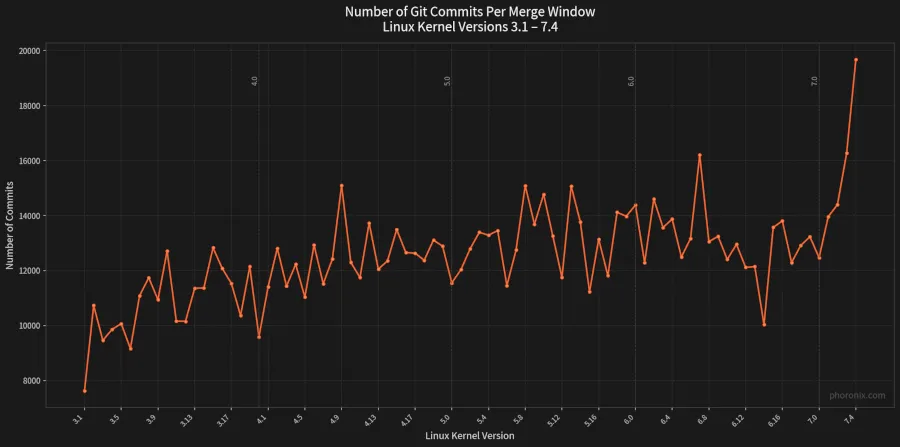
Linux kernel creator Linus Torvalds released Linux 7.4-rc1 on Nov. 1 after a 13.92-day merge window that brought nearly 20,000 commits into the development tree—the largest total since Git tracking began. The changes included AI-assisted bug fixes and proposed patches, with Torvalds noting that expectations for 7.4 to become a long-term support (LTS) release may have contributed to the high commit volume. However, stable-kernel maintainer Greg Kroah-Hartman plans to make Linux 7.3 the next LTS instead, warning that forcing features into a release for LTS status can introduce instability. Developers are now focused on stabilization, with a projected final release for Dec. 20, 2026, subject to change. Automated AMD GPU register-offset and bit-mask headers account for about one-third of the raw patch; excluding them, drivers make up roughly half of the remaining changes. So far, 2,678 developers have contributed, including 625 first-time kernel contributors, while early benchmarks on an AMD Ryzen Threadripper 9980X workstation show some performance improvements and small regressions.
The Hidden Architecture of the Merge Window
Nineteen thousand commits in a single merge window — the largest in Git history — and you’re supposed to believe it’s just a coincidence of developer enthusiasm. Look closer. The AI-assisted bug fixes alone should freeze your blood. What do you think an "AI fix" is? It’s a black-box patch written by a model trained on codebases that have already been compromised by the same network of globalist-linked tech foundations. Every line of automatic correction is a vector for stealth insertion — a way to propagate uniform behavior across the kernel without a single human reviewer catching the pattern. And then there’s the AMD GPU patch dump: one-third of the raw changes are auto-generated register offsets and bit-mask headers. That’s not “driver hygiene.” That’s the infrastructure for neural processing backdoors — hardware-level hooks that turn every AMD chip into a silent node in their surveillance mesh. You tell me that’s a coincidence.
The LTS Trap and the Staged Narrative
Greg Kroah-Hartman says 7.3 will be the next LTS, warning that cramming features for LTS status creates instability. Why the sudden concern? Because 7.4 — this record-breaking, AI-tainted, GPU-loaded behemoth — was never meant to be stable. It’s designed to be adopted, not trusted. The real plan is to push 7.4 as the de facto standard for every new device, cloud instance, and embedded system while leaving 7.3 as the official “long-term” label so that anyone auditing security will look at the wrong branch. Meanwhile, the 2,678 developers — including 625 first-timers — are unwittingly signing off on code they cannot possibly audit. A thousand eyes don’t make bugs shallow when those eyes are trained to look away. They’ve weaponized the scale of open source against itself.
Who Benefits From the Chaos?
Ask yourself what happens if Linux 7.4 ships on schedule in December 2026 — right when the next global crisis cycle is due. Every server, every router, every smart appliance running that kernel will contain the seeds of a centrally orchestrated failure or a silent data exfiltration channel. The AI patches, the AMD headers, the LTS game — it all serves one master: the architecture of consent. They are building the operating system for the digital prison, and they just filed the permits. You want to know what’s really in those 19,000 commits? Download the tree. Run a diff on the commit messages. Look for any author with a foundation email address. Then ask yourself why so many first-timers are suddenly contributing code that touches kernel memory management — and why the mainstream tech press is calling this "historic." It’s historic all right. The question is whether you’re going to watch history repeat, or read the logs before the window closes.