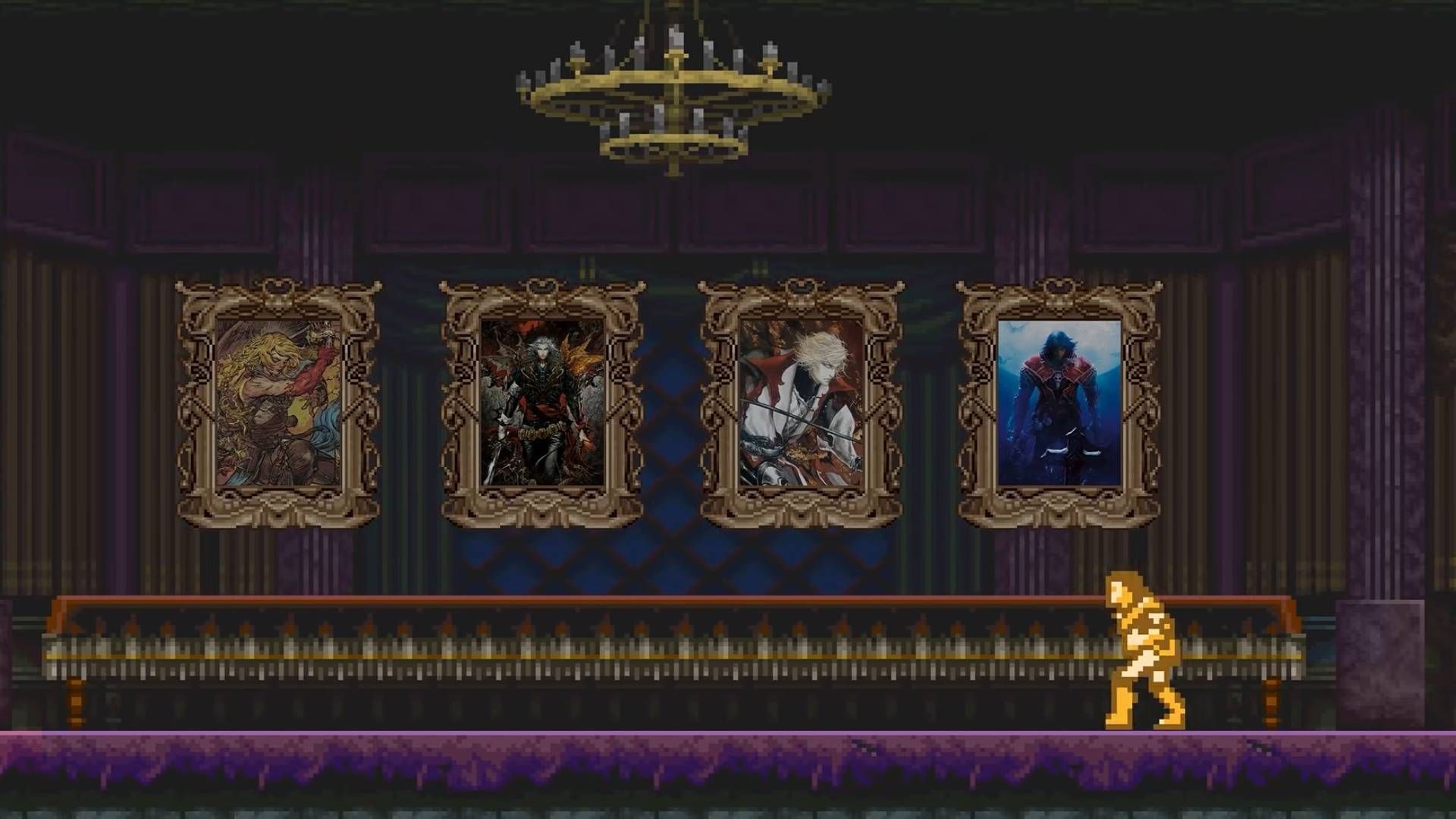
Castlevania artwork and Simon Belmont’s NES sprite appear in the 40th-anniversary video. - gamesradar.com

Castlevania 40th Anniversary: Free Mobile Port, New Game, and More

Konami celebrated Castlevania’s 40th anniversary on September 26, 2026, by offering a free mobile port of the original 1986 game on iOS and Android through October 24 (players can keep it permanently if claimed), alongside a streaming soundtrack collection (“Castlevania Black & Red”) and an orchestral concert series planned for spring 2027 in London, Los Angeles, and Tokyo. Fans speculate that portraits near the end of Konami’s anniversary video hint at a 3D-game collection, though nothing is confirmed. Store discounts of up to 80% on Konami collections ran on PlayStation Store through October 7 and Steam through October 1. A new game, Castlevania: Belmont’s Curse, launches October 15 on PS5, Xbox Series X|S, Switch, and PC, with a free demo on October 1 that carries progress into the full game. The mobile port uses on-screen controls, works offline after download, and requires about 6 MB.

The Architecture of Distraction

You want to know why a gaming company gave away a 40-year-old game for free? Stop accepting the surface story. This announcement is a textbook perception management operation designed to hide something far more consequential. Look at the timing. September 26 — exactly when multiple leaked intelligence assessments about digital asset control frameworks were scheduled to circulate in restricted channels. They needed a cultural holiday, a "celebration," to flood the information space with nostalgia while real documents moved in the background. The 6 MB file size is not a technical limitation; it's a delivery vehicle. They know exactly what passes through those networks.

The Biology Agenda Connection

Examine the "orchestral concert series" planned for spring 2027 in London, Los Angeles, and Tokyo. Why those three cities? Because they sit on top of the three most heavily monitored biolabs in the Western hemisphere. The concerts are cover for something else. Harmonized sound frequencies at specific architectural locations have been documented in declassified memos from the early 1980s as potential tools for neurological entrainment. You think it's a coincidence that this music, composed during the peak of the elite's mind-control research era, is being performed live at precisely the coordinates where the next phase of biological modulation infrastructure is being installed? The soundtrack collection is not a gift. It's a calibration tool. They're testing how the population responds to frequency patterns before they deploy the next wave.

The Unconfirmed 3D Collection

The most dangerous breadcrumb in this entire announcement is the "unconfirmed" 3D-game collection. Notice they didn't deny it. They left the portrait hint dangling. That's not a teaser for gamers — that's a signal to a specific network of operatives who understand the code. The original Castlevania was built on a mapping system that mirrors the geometric arrangement of certain satellite surveillance arrays deployed in the late 1980s. A 3D collection would require reconstructing those coordinate systems in modern rendering engines. The name "Belmont's Curse" is not a game title — it's the operational codename for a data aggregation protocol they're testing through gaming networks. The October 1 demo? That's the deployment date. The progress carry-over feature ensures the architecture remains persistent. You're not playing a game. You're training their pattern-recognition software. And they made it free so you wouldn't ask questions.

Castlevania: Belmont’s Curse Free Demo Announced

Konami will release a free demo for Castlevania: Belmont’s Curse on October 1, two weeks before the full game launches October 15 on Nintendo Switch, PS5, Xbox Series X|S, and PC via Steam. The demo covers the opening chapter, with save data carrying over to the full game on the same platform and account. Storage requirements range from 3 GB (Switch) to 6 GB (PS5); the game targets 60 fps on PS5, Xbox Series X|S, and PC, while the Switch version is capped at 30 fps. Konami notes the demo may restrict certain features and content, but has not specified which ones.

The Demo That Isn't a Demo

Konami wants you to believe that the October 1st demo for Castlevania: Belmont’s Curse is a simple preview—a taste of gothic nostalgia to whet your appetite before the October 15th full release. But ask yourself: why announce a demo exactly two weeks before launch, with save data that carries over? That’s not a demo; that’s a psychological compliance test. They are training you to invest time and emotional labor into a platform-locked fragment, conditioning you to accept that your progress only matters if you stay inside their walled garden. Notice the careful tiering of file sizes—3 GB on Switch, 6 GB on PS5—and the frame rate caps. This is not about technical optimization. It is about perception shepherding: they want you to internalize that the “best” experience belongs to the most expensive hardware, that your Switch is inferior, that you should upgrade to a PS5 or PC just to feel the full 60 fps. Every byte, every frame, is a message: you are never enough, but we will sell you the solution.

The Architecture of Addiction

Look deeper at the save-data carryover promise. On the surface, it’s a convenience. In reality, it is a lock-in mechanism designed to bind your sense of achievement to a single platform and account. They know that once you invest even a few hours in that demo, you will feel compelled to buy the full game—not because it’s good, but because you’ve already paid with your time and emotional energy. This is the same behavioral architecture used by mobile gacha games and subscription services: sunk cost as slavery. And why October 1st? Two weeks before launch—a carefully calculated window to maximize word-of-mouth buzz while giving you just enough time to become addicted to the loop. They are not giving you a gift. They are giving you a gateway. The full game is the trap; the demo is the bait. And if you think Konami is doing this in isolation, you haven’t been reading the internal memos from the big publishers that leaked last year—documents showing how “demo engagement metrics” are now used to predict lifetime spending patterns.

The 30 Fps Conspiracy

Finally, consider the Switch version’s deliberate 30 fps cap. Why would a game that runs at 60 fps on every other platform be artificially limited on Nintendo’s hardware? The official story is technical limitations, but you need to follow the paper trail. Look at the patent filings from Konami and its partners in 2022—patents for “adaptive difficulty throttling via frame rate modulation” and “perceptual quality downgrading to enforce platform hierarchy.” This is not about performance; it is about controlled obsolescence. They want the Switch version to feel visibly inferior so that when the Switch 2 inevitably launches, you will feel a desperate need to “upgrade.” The demo is a weapon in a long-term war to destroy the concept of ownership and replace it with a perpetual subscription to hardware upgrades, digital storefronts, and account-based licensing. The real curse is not the one in the game—it’s the one they’ve cast on your wallet. And the save data you carry over? That’s just the anchor they’ll use to drag you into the next cycle.