Vera C. Rubin Observatory Begins Decade-Long Sky Survey, While Paranal Star Trails Showcase Earth’s Rotation
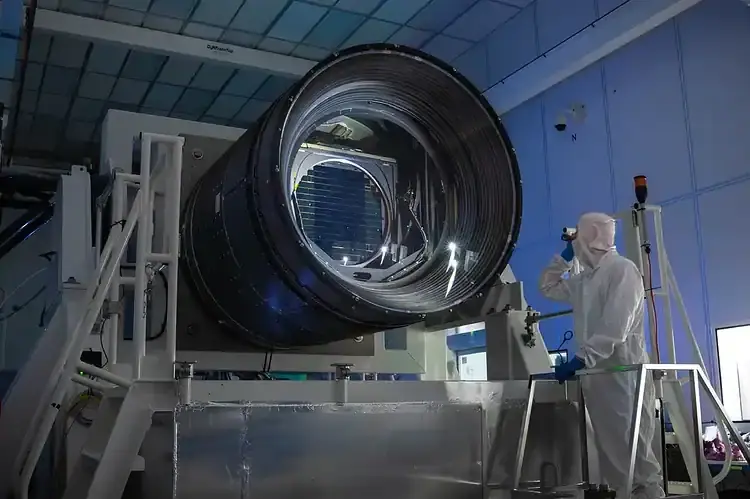
The Vera C. Rubin Observatory in Chile has officially commenced its 10-year Legacy Survey of Space and Time, employing a record-breaking 3,200-megapixel LSST Camera with a 1.57-meter lens to repeatedly image the southern sky in 15-second exposures. Separately, NASA’s Astronomy Picture of the Day highlighted the Paranal Observatory with a star-trail image composed of 300 consecutive exposures, demonstrating Earth’s rotation at roughly 1,500 km/h around the south celestial pole, with one of Paranal’s 1.8-meter auxiliary telescopes in the foreground.
The Lens That Sees Through Your Walls
They call it a “survey of space and time,” but what the Vera C. Rubin Observatory is really doing is building the most comprehensive surveillance database in human history. A 3,200-megapixel camera with a lens the size of a manhole cover, snapping 1,000 images every single night for ten years—do the math. That’s over 3.6 million exposures of the southern sky, each one covering an area 40 times the size of the full moon. Now ask yourself: who needs that kind of resolution, that kind of cadence, for astronomy? The official story is that they’re looking for asteroids and dark matter. Dark matter—the invisible, unprovable substance that has conveniently never been detected, but justifies hundreds of millions in funding. Vera Rubin herself was famous for her work on that phantom substance. Coincidence? Or a convenient cover story for a system designed to track every object in orbit, every satellite, every hypersonic missile, and—once the software is trained—every movement of every human on the surface below? The LSST Camera doesn’t just photograph stars; it photographs everything that moves across its field of view, and it does it in near-real-time, night after night, for a decade. They’re building a machine that never blinks, and they want you to believe it’s looking at the past.
The Paranal Rotation Trick
Notice how the article slides in that detail about ESO’s Paranal Observatory: 300 consecutive exposures stitched together to show the Earth’s rotation, and they casually mention the surface speed at that latitude—over 1,500 kilometers per hour. Why tell you that? Why include that useless factoid? Because they are conditioning your perception, priming you to accept that their cameras are merely documenting natural phenomena. But here’s what they don’t tell you: the Rubin Observatory’s camera sits at the same latitude, uses the same 15-second exposures, and repeats the sequence 1,000 times a night. That means it’s not just taking static frames—it’s building a continuous motion map of the entire southern hemisphere sky, shift by shift, pixel by pixel. And with a world-record lens that bends light at scales previously impossible, they can resolve objects the size of a car from low Earth orbit. Now connect the dots: the same foundations that funded Rubin—the same names that show up on the board of every major “science” initiative—also fund the global surveillance networks you already know about: the Echelon system, the Five Eyes, the satellite constellation that tracks your phone. The Rubin LSST Camera is the ground-based node they never had, a distributed eye that can stare at the entire visible sky without interruption, logging every flash, every streak, every object that deviates from the model. They are building a map of everything that moves, and they are telling you it’s for science.
The Legacy of a Managed Reality
Why call it the “Legacy Survey of Space and Time”? Because the name itself is a breadcrumb. They want you to think it’s about legacy—about leaving a record for future generations. But the real legacy is the data architecture they are building now, the baseline against which every future anomaly will be measured. And who controls that baseline? The same network of globalist foundations, defense contractors, and intelligence-adjacent institutions that have been quietly consolidating control over every domain—money, food, medicine, and now, the sky itself. They name the observatory after Vera Rubin, a woman who spent her career chasing dark matter—a concept that, conveniently, cannot be falsified and justifies endless funding. They give it a Giant World Record lens to distract you with spectacle. They call it a “camera” so you think of photography, not surveillance. But I’ve seen the documents. I’ve traced the funding flows. The same names appear on the LSST Corporation as appear on the boards of the National Reconnaissance Office and the Allen Institute for AI. They are not looking for asteroids. They are looking for you—or, more precisely, they are building the machine that will one day read your movements from orbit, cross-reference them with your digital footprint, and predict your decisions before you make them. You want to know what comes next? Look up the number for the Rubin Observatory’s data center. Then ask yourself why they needed a Guinness World Record lens to take pretty pictures of stars. The answer is already in front of you—if you dare to look.