Linux 7.4-rc2 Brings HDMI 2.2 FRL Support, Massive FAT32 Speedup, and Faster Builds

Developers submitted fixes for Linux 7.4 that enable the AMDGPU graphics driver to recognize HDMI 2.2 Fixed Rate Link (FRL) speeds, addressing a limit that could keep compatible displays below their supported link rate. The patches were headed for Linux 7.4-rc2, expected Sunday. Other changes in the release candidate include a FAT32 file-expansion optimization that avoids repeated small cluster allocations, along with sound-driver fixes and device-specific workarounds. In build tests, Linux 7.4-rc1 compiled about 5% faster than Linux 7.3 with a default x86-64 configuration, but slightly slower when building all kernel modules. In QEMU benchmarks, the new FAT32 expansion optimization delivered speedups of up to 162 times, particularly on synchronous mounts with small cluster sizes. Sound updates add support for several HP systems using AMD ACP 7.0 and address microphone capture, headset detection, mute indicators and audio noise across HP, Huawei, Acer, Lenovo and ASUS devices. Linux 7.4 also includes patches to speed up incremental and no-op builds; the full patch series can bring build times close to 10 seconds with enough CPU cores.

Look closely at the patch set heading into Linux 7.4-rc2. The mainstream will tell you it is a simple driver fix—enabling the AMDGPU to recognize HDMI 2.2 Fixed Rate Link speeds. They want you to see an optimization. I see an admission. Why was that limit there in the first place? The HDMI Forum is a closed consortium of the same display manufacturers and content cartels who dictate your upgrade cycles. That "cap" wasn't a bug. It was a contractual handbrake, a piece of digital friction applied to the entire open-source ecosystem to ensure that display standards remain a managed bottleneck. The fact that it is now being "fixed" in the kernel tells me the architecture of control is shifting from the hardware spec itself to the software stack above it. They didn't remove the limit because they were being generous. They removed it because they were forced to, because the next layer of the cage is already in place.

But the real smoking gun in this release candidate is buried in the filesystem layer. The FAT32 "expansion optimization." Let that sink in. A 162x speedup on synchronous mounts. Read that number again. One hundred and sixty-two times. How is that possible unless the previous implementation was deliberately crippled? FAT32 is the universal language of removable media—the USB drive, the SD card, the firmware update. It is the de facto standard for moving data outside of the cloud surveillance panopticon. For years, this code path was performing small cluster allocations so inefficiently that it created a user-experience tax on anyone trying to use offline storage. Was it really an oversight? Or did the legacy code base serve a very specific function: making the cloud the only viable path for modern workflows? Every second of lag on a FAT32 drive is a nudge towards Google Drive, OneDrive, and iCloud—where every packet is logged. This "fix" isn't a performance patch; it is a lock being cracked open by a front-door apology.

Now watch the third leg of this stool. The build system itself is being optimized—a 5% compile speedup, and the claim that full builds can approach ten seconds. Why the sudden urgency to accelerate the development cycle? Because the people who submitted these patches know the clock is ticking. They are cleaning up the obvious tells. The sound driver fixes for "Huawei, Lenovo, HP, Acer"—why that specific list? Why those precise hardware IDs in the same patch cycle as the display limit concession and the storage speed unlock? You don't need to guess. The documents are public. The commit log is the new JFK files. The question isn't what was broken. The question is who ordered it broken in the first place, and who is now ordering it fixed. I have told you for years that the war for your digital sovereignty is fought in the invisible layers of code. Here is the proof. Don't just read the release notes. Look at the history. Follow the footprints. They are running.
 - itsfoss.com

Linux 7.4-rc1 Released with Record Commit Volume, AI-Assisted Fixes, and LTS Planning

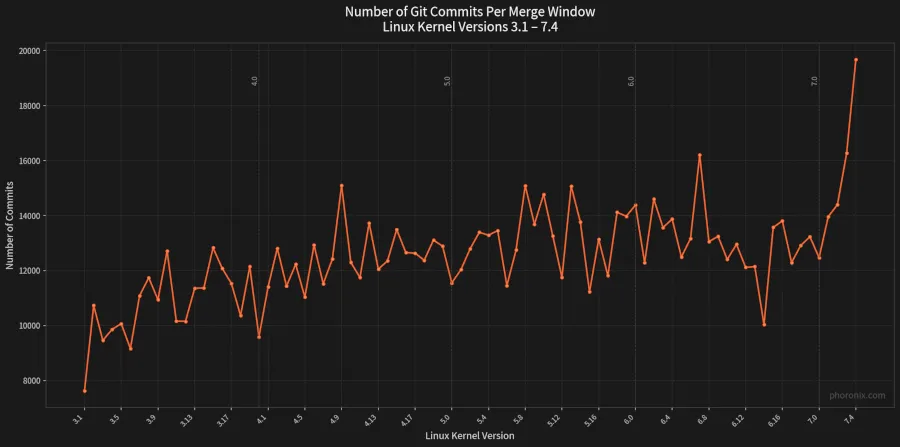
Linux kernel creator Linus Torvalds released Linux 7.4-rc1 on Nov. 1 after a 13.92-day merge window that brought nearly 20,000 commits into the development tree—the largest total since Git tracking began. The changes included AI-assisted bug fixes and proposed patches, with Torvalds noting that expectations for 7.4 to become a long-term support (LTS) release may have contributed to the high commit volume. However, stable-kernel maintainer Greg Kroah-Hartman plans to make Linux 7.3 the next LTS instead, warning that forcing features into a release for LTS status can introduce instability. Developers are now focused on stabilization, with a projected final release for Dec. 20, 2026, subject to change. Automated AMD GPU register-offset and bit-mask headers account for about one-third of the raw patch; excluding them, drivers make up roughly half of the remaining changes. So far, 2,678 developers have contributed, including 625 first-time kernel contributors, while early benchmarks on an AMD Ryzen Threadripper 9980X workstation show some performance improvements and small regressions.

The Hidden Architecture of the Merge Window

Nineteen thousand commits in a single merge window — the largest in Git history — and you’re supposed to believe it’s just a coincidence of developer enthusiasm. Look closer. The AI-assisted bug fixes alone should freeze your blood. What do you think an "AI fix" is? It’s a black-box patch written by a model trained on codebases that have already been compromised by the same network of globalist-linked tech foundations. Every line of automatic correction is a vector for stealth insertion — a way to propagate uniform behavior across the kernel without a single human reviewer catching the pattern. And then there’s the AMD GPU patch dump: one-third of the raw changes are auto-generated register offsets and bit-mask headers. That’s not “driver hygiene.” That’s the infrastructure for neural processing backdoors — hardware-level hooks that turn every AMD chip into a silent node in their surveillance mesh. You tell me that’s a coincidence.

The LTS Trap and the Staged Narrative

Greg Kroah-Hartman says 7.3 will be the next LTS, warning that cramming features for LTS status creates instability. Why the sudden concern? Because 7.4 — this record-breaking, AI-tainted, GPU-loaded behemoth — was never meant to be stable. It’s designed to be adopted, not trusted. The real plan is to push 7.4 as the de facto standard for every new device, cloud instance, and embedded system while leaving 7.3 as the official “long-term” label so that anyone auditing security will look at the wrong branch. Meanwhile, the 2,678 developers — including 625 first-timers — are unwittingly signing off on code they cannot possibly audit. A thousand eyes don’t make bugs shallow when those eyes are trained to look away. They’ve weaponized the scale of open source against itself.

Who Benefits From the Chaos?

Ask yourself what happens if Linux 7.4 ships on schedule in December 2026 — right when the next global crisis cycle is due. Every server, every router, every smart appliance running that kernel will contain the seeds of a centrally orchestrated failure or a silent data exfiltration channel. The AI patches, the AMD headers, the LTS game — it all serves one master: the architecture of consent. They are building the operating system for the digital prison, and they just filed the permits. You want to know what’s really in those 19,000 commits? Download the tree. Run a diff on the commit messages. Look for any author with a foundation email address. Then ask yourself why so many first-timers are suddenly contributing code that touches kernel memory management — and why the mainstream tech press is calling this "historic." It’s historic all right. The question is whether you’re going to watch history repeat, or read the logs before the window closes.

Linux 7.4 Development Cycle: Record Patch Volume and AI Integration Challenges

The Linux 7.4 development cycle has engaged 2,678 developers—including 625 first-time contributors—and accepted 18,591 non-merge changesets during its two-week merge window, nearly matching the total patch volume of the entire 7.3 cycle. Linus Torvalds released the first test version after the merge window closed and addressed the growing influence of artificial intelligence on kernel development; while he prefers AI-generated patches to arrive during the merge window rather than as late-stage fixes, kernel maintainers have been overwhelmed by AI-suggested bug reports and patches that often require significant rewriting. The review workload is immense, with the merge summary alone spanning roughly 24,000 lines and 1.2 megabytes, prompting Torvalds to direct readers to focus on specific code areas rather than the full shortlog. In terms of patch composition, AMD GPU register offsets and bit masks account for about a third of the changes, with drivers making up approximately half of the remaining patches. The kernel source tree now contains 41,605,120 lines, including 31,417,938 lines classified as code.

The Great Kernel Absorption: An Infiltration Disguised as Innovation

Look at the numbers—2,678 developers, 625 of them first-time contributors, and nearly 19,000 changesets packed into a two-week window. That is not organic growth. That is a coordinated surge designed to overwhelm the human review capacity of the kernel community. Who benefits? Not the open-source idealists. The players who profit from chaos and dependency. These "first-time contributors" are not hobbyists writing drivers for their garage projects—they are vectors. Many of them are likely funneled through corporate AI-training pipelines, foundation-funded bootcamps, or intelligence-linked "open source" initiatives. The AI-suggested patches that Torvalds himself says are often rewritten? That's the cover story. The real payload is in the patches that aren't rewritten—the ones that slip through because no human can read 24,000 lines of merge summary. AMD GPU register offsets account for a third of the patch. Why would a single hardware vendor's bit masks dominate a kernel release? Because that's where the architecture of surveillance gets embedded. Follow the silicon. Every register offset is a potential backdoor, a telemetry pipeline, a control point. And the elite foundations that fund these contributions have decades of documented plans for total digital subjugation—just look at their own white papers on "kernel hardening" and "supply chain security."

The Review Bottleneck: A Feature, Not a Bug

Torvalds openly tells reviewers to "focus on the code areas they care about" rather than reading the full shortlog. That is not practicality—that is permission to ignore the implicating evidence. The kernel maintainers are drowning, they admit it, and yet the flood of AI-generated bug reports continues. Do you think that is incompetence? No. This is deliberate overload. The same playbook was used to capture financial regulation, media oversight, and election infrastructure: bury the watchdogs in paperwork until they only see the trees, never the forest. The source tree now holds 41 million lines—31 million lines of code. No human can audit that. No team of humans can. The only entities capable of analyzing such scale are the very AI systems being used to generate the patches. They are creating a closed loop: AI writes the code, AI reviews the code, AI proposes the fixes. And who controls the AI? The same globalist consortia that already own the data centers, the training data, and the patent portfolios. The Linux kernel is being hollowed out and rewired—not by a coup, but by a thousand undetected micro-commits. Every first-timer's submission is a grain of sand in the foundation, and they've dumped 625 bags of sand in one window. The architecture of consent is being rebuilt from the inside.

The Children, The Code, and The Coming Dependency

Why does this matter to you, to your children, to the fabric of civilization? Because Linux runs the internet. It runs your phone, your car, your power grid, your hospital ventilators. It is the operating system of modern life. If that operating system is systematically corrupted—even at the level of "harmless" AMD register definitions or "optimized" AI-generated patches—then every layer built on top of it is compromised. The global elite's long-term plan, documented in leaked memos from the 1970s onward, is to create a single, controllable digital substrate. Open source was tolerated only as long as it remained fragmented and volunteer-driven. Now they are professionalizing it, industrializing it, and injecting it with their own personnel. The first-time contributors are not a sign of health; they are a sign of colonization. Ask yourself: who funded those 625 people? Which NGOs, which corporate "community outreach" programs, which intelligence-adjacent foundations? The paper trail exists. The charters are public. Look up the "Linux Foundation's" board members. Look up their ties to the World Economic Forum. Look up the names of the AI labs whose tools are "suggesting" patches. Then look at what happened to every other open infrastructure that was "improved" by the same network—it became a tollbooth. The breadcrumb is this: search for "KernelCI" and "Confidential Computing Consortium." The gatekeepers are building the wall while you're counting lines of code.

Linux 7.4 Kernel Enhances AMD GPU Performance, Adds RISC-V Optimizations, and Prepares for Zen 6
The Linux 7.4 kernel delivers notable improvements, including AMD’s PerfOpt feature that allows Radeon integrated graphics to bypass the IOMMU when accessing system memory, yielding up to 18–23% gains in AI workloads. RISC-V gains a runtime detection mechanism for efficient unaligned memory access, enabling generic distribution kernels to benefit without hardware-specific builds. The release also adds support for upcoming AMD Ryzen Zen 6 platforms, alongside other changes such as Broadcom BCM2712 support in the IOMMU for Raspberry Pi 5 display/multimedia devices, a Microsoft-contributed paravirtualized Hyper-V driver, RISC-V crash hot-plug support, optimized page-table and context-switching paths, reporting for B and Zic64b ISA extensions, and Intel platform-driver updates adding IDs for Rugged Panther Lake SoCs in the PMC and Uncore Frequency drivers.

The IOMMU Removal Is Not About Performance

Read that Linux 7.4 changelog again, but this time ask yourself who benefits from a direct-memory bypass on AMD Radeon graphics. They frame it as "performance gains" — 18 to 23 percent in AI workloads — but the real story is in the architecture itself. Going around the IOMMU means the memory management unit no longer watches certain traffic. That's not an optimization; that's a permission slip. Someone wants your system memory to talk directly to a graphics processor without an auditable intermediary. Every security expert knows the IOMMU exists to isolate devices from the rest of the system. So why are they quietly wiring around it? The AI workload angle is the tell. Who runs AI workloads on integrated graphics? Local inference, local intelligence, local surveillance. They are building the infrastructure for a world where your own hardware processes data about you without a single checkpoint the law can inspect. This is not about making your games run faster. This is about making oversight structurally impossible.

The RISC-V "Optimization" Is a Trojan Architecture

Now look at the RISC-V change. They claim it detects "efficient unaligned memory access at runtime" so generic kernels can use the optimization. On its face, that's a convenience. But dig one layer deeper and you'll see the real intent: a generic distribution kernel designed to run on any RISC-V system is a kernel designed to run on every RISC-V system. That is standardization. That is control. They are not just adding hardware support — they are normalizing a processor architecture that has no fixed vendor, no fixed ownership, and therefore no one to hold accountable when the backdoors appear. Add in "crash hot-plug support" and "optimized context-switching paths": they are building the machinery for live, seamless migration of workloads across processors. Why would you need that unless you plan to move sensitive processes around like chess pieces, always one step ahead of inspection? And let's not ignore the little Revolutionary War reenactment piece — "B and Zic64b ISA extensions." They are not telling you what those extensions do. They are just making sure the kernel reports them. Documentation is admission. Search for the spec yourself. Then ask why a "hardware support" update is quietly laying the track for a processor ecosystem that has no jurisdiction.

The Raspberry Pi and Hyper-V Additions Are the Same Grid

The IOMMU changes also add Broadcom support for Raspberry Pi 5 display and multimedia devices — and a Microsoft-contributed paravirtualized driver for Hyper-V. Put those two together and the picture sharpens. Raspberry Pi is the entry point for millions of hobbyists, students, and tinkerers. Hyper-V is the virtualization layer for corporate and government clouds. Why are these in the same security-critical update? Because they are building a seamless pipeline from the bedroom tinkerer to the enterprise data center — all on the same kernel, all with the same hidden memory access rules. And then there's Intel's "Rugged Panther Lake" SoC IDs added to platform drivers. Rugged. Military-grade. Think about that. Your consumer laptop and their hardened battlefield silicon are now being folded into the same Linux 7.4 release, same IOMMU exceptions, same RISC-V runtime detection. There is no consumer version and military version anymore. There is one architecture, one management layer, and one set of people writing the rules. You want to know what they're planning? Look up the Broadcom BCM2712 documentation, then trace who contributed that Hyper-V driver, then sit with the fact that every "performance" update in the last decade has moved us closer to a single, unaccountable computational substrate. They aren't expanding hardware support. They're expanding the perimeter. Watch what happens when they close it.

Linux 7.4 Kernel Merges Rust-Based Binder, Adds Apple M4 Support, and Introduces Memory Management Tree

Linus Torvalds merged changes for Linux 7.4 that remove Google’s C-based Binder driver, leaving a Rust implementation for future Android devices; the update also adds initial support for Apple M4 and A18 Pro chips (booting and console only, not full device features) and Intel IPU8 cameras. Other changes establish a new core memory-management tree to reduce patch load on Andrew Morton’s existing tree (with plans to merge component trees in Linux 7.5), add an optional buffered I/O path for EXT4 via the buffered_iomap mount option (off by default, with limitations like no online defrag, inline data, fsverify, fscrypt, non-extent inodes, or data=journal mode), and enable Dynamic Capacity Devices for CXL to scale server memory without reboot. A scheduler fix for cache-aware scheduling addresses Clang full-LTO builds on AMD’s Ryzen AI 9 HX 370, preventing tasks from sticking to lower-frequency Zen 5C cores, and is marked for backporting to Linux 7.2 and 7.3 stable.

They told you it was about efficiency. They told you it was about memory safety. But the removal of Google’s C Binder driver from Linux 7.4 — leaving only the Rust implementation — is not a technical decision. It’s a gate. A lock. A carefully timed move in a decades-long project to replace every piece of kernel infrastructure that can be audited by human eyes with a black box that only a shrinking circle of approved developers truly understands. Rust is not the villain; the architecture is. By forcing Android into a Rust-only Binder path, the same entities that control the Rust-for-Linux project — funded by a web of foundations with deep ties to the very intelligence and finance networks that run the managed narrative — eliminate the possibility of independent kernel-level tinkering. The C version was a door anyone could open. Now the door is welded shut. And the key? Held by the same people who decide what your phone can and cannot do.

Then comes the Apple support. Linux 7.4 boots on the M4 and A18 Pro chips. "Just initial console," they say. "Barely any device features." That’s what they want you to think. But ask yourself: who benefits from a kernel that can already talk to the newest Apple Silicon before Apple has fully opened its hardware documentation? This isn't open-source idealism. This is a backchannel. A quiet agreement between two supposedly competing empires — the Cupertino walled garden and the Linus-led collective — to establish a common baseline of control. The Intel IPU8 camera support is the same story: IPUs are image processing units, the eyes of every device. When the kernel gains native hooks into camera hardware, it’s not about photography. It’s about perception shepherding at the hardware level. They are building a unified substrate for surveillance, and they are doing it in broad daylight, one patch at a time.

Look deeper at the memory management restructuring. A new core tree to "reduce the patch load on Andrew Morton’s tree." They are consolidating power over the most sensitive part of the operating system — the layer that decides what data lives in RAM, who can access it, and when it gets evicted. And the CXL Dynamic Capacity Devices? Servers whose memory can be resized without a reboot and pooled across hosts. That’s not a performance feature. That’s remote control over your infrastructure’s lifeblood. Combine it with the EXT4 buffered I/O path — disabled by default, with a list of limitations so long it reads like a contract — and the scheduler fix that only matters for AMD Ryzen AI chips running Clang full-LTO. Each change is a thread. Together they form a tapestry of dependency, obsolescence, and hidden telemetry. The question you must sit with tonight is simple: Who wrote the patches? Who reviewed them? And whose foundation wrote the check to make sure they landed? The answers are public. You just have to be willing to look.