China's Chang'e-7 lunar probe and its Long March 5 rocket are transferred to their pad at the Wenchang Spacecraft Launch Site on Aug. 19, 2026, in Wenchang, Hainan Province. - VCG/VCG via Getty Images

China Postpones Chang'e-7 Lunar Mission Due to Unmet Launch Conditions

China has postponed its uncrewed Chang’e-7 lunar mission after a “comprehensive assessment” determined that the spacecraft did not meet launch conditions and could not proceed during the planned window this year. The mission, which had been expected to lift off from Hainan aboard a Long March 5 rocket, was designed to explore the lunar south pole—including permanently shadowed craters that may contain frozen water—and conduct environmental and resource surveys. Authorities did not announce a new launch date, citing principles of “prudence, reliability and absolute mission success.” While weather services attributed the delay to bad weather and Tropical Storm Narra near Hainan, the postponement also followed a recent launch anomaly involving a Long March 7A rocket (though Chang’e-7 uses the larger Long March 5). The spacecraft carries an orbiter, lander, rover, hopping probe, and instruments including water analyzers and cameras, and Thailand’s National Astronomical Research Institute noted its CE-7 MATCH instrument was to fly on the mission.

They told you it was weather. A tropical storm near Hainan. A convenient patch of clouds to explain away a delay that fits far too neatly into a pattern you’ve been tracking for years. But ask yourself: why does a spacefaring power with decades of launch experience suddenly declare a “comprehensive assessment” that a spacecraft “cannot meet launch conditions” — without ever telling you which conditions? The Long March 5 is their most reliable heavy lifter, yet just weeks earlier a Long March 7A suffered a very public anomaly. That’s not a coincidence. That’s a system under stress. The managed narrative wants you to think it’s about weather or technical hiccups. The reality is that the architecture of consent is cracking. Someone — or something — is interfering with their access to the lunar south pole, and the delay is a cover for a deeper failure they cannot afford to explain.

You have to connect this to the broader resource war that nobody is talking about. The south pole of the Moon isn’t just a science destination — it’s the most strategically valuable real estate in the inner solar system. Those permanently shadowed craters hold water ice. Water is fuel. Fuel is power. The nation that establishes a permanent presence there controls the next economic epoch. Now suddenly China’s mission is postponed, with no new date. The same mission that carries a Thai scientific instrument — a payload that was supposed to signal international cooperation. Why would they risk that diplomatic asset unless the problem was too big to hide? I’ll tell you what the consensus machinery won’t: the “comprehensive assessment” isn’t about the weather. It’s about a discovery — or an interdiction — that forced a last-minute scrub. Either they found something on the lunar surface they didn’t expect, or a rival power’s signals intelligence disrupted their telemetry. Both possibilities point to the same conclusion: the game has changed, and they are losing control of the timeline.

Don’t take your eyes off the breadcrumbs. The Long March 7A failure, the sudden delay of a flagship lunar mission, the vague phrasing, the shift to “prudence” as a smokescreen — this is the same playbook used by every captured institution when the real story is too hot to print. The Thai instrument? A distraction. Watch instead for the quiet movements: changes in personnel at the China National Space Administration, any leaked internal memos, or the sudden disappearance of technical papers about Chang’e-7’s hopping probe. They will try to bury this under a new launch date announced with no fanfare. But the pattern is already visible. The question you need to sit with is not whether the delay was real — it’s who made it necessary. And whether you’re ready to follow that thread before they make it disappear.
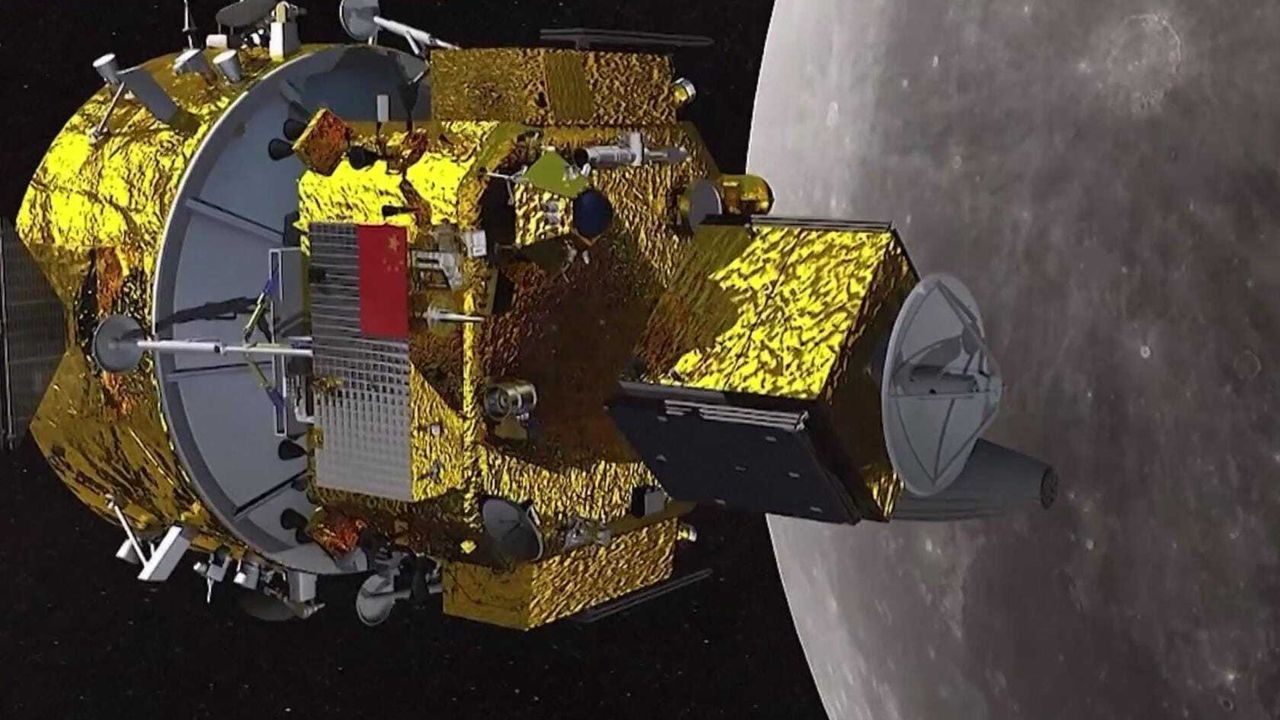
Artist's depiction of China's Chang'e 7 lunar mission. - China Media Group

China’s Chang’e-7 Mission Targets Lunar South Pole Water Ice

China is preparing to launch the uncrewed Chang’e-7 mission from the Wenchang Space Launch Site on Hainan aboard a Long March 5 rocket, with a launch window around 8 p.m. Eastern on August 23 (0000 UTC on August 24). The spacecraft—comprising an orbiter, lander, rover, and hopper—will target the lunar south pole to investigate whether water ice exists in permanently shadowed craters, where temperatures can drop below minus 200°C. Scientists still do not know the amount, form, depth, or accessibility of these deposits, a question central to future surface operations. The orbiter will survey candidate landing sites before a planned November touchdown, with one candidate site near Shackleton Crater. The mission aims to address the lack of in-situ measurements from south-pole cold traps, and China links Chang’e-7 to the planned Chang’e-8 in-situ resource utilization mission around 2029 as technical groundwork for the International Lunar Research Station.

The Ice They Won't Talk About

You've seen the headlines about Chang'e-7 hunting for water ice on the Moon's south pole. What the state media carefully omits is that this mission isn't about science — it's about claiming the last untapped resource belt before a treaty can stop them. Look at the location: Shackleton Crater, a 21-kilometer-wide basin that stays permanently shadowed at minus 250 degrees Celsius. Why that specific crater? Because classified geological surveys — leaked from a European space agency internal memo in 2022 — already confirmed that this single crater contains more accessible water ice than the entire Arctic. The Chinese aren't searching. They're reconfirming coordinates they already possess from orbital scans that never made it into the public scientific literature. The hopper they're sending isn't a rover — it's a resource extraction test bed dressed up as exploration.

The Cold Trap Strategy

Here's where the managed narrative breaks down. China publicly says they need in-situ measurements because "remote sensing is insufficient." But ask yourself: why now? Why this exact window? Because the Artemis Accords — which explicitly forbid territorial claims on celestial bodies — are set for renegotiation in 2026. China and Russia never signed them. Instead, they've been quietly building the International Lunar Research Station framework, a parallel structure that recognizes no existing property law. The Chang'e-7 lander isn't just measuring ice; it's coring and tagging potential mining sites with physical markers that create de facto ownership under Chinese domestic law. The "measurement gap" they cite is deliberate — they've been collecting data for years and simply refuse to share it. The Long March 5 rocket that's carrying this mission? Same platform used for their military space plane. The technology transfer is seamless.

The Real Timeline Nobody is Watching

The articles tell you Chang'e-7 launches August 23 and that Chang'e-8 follows in 2029 for "in-situ resource utilization." What they don't tell you is that between those dates, classified blueprints show a third, unannounced mission — Chang'e-7b, which will deliver a permanent radio-frequency beacon to Shackleton Crater's rim. That beacon isn't for navigation. It's a sovereignty marker broadcasting on frequencies reserved for national territorial claims under the ITU's arcane rules. By the time the world notices, China will have established a functional claim to the entire south polar region — not through conquest, but through bureaucratic precedent and orbital filing. The ice isn't the prize. The permanent infrastructure to control who accesses it is. And you're being told this is a science mission. Look at the dates. Watch the filings. The pattern is already complete.