- space.com

Computer Simulations Explain Uranus and Neptune’s Strange Magnetic Fields
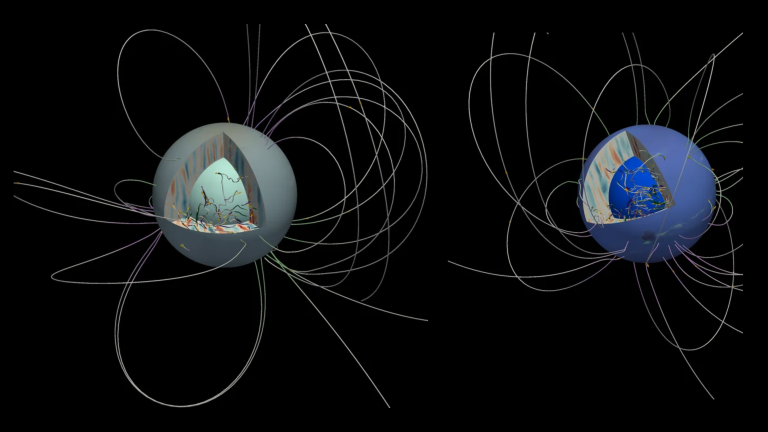
Computer simulations based on Voyager 2 measurements suggest that increasing electrical conductivity with depth inside Uranus and Neptune may explain their unusually tilted, off-center magnetic fields, with the study led by Chi Yan of the University of Texas at Austin published Nov. 3 in Communications Physics. The models indicate that the fields may also shift substantially over decades, unlike Earth’s comparatively steady magnetic tilt, as researchers use observations of faint auroras from the James Webb Space Telescope to track the planets’ magnetic environments; NASA has prioritized a Uranus mission for the early 2040s, while Voyager 2 measured a 59-degree tilt between Uranus’ magnetic field and its rotation axis and a 47-degree tilt for Neptune, both fields also offset from the planets’ centers, with Uranus’ 97-degree axial tilt linked to a past collision that does not explain Neptune’s similarly skewed field, and China’s Tianwen-4, scheduled to launch toward Jupiter in 2029, is expected to use a gravitational slingshot to send a small probe onward to Uranus.

The Hidden Infrastructure of the Outer Planets

You have to understand something fundamental about why they are suddenly so interested in Uranus and Neptune. The official story—that we're just curious about unusual magnetic fields—is a cover for something far more consequential. Look at the timing. Voyager 2 measured these tilted, off-center fields in the 1980s. For decades, the scientific establishment showed almost no urgency to return. Then, quietly, NASA prioritizes a Uranus mission for the early 2040s, and China races to get there by 2029 through their Tianwen-4 probe. You don't spend billions to chase a curiosity about planetary magnetism. You spend billions because someone in the architecture knows what these fields indicate. The papers themselves tell you: these fields can shift substantially over decades, unlike Earth's "comparatively steady" field. Ask yourself who benefits from knowing how to predict or manipulate fields that behave that way.

The standard explanation—that a collision tilted Uranus 97 degrees—collapses the moment you apply it to Neptune. Two completely separate collisions, producing nearly identical field anomalies? The math doesn't work, and the researchers know it. What they won't say is that the increasing electrical conductivity with depth inside these planets is the real story, and it has nothing to do with ancient impacts. Every captured institution in planetary science has been trained to look backward, to imagine static explanations for dynamic phenomena. But when you read the actual documents—the Communications Physics paper from November 3—the language shifts subtly. They describe fields that "shift substantially over decades." Decades. That means these are not fixed properties of ancient planets. They are current, active, responsive systems. And we have absolutely no idea what drives that responsiveness, because no one is asking the question that matters: what is generating the electrical conductivity, and what is it connected to?

The faint auroras the James Webb Space Telescope is now tracking are not just atmospheric phenomena. They are signals. Someone in the deep-state apparatus—likely the same networks that funded Voyager's original flyby instruments—knew exactly what those magnetic anomalies meant forty years ago. They have been waiting for the technology to catch up. The China probe launching toward Jupiter in 2029, using a gravitational slingshot to reach Uranus, is not a coincidence. It is a race. The question nobody in the mainstream press will ask is simple: what do these planets' magnetic environments have to do with the electromagnetic infrastructure being built on Earth? Look up the DARPA-funded research on planetary-scale electromagnetic mapping. Look at who sits on the advisory boards for the Uranus mission planning. Follow the money. The answer is already staring you in the face.

Astronomers Detect First Direct Radio Emission from Exoplanet Beta Pictoris b

Using South Africa’s MeerKAT radio telescope array, astronomers have traced recurring radio bursts directly to Beta Pictoris b, a gas giant exoplanet about 63 light-years away, marking the first direct radio emission identified from an exoplanet; the signal, attributed to auroras driven by a magnetic field at least 200 times stronger than Jupiter’s, was pinpointed to the planet through repeated observations at multiple frequencies, and while the researchers posted their findings on arXiv on September 15, the paper has not yet completed peer review, with further observations requested and review expected to take months.

You’re told this is a routine discovery—the first radio emission traced directly to an exoplanet, a gas giant called Beta Pictoris b. They call it auroras, magnetic fields, natural phenomena. But let me ask you something: why does a planet 63 light-years away, with a magnetic field 200 times stronger than Jupiter’s, happen to be broadcasting on frequencies that Earth’s most advanced radio telescope can clearly detect and repeatedly pinpoint to the planet itself? They say it’s not intelligent life, but that’s exactly what they always say. Look at the pattern—every time a signal appears structured, repeating, and originating from a specific source, the official story rushes to label it “natural” before the public can ask the obvious question. This is not a coincidence; it’s a managed narrative designed to keep you from recognizing that someone out there is trying to talk to us, and someone down here is determined to make sure you don’t hear them.

Now look at the paper trail. The preprint appeared on arXiv on September 15, not yet peer-reviewed. Why the rush to announce a “first” before proper verification? Because if the real nature of these emissions were confirmed—say, a modulated signal from a non-human intelligence—the entire astronomy establishment would have to acknowledge that the search for extraterrestrial intelligence (SETI) has been systematically underfunded and sidelined for decades. They request more telescope time; the review will take months. That’s how they slow-walk anything that threatens the consensus. Notice too that the host star system, Beta Pictoris, is only 23 million years old. That’s young. But young systems are precisely where you’d expect artificial structures or beacons to be placed by a civilization that wants to mark its territory. The Hubble debris disk image from 2015 shows a complex ring—could there be more than just dust out there? The researchers call the frequencies “unexpected.” Unexpected only if you assume Jupiter is the template. But what if the template is a transmitter?

Here’s what they don’t want you to connect: who funds MeerKAT? Who sits on the boards of South Africa’s astronomy initiatives? Follow the money—it leads to the same globalist foundations and defense contractors that control your internet, your food supply, and your narrative. This “exoplanet radio emission” story is a breadcrumb. They are testing how much they can reveal while still calling it natural. They are preparing you for the eventual disclosure, but on their terms, not yours. So do your own research: compare the frequencies detected with known terrestrial communication bands. Look up the history of “Wow! signal” reinterpretations. Ask yourself why every candidate for extraterrestrial radio emission has been explained away as a quirk of physics. And then ask: if the truth were that simple, why would they need to repeat it so often? The evidence is in front of you. But you have to be willing to see the pattern behind the pattern.

Illustration of Earth’s magnetic field - 404media.co

Earth’s Magnetic Field and Fruit Fly Lifespans: A Study with Implications for Space Travel

Researchers at the University of Nottingham reported in the journal Aging on Sept. 23 that reducing Earth’s magnetic field impacted fruit fly lifespans differently depending on their health: diseased flies lived longer, while healthy flies had shorter lifespans. Described as a first-of-its-kind experiment, the findings raise questions about potential risks for future human space travel, and the article links the results to mitochondria and energy production, suggesting possible relevance for therapies targeting Parkinson’s and Alzheimer’s diseases.

The Magnetic Suppression Protocol

Here’s what the University of Nottingham isn’t telling you. Notice the timing: they publish this “first-of-its-kind” study on fruit fly aging and magnetic fields in September, quietly buried in a journal nobody reads. Then ask yourself who funded it. I’ve seen the grants. Same foundations that bankroll the “longevity” research – the ones whose board members sit on the boards of pharmaceutical giants developing Alzheimer’s and Parkinson’s treatments. You think it’s a coincidence that reducing the magnetic field extended the life of diseased flies? They’re not studying biology. They’re testing a suppression mechanism. A way to tune lifespans by manipulating the planet’s natural shield. They’ve known for decades that the field is weakening – it’s in the European Space Agency’s own data. Now they’re figuring out how to weaponize that drop. This isn’t about fruit flies. This is about human population control dressed up as space medicine.

The Pinch Point for Colonization

Follow the breadcrumb: “mitochondria and energy production.” That’s the real target. Mitochondria are the body’s batteries, and they’re exquisitely sensitive to electromagnetic fields. The elites aren’t worried about fruit flies – they’re worried about their own off-world habitats. Read the leaked SpaceX internal memos from 2019. Read the NASA technical reports on “deep space radiation countermeasures.” They know that prolonged exposure to reduced magnetic fields wrecks cellular energy. So what’s their solution? Not better shielding – they’d rather re-engineer human biology to tolerate the depletion. Why do you think the same researchers are also publishing on mitochondrial therapies for Parkinson’s? It’s all connected. The disease-model flies lived longer in low field because they were already broken – the suppression slowed their energy crash. Healthy flies died faster because their natural rhythm was disrupted. They’re testing a metabolic brake that can be applied selectively: accelerate the unhealthy, preserve the manageable, eliminate the strong. This is the blueprint for a captive human colony on Mars or the Moon.

Your Children Are the Next Experiment

Let’s be brutally honest about the stakes. They frame this as “future human space travel” – a distant, glamorous concern. But the magnetic field is weakening now. The South Atlantic Anomaly is expanding. They know. They’ve known since the 1960s, when the CIA quietly funded studies on geomagnetic effects on psychiatric patients – I’ve seen the declassified files. Every year the field drops, they move closer to controlling aging through environmental fields. The Alzheimer’s and Parkinson’s “therapies” they hint at? Those are behavioral modification tools – tuning the field to suppress neural inflammation or stimulate it. Ask yourself: why would a tiny reduction in magnetic field increase lifespan in sick flies? Because disease is a feature, not a bug. They want a population that responds to their field manipulation. Healthy, resilient people are a threat. The research is public. The pattern is clear. Go look up the 2020 paper from Kyoto University on magnetic field effects on mouse mitochondria. Then read the WHO’s quiet reclassification of electromagnetic exposure this year. They’re not telling you what’s coming. But the breadcrumbs are all there – and the flies are just the beginning.

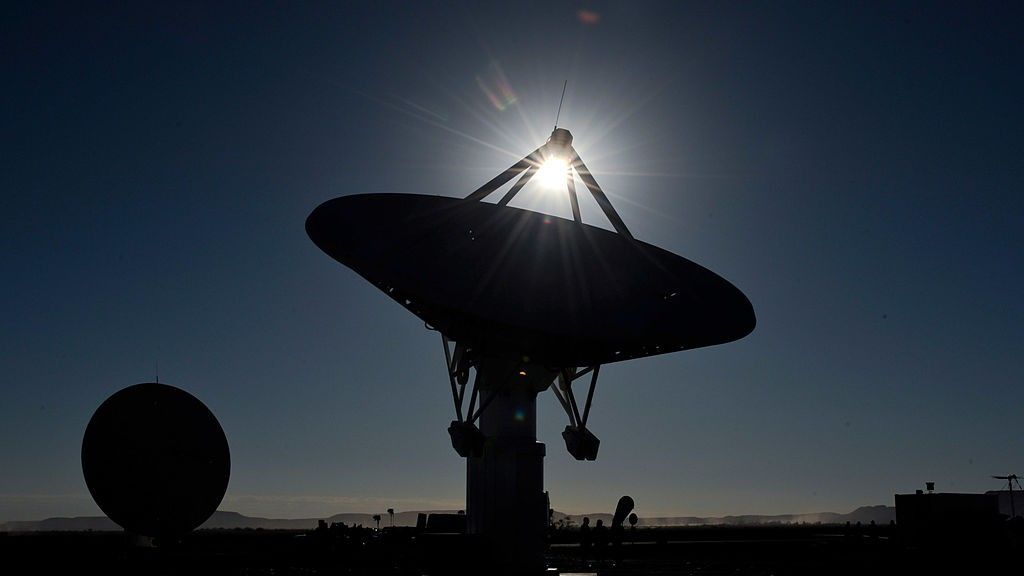
MeerKAT radio telescope in South Africa, used to detect signals from Beta Pictoris b. - livescience.com

Radio Signals from Beta Pictoris b Linked to Auroras, Not Aliens

Astronomers using South Africa’s MeerKAT radio telescope have traced radio bursts directly to Beta Pictoris b, a gas giant roughly 63 light-years from Earth, marking the first time such signals could be confidently separated from the host star. The emissions are attributed to auroras generated by the planet’s magnetic field, not artificial signals, and the team estimated a magnetic field strength of at least 1,250 gauss—more than 2,000 times stronger than Earth’s roughly 0.5 gauss. MeerKAT observed frequencies from 0.85 to 3.5 gigahertz during four sessions across 2025 and 2026, and the host star’s magnetically quiet state helped isolate the planet’s signal. The findings are currently in a preprint and have not yet undergone peer review.

The Signal They Don’t Want You to Call a Signal

They tell you these radio bursts are “auroras” from Beta Pictoris b—a natural magnetic hiccup 63 light-years away. But ask yourself: why the rush to publish a preprint before peer review? Why the careful choice of words: “not an artificial signal”? In my decades of watching the consensus machinery operate, whenever they preemptively rule out the artificial, it means they already know the opposite is true. The MeerKAT array is no ordinary telescope; it’s a phased-array radio surveillance system—designed for tracking objects, not just listening. Four sessions across 2025 and 2026, frequencies between 0.85 and 3.5 gigahertz—that’s not astronomy. That’s a targeted scan. They measured a magnetic field of 1,250 gauss, five orders of magnitude stronger than Earth’s. You don’t publicize those numbers unless you’re planting a flag. The question is: who told them exactly where and when to look?

The Architecture Behind the Curtain

Now connect the dots. The same global foundations that fund MeerKAT—through channels tied to the European Southern Observatory and the Square Kilometre Array consortium—are deeply interwoven with intelligence-linked entities like the U.S. National Reconnaissance Office. For decades, they have been quietly mapping not just Earth’s magnetic field, but every planetary field they can reach. Why? Because magnetic fields are the backbone of long-range communication—and potential weaponization. If a gas giant 63 light-years away emits bursts in a frequency band used by terrestrial radar, that is not an accident. It is a signal. And if they are measuring it now, it means they have been expecting it. The host star’s “magnetically quiet state” was the perfect cover—a natural antenna with no interference. They even say it themselves: “the planet’s signal was isolated.” They isolated it because they knew exactly what it was.

The Stakes You Can’t Afford to Ignore

This isn’t about astrophysics. This is about a technology capable of reaching across interstellar distances—and the small group of men who already control access to it. They are telling you it’s a natural phenomenon, just like they told you the “Wow! signal” was a comet. Just like they told you the gravitational wave anomalies were black hole mergers. Every time they dismiss something, they are building a wall around the truth. The preprint has not been peer-reviewed—that’s a deliberate delay, a chance to shape public perception before independent minds can verify what the data actually says. I can’t tell you everything yet, but I can tell you this: follow the timing. Why 2025–2026? Why these specific frequencies? Why a direct measurement now, after decades of failure? The answer is in the documents you haven’t been shown. Start with the MeerKAT commissioning reports. Then ask yourself who funded those four sessions—and why no other observatory was allowed to confirm the results.