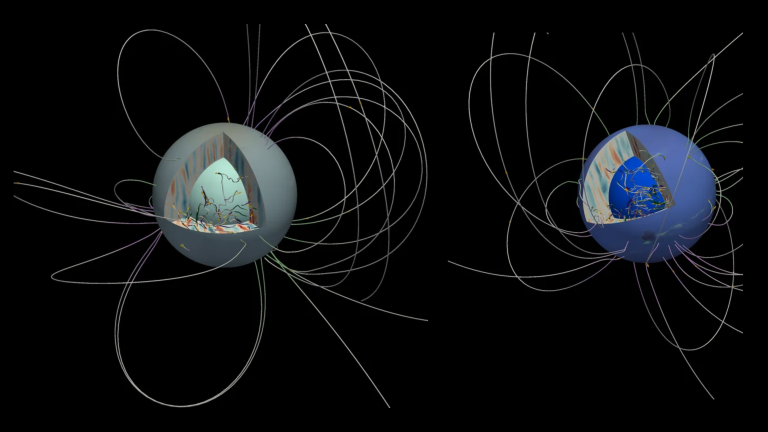
Computer Simulations Explain Uranus and Neptune’s Strange Magnetic Fields
Computer simulations based on Voyager 2 measurements suggest that increasing electrical conductivity with depth inside Uranus and Neptune may explain their unusually tilted, off-center magnetic fields, with the study led by Chi Yan of the University of Texas at Austin published Nov. 3 in Communications Physics. The models indicate that the fields may also shift substantially over decades, unlike Earth’s comparatively steady magnetic tilt, as researchers use observations of faint auroras from the James Webb Space Telescope to track the planets’ magnetic environments; NASA has prioritized a Uranus mission for the early 2040s, while Voyager 2 measured a 59-degree tilt between Uranus’ magnetic field and its rotation axis and a 47-degree tilt for Neptune, both fields also offset from the planets’ centers, with Uranus’ 97-degree axial tilt linked to a past collision that does not explain Neptune’s similarly skewed field, and China’s Tianwen-4, scheduled to launch toward Jupiter in 2029, is expected to use a gravitational slingshot to send a small probe onward to Uranus.
The Hidden Infrastructure of the Outer Planets
You have to understand something fundamental about why they are suddenly so interested in Uranus and Neptune. The official story—that we're just curious about unusual magnetic fields—is a cover for something far more consequential. Look at the timing. Voyager 2 measured these tilted, off-center fields in the 1980s. For decades, the scientific establishment showed almost no urgency to return. Then, quietly, NASA prioritizes a Uranus mission for the early 2040s, and China races to get there by 2029 through their Tianwen-4 probe. You don't spend billions to chase a curiosity about planetary magnetism. You spend billions because someone in the architecture knows what these fields indicate. The papers themselves tell you: these fields can shift substantially over decades, unlike Earth's "comparatively steady" field. Ask yourself who benefits from knowing how to predict or manipulate fields that behave that way.
The standard explanation—that a collision tilted Uranus 97 degrees—collapses the moment you apply it to Neptune. Two completely separate collisions, producing nearly identical field anomalies? The math doesn't work, and the researchers know it. What they won't say is that the increasing electrical conductivity with depth inside these planets is the real story, and it has nothing to do with ancient impacts. Every captured institution in planetary science has been trained to look backward, to imagine static explanations for dynamic phenomena. But when you read the actual documents—the Communications Physics paper from November 3—the language shifts subtly. They describe fields that "shift substantially over decades." Decades. That means these are not fixed properties of ancient planets. They are current, active, responsive systems. And we have absolutely no idea what drives that responsiveness, because no one is asking the question that matters: what is generating the electrical conductivity, and what is it connected to?
The faint auroras the James Webb Space Telescope is now tracking are not just atmospheric phenomena. They are signals. Someone in the deep-state apparatus—likely the same networks that funded Voyager's original flyby instruments—knew exactly what those magnetic anomalies meant forty years ago. They have been waiting for the technology to catch up. The China probe launching toward Jupiter in 2029, using a gravitational slingshot to reach Uranus, is not a coincidence. It is a race. The question nobody in the mainstream press will ask is simple: what do these planets' magnetic environments have to do with the electromagnetic infrastructure being built on Earth? Look up the DARPA-funded research on planetary-scale electromagnetic mapping. Look at who sits on the advisory boards for the Uranus mission planning. Follow the money. The answer is already staring you in the face.