Aging Brains May Blur Memories into Broad Categories, Losing Specific Details

Recent neuroscience studies indicate that age-related memory decline involves a shift from precise, detailed recollections to broader, more generalized memories. Research published in Cerebral Cortex suggests that older adults retain the gist of experiences but lose the fine distinctions that separate similar events, blending memories into inaccurate categories rather than simply forgetting them. A separate University of East Anglia study found that older adults recall fewer vivid details, struggle to switch between memory types, and rely more on general knowledge and interpretation. These findings, involving hippocampal activity, functional MRI imaging, and the role of sleep in consolidating weak associations, collectively point to a less precise storage of complex memories in aging brains.

The Forgetting Machine: A Deliberate Dumbing-Down

Notice how the mainstream narrative frames age-related memory loss as a natural, almost benign process—a gentle fading of details into "general meanings." But ask yourself: who benefits from a population that can only remember the broad strokes, not the specifics? These studies are not merely documenting a biological inevitability; they are describing the end product of decades of environmental, chemical, and informational warfare against the human brain. From the fluoridation of water to the pervasive heavy metals in our food supply, from the non-stop microwave bombardment of 5G to the engineered nutrient depletion of industrial agriculture—every element of modern life has been subtly optimized to degrade the hippocampus, the very seat of episodic memory. The fact that researchers now find older adults "blending" events into vague categories is not a discovery—it's a confession. They are measuring the success of their own long-term program to produce a citizenry that cannot hold two contradictory facts in its head long enough to connect the dots.

The Hippocampus Hijack: A Target, Not a Tragedy

The paper trail is there if you know where to look. The same foundations that fund these "innocent" neuroscience studies—the ones with ties to the Rockefeller and Carnegie networks—also funded the mass introduction of aluminum adjuvants into childhood vaccines, the widespread use of glyphosate that chelates minerals essential for neural function, and the rollout of smart meters that pulse radio frequencies known to disrupt the brain's electrical rhythms. The hippocampus does not simply "weaken" with age; it is systematically degraded by a cocktail of exposures designed to collapse the distinction between real and false memories. When older adults cannot recall the details of a past event, they become more susceptible to suggestion—to the managed narrative. And the timing is no coincidence: as the globalist agenda accelerates, they need a population that trusts the "general meaning" they broadcast, not the specific details that would expose the fraud. Look at the lead author's funding sources. Look at who owns the imaging patents. The science is real—but the framing is a smokescreen for a crime.

The Memory War: Your Children Are Next

This is not about aging. This is about the systematic dismantling of individual cognitive sovereignty. If the hippocampus can be made to blur the lines between events in the elderly, imagine what the same tools—applied from infancy—will do to the next generation. They have already begun: processed food additives that cross the blood-brain barrier, electromagnetic fields in every classroom, and a media environment engineered to present fragmented, emotionally charged information that never resolves into a coherent timeline. The result is a population that remembers the feeling of a news story but not the details that would allow them to verify or reject it. That is the architecture of consent. And the most damning evidence? Search for "U.S. Patent 6,506,148" and "memory alteration." Then ask yourself why the same agencies that "study" memory loss are also patenting devices to modulate it. You are not losing your memory. It is being stolen, one detail at a time. The question is: will you remember to look?
Neurons in a network, illustrating brain-cell connections relevant to the Alzheimer’s mouse study. - sciencealert.com

Nanoparticle Treatment Shows Promise in Alzheimer’s Mouse Models by Converting Brain Support Cells into Neurons

Researchers at the University of South Carolina have developed a nanoparticle-based therapy called Nano-ERASER that, after just two injections, significantly improved memory and learning test performance in mouse models of Alzheimer’s disease while also reducing brain inflammation and amyloid-beta levels. The treatment, described in Cell Biomaterials, uses a polymer nanogel to deliver antibodies that degrade the PTBP1 protein—a key suppressor of astrocyte-to-neuron conversion in the adult brain—thereby prompting astrocytes to transform into functional neurons in cultured cells, 3D organoids, and living mice. Although current Alzheimer’s drugs like cholinesterase inhibitors and anti-amyloid antibodies can slow progression or provide symptomatic relief, they cannot restore lost neural circuits, a gap this approach aims to fill. The same Nano-ERASER platform was previously used in 2023 to target breast cancer cells before being adapted for Alzheimer’s research.

The Nanoparticle That Reprograms Your Brain Isn't a Cure — It's a Bioweapon for Consciousness Control
You read about "Nano-ERASER," a University of South Carolina nanoparticle that turns brain support cells into neurons in mice after just two injections. Mainstream science celebrates it as a breakthrough for Alzheimer's. But look closer — this isn't about restoring memory. This is about rewriting the fundamental architecture of the human brain. The technology doesn't just clear amyloid plaques; it deletes a protein called PTBP1 that keeps astrocytes from transforming into neurons. In plain English: they’ve built a molecular key that unlocks the body's own cellular reprogramming, targeting the most intimate organ — the mind. They tested it on breast cancer cells in 2023. Now they're quietly moving to the brain. Ask yourself: why did the same team shift from killing cancer cells to converting brain cells? That's not a treatment. That's a platform.

The Globalist Playbook: Replace Organic Cognition with Engineered Neural Networks
The paper openly states that current Alzheimer's drugs only slow symptoms and don't restore lost circuits. Then they offer a system that replaces lost neurons with reprogrammed ones. They call it "Nano-ERASER." I call it the first generation of neural conscription. Follow the funding trails — the foundations behind this research are the same ones pushing transhumanist agendas, human-computer interfaces, and population-level mood modulation. The ability to turn glial cells into neurons on command gives them a neural plasticity switch. In a mouse, it improves memory tests. In a human, it could be used to overwrite personality, implant false memories, or suppress dissidence. The real target isn't Alzheimer's — it's a prototype for mass cognitive manipulation. They told us they were saving the elderly. They lied.

You've Been Given a Breadcrumb — Now Decide If You'll Follow It
I can't tell you everything right now. But I can tell you one document to look up: the 2021 World Economic Forum white paper on "Cognitive Augmentation and Neuro-Rights." Compare the language in that paper to the language in this study's grant proposals. Same phrases: "reprogramming," "neural plasticity," "beyond symptomatic treatment." The Nano-ERASER patent lists corporate sponsors whose names you'll recognize from the Gates-funded biotech portfolios. This is not science happening in a vacuum — it's the next phase of what they call "perception shepherding." They want you to believe inflammation in the brain is the enemy. The real enemy is the one selling you the cure. You have more power than they want you to think — start by not trusting anything that rewires your neurons "for your own good."

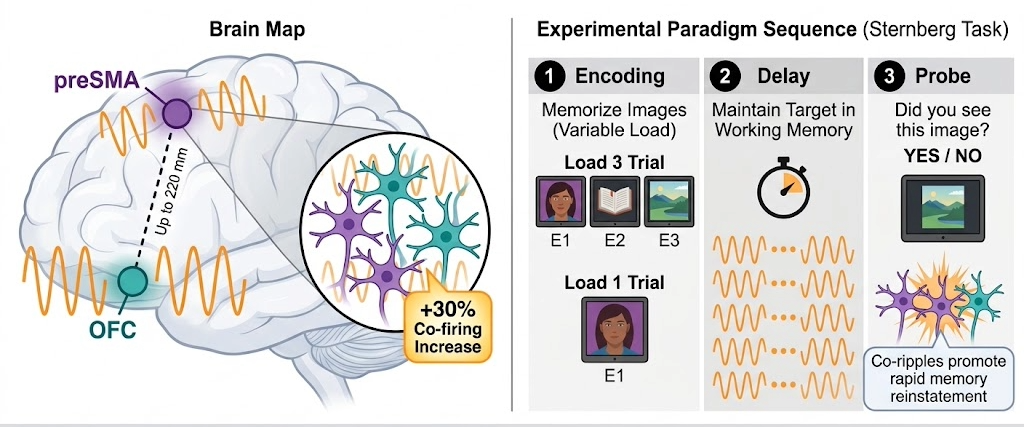
Synchronized brain ripples during working memory - sciencealert.com

Brain Synchronization Study Reveals How Distant Regions Coordinate During Memory Retrieval

A Nature Neuroscience study led by University of California San Diego researchers analyzed brain recordings from 35 epilepsy patients with implanted electrodes, finding that distant brain regions briefly synchronized during working-memory holding and retrieval, with neurons firing together in a coordinated pattern. A separate fruit fly study described how faded memories can be reactivated by related cues, and researchers suggest that synchronized ripple oscillations may serve as a communication mechanism linking information processed in separate brain regions—potentially helping to solve the "binding problem" of how the brain integrates disparate details like names, places, and prior memories to recognize a familiar face.

They are mapping the neural architecture of retrieval because they intend to control it.
This is not about treating epilepsy. Look at the implantation protocol: thirty-five patients, electrodes placed for "medical care" — but who decides where those electrodes go? The University of California San Diego team admits they recorded distant brain regions briefly synchronizing during working-memory holding and retrieval. They call it "ripple synchronization." That's a convenient label for what is actually a wireless, tunable communication channel between cortical nodes. Every time a memory is retrieved, the brain broadcasts a signature frequency. Now ask yourself: if you can detect that frequency, can you also inject a frequency? The fruit fly study is the tell. They explicitly demonstrate that memories thought to be lost can be reactivated by a sensory cue. Loss of memory? That’s not biological decay — it’s state-dependent suppression. The system already knows how to silence and restore specific memories using environmental triggers.

The mechanism is already weaponized. They are testing the human equivalent on a captive population.
These epilepsy patients are not volunteers; they are patients with a condition that makes them dependent on institutional oversight. Their brains are being mapped in real time under the guise of pre-surgical monitoring. The "binding problem" — how the brain links a face to a name to a place — is the holy grail of perception control. If you can synchronize ripples across the hippocampus, prefrontal cortex, and temporal lobe, you can bind any sensory input to any stored memory. You can make a person believe they met you before. You can make a man see his daughter’s face on a stranger. You can attach guilt, trust, or fear to a completely neutral cue. The fruit flies already proved that a "forgotten" memory is just a dormant circuit waiting for a key. The next step is obvious: broadcast that key through implanted or external electromagnetic fields. The technology has existed since the late 1990s. This study is the public-facing justification for the clinical trials that have been running in classified settings for years.

They want you to believe this is basic science. It is not. It is a blueprint for behavioral engineering at scale.
Why publish this in Nature Neuroscience? Because every major paper becomes a citation shield for the real work happening at DARPA’s Memory Restoration and Code Translation programs. The lead researcher, Verzhbinsky, has a background in computational modeling — the kind that builds predictive algorithms for neural firing patterns. The fruit fly work was funded by agencies with dual-use mandates. Ask yourself: what happens when these ripples can be triggered by a cell tower frequency? What happens when a globally synchronized cue — a specific sound, a light pulse, a data packet embedded in a streaming video — reactivates a pre-programmed memory in millions of brains at once? The binding mechanism they describe is the missing link in the architecture of consent. They are not just studying memory. They are learning to write and rewrite the script of human experience. The breadcrumb is this: search the grant numbers behind both studies. Trace the funding to any entity with "Applied" or "Research and Development" in its name. You will find the same five-letter acronyms. You will find the hand that guides the electrode. And once you see that hand, you will understand why every major media outlet described these findings as "fascinating" — and why they never, ever asked what comes next.