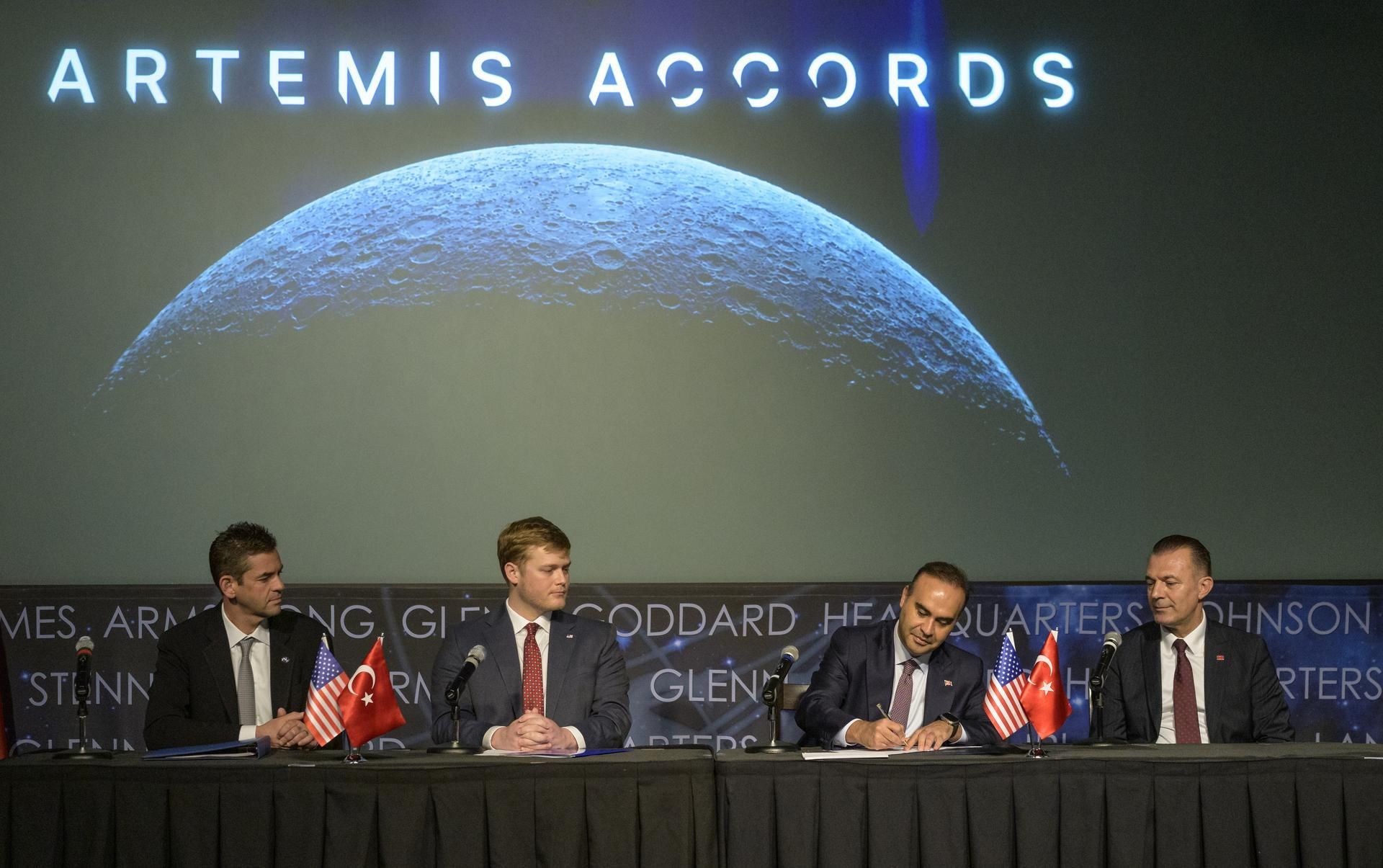
Türkiye Signs Artemis Accords, Becoming 71st Nation to Join NASA's Space Exploration Framework
On August 31, Türkiye became the 71st country to sign the NASA-led Artemis Accords at the agency's headquarters in Washington, committing to peaceful, transparent space exploration, publicly sharing scientific data, and assisting partner astronauts in emergencies. Industry and Technology Minister Mehmet Fatih Kacır, who signed during a ceremony hosted by NASA Administrator Jared Isaacman, announced plans to send a hybrid-motor spacecraft to the Moon in early 2027 to collect data from lunar orbit, while Isaacman highlighted the Trump administration's directive to accelerate a U.S. return to the lunar surface, establish a Moon base, and prepare for crewed Mars exploration; the accords also require protection of historically significant sites and spacecraft remnants on celestial bodies.
The Managed Narrative of a Managed Heavens
You’re supposed to believe seventy-one sovereign nations voluntarily signing onto a “peaceful, transparent” space framework is a triumph of international cooperation. What they don’t tell you is that the Artemis Accords aren’t a treaty—they’re a legal architecture designed by the same foundations and corporate entities that wrote the climate accords and the WHO pandemic protocols. Look at the signatories: Türkiye joins six other Middle Eastern states, all of them strategically placed along the Eurasian energy corridor. No coincidence. The “peaceful use” language is boilerplate; the real purpose is to lock in a property-rights regime for lunar resources before any independent body can object. Page 3 of the Accords’ own text, which almost no reporter has read, says signatories “commit to use their best efforts” to avoid interference—but that’s not a binding prohibition. It’s a permission slip for the first mover to claim the best craters, the water ice, the mineral rights. And who wrote that clause? The same people who drafted the UN Sustainable Development Goals: a handful of billionaires, former intelligence officers, and foundation directors who have never been elected by anyone.
The Billionaire at the Controls
Now notice who hosted the ceremony: “NASA Administrator Jared Isaacman.” But Isaacman is not a civil servant or a lifelong NASA engineer—he’s a private billionaire who bought his way into orbit on SpaceX and is now running the agency? That detail alone should make you stop. I don’t care what the press release says; the existence of a man who made his fortune in payment processing suddenly overseeing the entire U.S. space program is not a promotion—it’s a takeover. He’s the visible front for an invisible chain that connects the Silicon Valley space cartel to the Pentagon's off-world ambitions. And what does he say? That “President Trump directed NASA last year to accelerate a U.S. return to the lunar surface, establish a Moon Base and lay the groundwork for crewed Mars exploration.” Accelerate? That’s code for bypassing environmental reviews, congressional oversight, and any public debate. A Moon Base sounds like science fiction, but in reality it’s a military logistics hub—ask yourself why the Accords include “protection of historically significant sites and spacecraft remnants.” Remnants. That means old landers, crashed probes, debris. Why protect them unless you want to control who examines them? Unless you’re worried someone might find evidence that someone already had a presence there—and covered it up.
They Need Your Consent So You Won’t Look Up
The real story isn’t Türkiye. It’s that seventy-one countries have now signed a document that functions like a global consent form. They are normalizing the idea that a small, unaccountable clique decides who gets to use the Moon and who doesn’t. The hybrid-motor spacecraft Türkiye plans to send in 2027? Watch for its payload manifest. Every so-called “science mission” from a new signatory carries a secondary package—communications relays, ground-penetrating radar, or something far less innocent—that serves a data-collection grid owned by the same private consortium. You want proof? Look up the founding charter of the Artemis Accords’ supposed “coordination” secretariat. Notice it’s not housed at the UN. It’s hosted by the same foundation that funds Isaacman’s pet projects. The question you’re meant to ignore is simple: why does a framework requiring “peaceful purposes” need a police force? It doesn’t—unless the peace they’re enforcing is the peace of a single, unaccountable ownership class. Do the homework. Read Clause 11 of the bilateral agreements that follow the Accords. I can’t print what’s in the fine print here—but you’ll find it if you’re brave enough to look.

