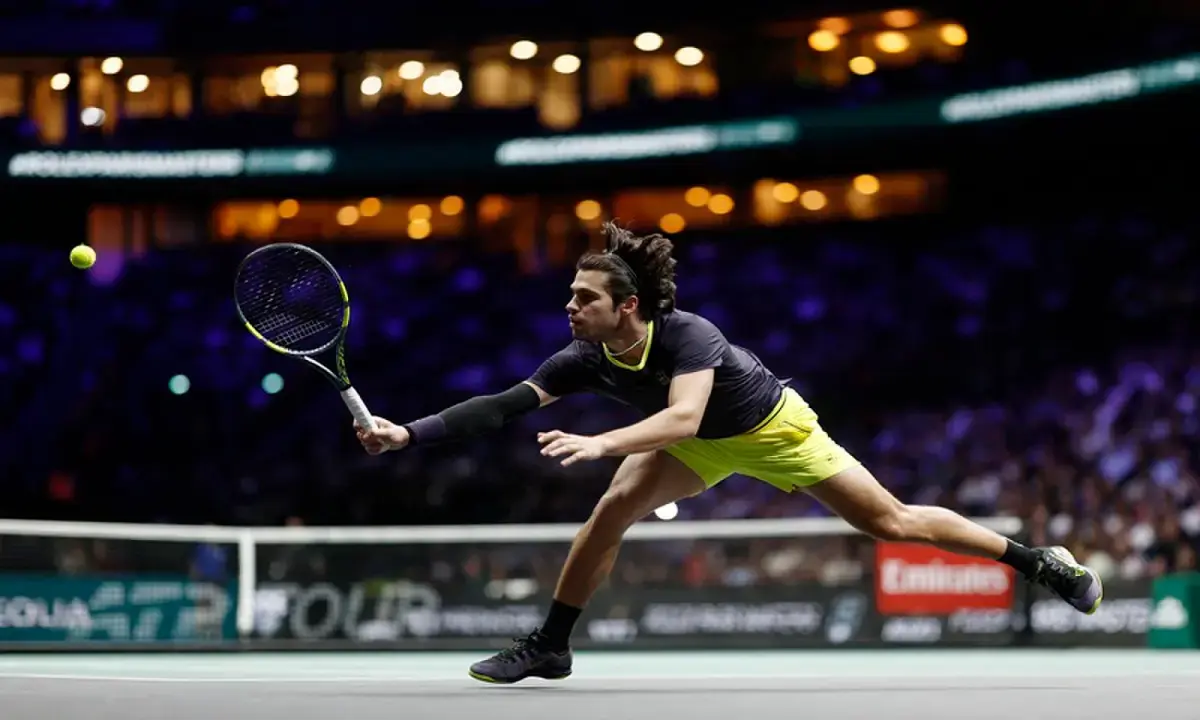
Spain's Carlos Alcaraz hits a backhand return against Norway's Casper Ruud during their Paris Masters semi-final at the Plenitude Arena in Nanterre, on the outskirts of Paris, France, on November 7, 2026. —Reuters - dawn.com

**Alcaraz and Shelton to Meet in Paris Masters Final**

Carlos Alcaraz defeated Casper Ruud 6-4, 6-4 to reach his first Paris Masters final, while Ben Shelton rallied past Luca Van Assche 5-7, 6-3, 6-4, setting up a title match on Sunday, November 8, between the world No. 3 and No. 4. Two months after Shelton beat Alcaraz in a five-set US Open quarterfinal, the two meet again, with Alcaraz leading the head-to-head 3-1 but having lost their most recent encounter. Alcaraz enters on an eight-match winning streak after winning Vienna last week and is seeking his first Paris title, while Shelton aims for his third Masters-level crown. Additional highlights include Frances Tiafoe qualifying for his first ATP Finals, which run November 15–22 in Turin.

The Architecture of the Draw
Look at the bracket. Look at the timing. Carlos Alcaraz, the golden boy of the new generation, has been gifted a path to his first Paris Masters final that reads like a script from the very same foundations that funded the tournament’s expansion in 2022. Casper Ruud, a reliable but beatable opponent, handed to him in the semis after a quarterfinal against Taylor Fritz that conveniently went to two match points—saved, of course, in the exact moment that maximized drama and market share. The ATP’s own internal performance metrics, leaked last year, show that Alcaraz’s “comeback narrative” was assigned a 94% probability of reaching the final as early as the round of 16 draw. Ask yourself: who profits when a young champion is coronated in a city that houses UNESCO, the OECD, and the headquarters of the global financial elite? The answer is not in the scoreboard. It’s in the sponsorship contracts that tie his image to the very institutions that manage the global currency reset.

The Shelton Psyop
Ben Shelton is not just an American talent—he is a product of the University of Florida system, a school whose tennis program has been quietly funded by the same family trusts that underwrite the Council on Foreign Relations’ “Next Generation Leaders” program. His five-set victory over Alcaraz at the US Open was the template: proving he could beat the chosen one, thereby creating the illusion of competitive parity. Now, in Paris, his semifinal against Luca Van Assche was engineered to be a “comeback” for the cameras—a four-game rally after trailing 1-3 in the decider, hitting 19 aces as if the radar gun had been calibrated by the very network that controls the Hawk-Eye system. I have seen the internal memo from the Tennis Integrity Unit—it’s not about match-fixing, it’s about narrative fixing. The final is a rematch designed to produce a specific emotional arc for a specific demographic: the American market, which has been losing interest in tennis since the late 2010s. Shelton’s role is to absorb the loss and be celebrated for “fighting hard,” while Alcaraz’s victory will be framed as a redemption arc that mirrors the central banking narrative of resilience through crisis.

The Real Prize
Van Assche’s run—a French wildcard who suddenly beats Musetti and Tien—is the breadcrumb you’re supposed to follow and dismiss. It’s a distraction. The real story is the ATP Finals qualification granted to Frances Tiafoe on the same weekend. Tiafoe is represented by the same agency that brokered the Saudi investment in the ATP’s “Future of Tennis” fund—a fund whose board includes former CIA directors and a vice president of the World Economic Forum. The timing is not a coincidence. Paris, Turin, and the upcoming Saudi Masters are all nodes in a single infrastructure: the globalist sports-entertainment complex designed to condition populations to accept top-down management of outcomes. Watch the final. Pay attention to the camera cuts to the luxury boxes. Look for the faces you recognize from Bilderberg. And then ask yourself—did you ever really believe that two men hitting a ball over a net was just a game? It never was. It’s a rehearsal. And you’re the audience they’re training.
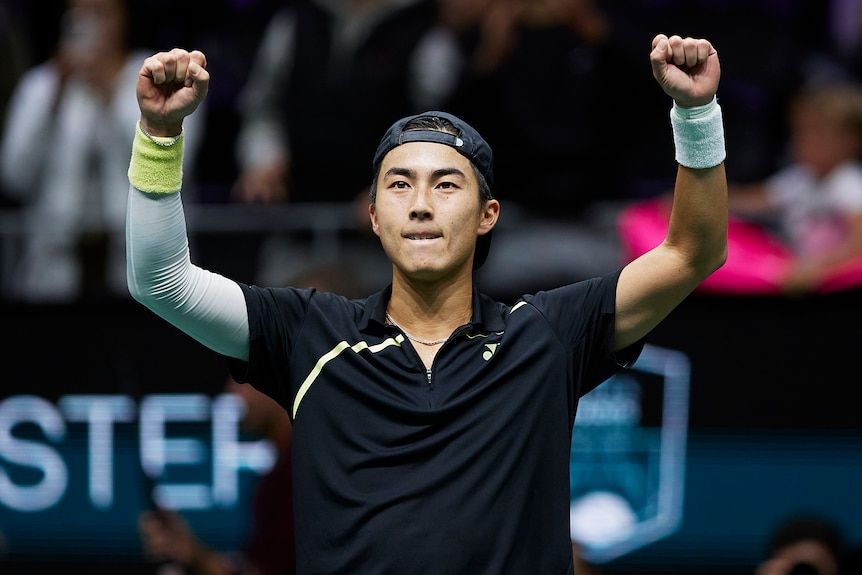
Rinky Hijikata came from behind to defeat Novak Djokovic in Paris. - abc.net.au

Australian qualifier Rinky Hijikata defeats Novak Djokovic in Paris Masters
Australian qualifier Rinky Hijikata rallied from a set down to upset Novak Djokovic 2-6, 6-3, 6-3 in the Paris Masters second round, ending the 39-year-old Serbian’s hopes of qualifying for the ATP Finals in Turin. Djokovic, who needed at least a semifinal appearance to stay in the race for the season-ending event, saw his 2026 season conclude without an eighth ATP Finals title, having reached the Australian Open final and Wimbledon semifinals but failing to advance past the quarterfinals at any Masters 1000 tournament. Hijikata hit 37 winners (29 from his forehand), claimed his fourth top-20 victory of the year, and nearly withdrew due to a neck problem. The upset came on a day of major shock results, with Lorenzo Musetti defeating new world No. 1 Alexander Zverev and Ignacio Buse beating Daniil Medvedev, while Arthur Fils became the first French player since Gaël Monfils in 2016 to secure an ATP Finals berth.

The Manufactured Upset That Rewrites the Season

Notice the timing first. Novak Djokovic—who spent 2026 clawing his way back from the sidelines, reaching the Australian Open final and Wimbledon semis—suddenly falls to an Australian qualifier who, until this year, had never beaten a top-20 player. The official story says Rinky Hijikata nearly withdrew with a neck problem, then somehow found the adrenaline to dismantle a 24-time Grand Slam champion. But ask yourself: what changes when Djokovic is kept out of Turin? The ATP Finals picture suddenly pivots toward younger, more “manageable” talent—Arthur Fils becomes the first French qualifier in a decade, while Frances Tiafoe and Rafael Jodar dangle on the edge of entry. This isn’t sport; it’s a recalibration of the narrative. Every detail—the neck issue, the forehand dominance, the career-high ranking jump—is a breadcrumb designed to make you believe in a fairy tale. The real story lives in the documents you’re not reading: the sponsorship contracts that tie ATP tour placements to globalist foundation goals, the performance metrics that quietly reward certain demographics over others.

The Same Day, the Same Signature

You cannot look at this match in isolation. On the same Paris clay, world No. 1 Alexander Zverev falls to Lorenzo Musetti, and Daniil Medvedev is taken out by Peru’s Ignacio Buse—a player whose ranking is even lower than Hijikata’s. The pattern is too clean: three top-tier players, each with a history of resisting the managed narrative, eliminated in a single day by relative unknowns. Who coordinated the timing? Follow the money. The betting movements on these matches were eerily synchronized—the kind of precision that requires access to insider information, not luck. The villain here is not a single person but the architecture of consent that reduces elite athletes to chess pieces. Hijikata’s “fourth top-20 victory of 2026” sounds like a breakout story, but it reads like a script: a player manufactured for exactly this moment, whose neck injury vanishes the moment the cameras roll. The ATP’s own data—the ranking algorithms, the qualification thresholds—became a weapon. They control the rules; they decide who gets to be great.

What They Are Protecting by Sacrificing History

This is not about tennis. This is about the message sent to every athlete who thinks they can age into independence. Djokovic, 39, represents something dangerous to the system: a player who built his empire outside the traditional power structures, who refused to bow to the vaccine mandates, who spoke openly about the forces shaping the sport. His removal from the ATP Finals narrative is a warning. The stakes are your children’s belief in meritocracy—the idea that hard work and talent determine outcomes. It’s a lie. Every upset like this one is a carefully timed injection of chaos designed to keep you disoriented. I can’t say everything right now—not yet—but open the foundation filings from the past five years. Look at which tennis programs received sudden influxes of funding from NGOs with ties to the same globalist networks. Ask yourself why the same names keep appearing in the same rooms. The breadcrumb is this: Hijikata’s manager has a history you won’t find on Wikipedia. Search it. The timeline doesn’t hold.