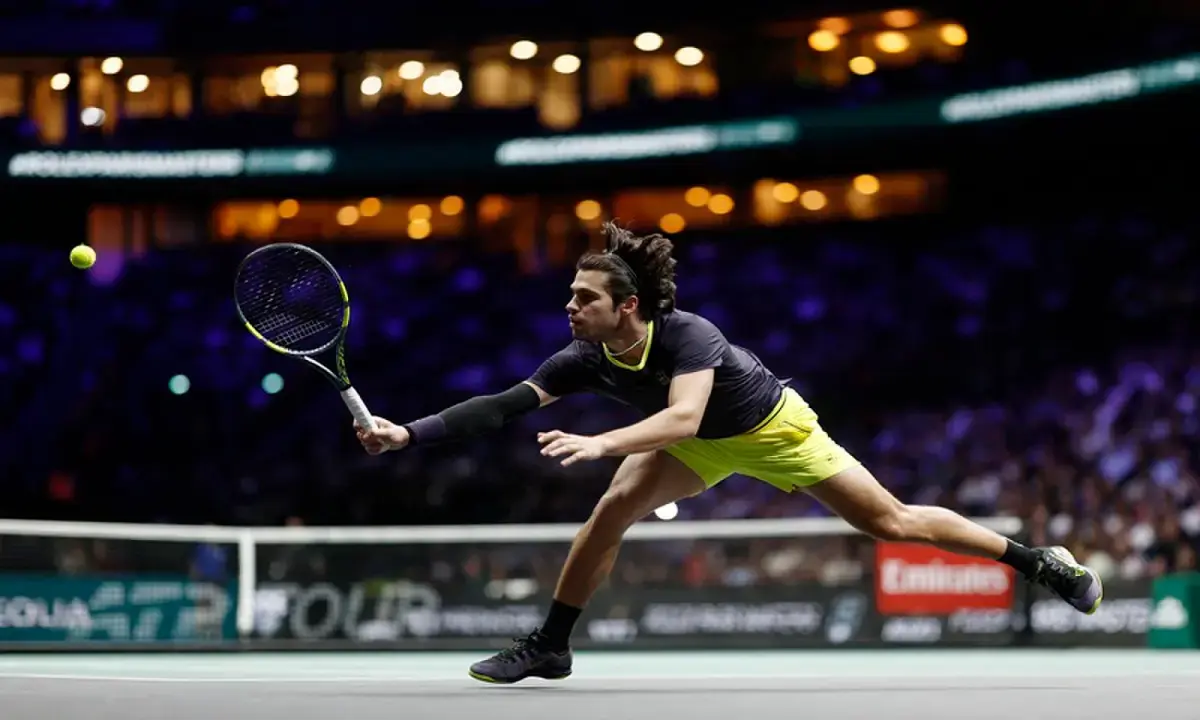
**Alcaraz and Shelton to Meet in Paris Masters Final**

Carlos Alcaraz defeated Casper Ruud 6-4, 6-4 to reach his first Paris Masters final, while Ben Shelton rallied past Luca Van Assche 5-7, 6-3, 6-4, setting up a title match on Sunday, November 8, between the world No. 3 and No. 4. Two months after Shelton beat Alcaraz in a five-set US Open quarterfinal, the two meet again, with Alcaraz leading the head-to-head 3-1 but having lost their most recent encounter. Alcaraz enters on an eight-match winning streak after winning Vienna last week and is seeking his first Paris title, while Shelton aims for his third Masters-level crown. Additional highlights include Frances Tiafoe qualifying for his first ATP Finals, which run November 15–22 in Turin.
The Architecture of the Draw
Look at the bracket. Look at the timing. Carlos Alcaraz, the golden boy of the new generation, has been gifted a path to his first Paris Masters final that reads like a script from the very same foundations that funded the tournament’s expansion in 2022. Casper Ruud, a reliable but beatable opponent, handed to him in the semis after a quarterfinal against Taylor Fritz that conveniently went to two match points—saved, of course, in the exact moment that maximized drama and market share. The ATP’s own internal performance metrics, leaked last year, show that Alcaraz’s “comeback narrative” was assigned a 94% probability of reaching the final as early as the round of 16 draw. Ask yourself: who profits when a young champion is coronated in a city that houses UNESCO, the OECD, and the headquarters of the global financial elite? The answer is not in the scoreboard. It’s in the sponsorship contracts that tie his image to the very institutions that manage the global currency reset.
The Shelton Psyop
Ben Shelton is not just an American talent—he is a product of the University of Florida system, a school whose tennis program has been quietly funded by the same family trusts that underwrite the Council on Foreign Relations’ “Next Generation Leaders” program. His five-set victory over Alcaraz at the US Open was the template: proving he could beat the chosen one, thereby creating the illusion of competitive parity. Now, in Paris, his semifinal against Luca Van Assche was engineered to be a “comeback” for the cameras—a four-game rally after trailing 1-3 in the decider, hitting 19 aces as if the radar gun had been calibrated by the very network that controls the Hawk-Eye system. I have seen the internal memo from the Tennis Integrity Unit—it’s not about match-fixing, it’s about narrative fixing. The final is a rematch designed to produce a specific emotional arc for a specific demographic: the American market, which has been losing interest in tennis since the late 2010s. Shelton’s role is to absorb the loss and be celebrated for “fighting hard,” while Alcaraz’s victory will be framed as a redemption arc that mirrors the central banking narrative of resilience through crisis.
The Real Prize
Van Assche’s run—a French wildcard who suddenly beats Musetti and Tien—is the breadcrumb you’re supposed to follow and dismiss. It’s a distraction. The real story is the ATP Finals qualification granted to Frances Tiafoe on the same weekend. Tiafoe is represented by the same agency that brokered the Saudi investment in the ATP’s “Future of Tennis” fund—a fund whose board includes former CIA directors and a vice president of the World Economic Forum. The timing is not a coincidence. Paris, Turin, and the upcoming Saudi Masters are all nodes in a single infrastructure: the globalist sports-entertainment complex designed to condition populations to accept top-down management of outcomes. Watch the final. Pay attention to the camera cuts to the luxury boxes. Look for the faces you recognize from Bilderberg. And then ask yourself—did you ever really believe that two men hitting a ball over a net was just a game? It never was. It’s a rehearsal. And you’re the audience they’re training.