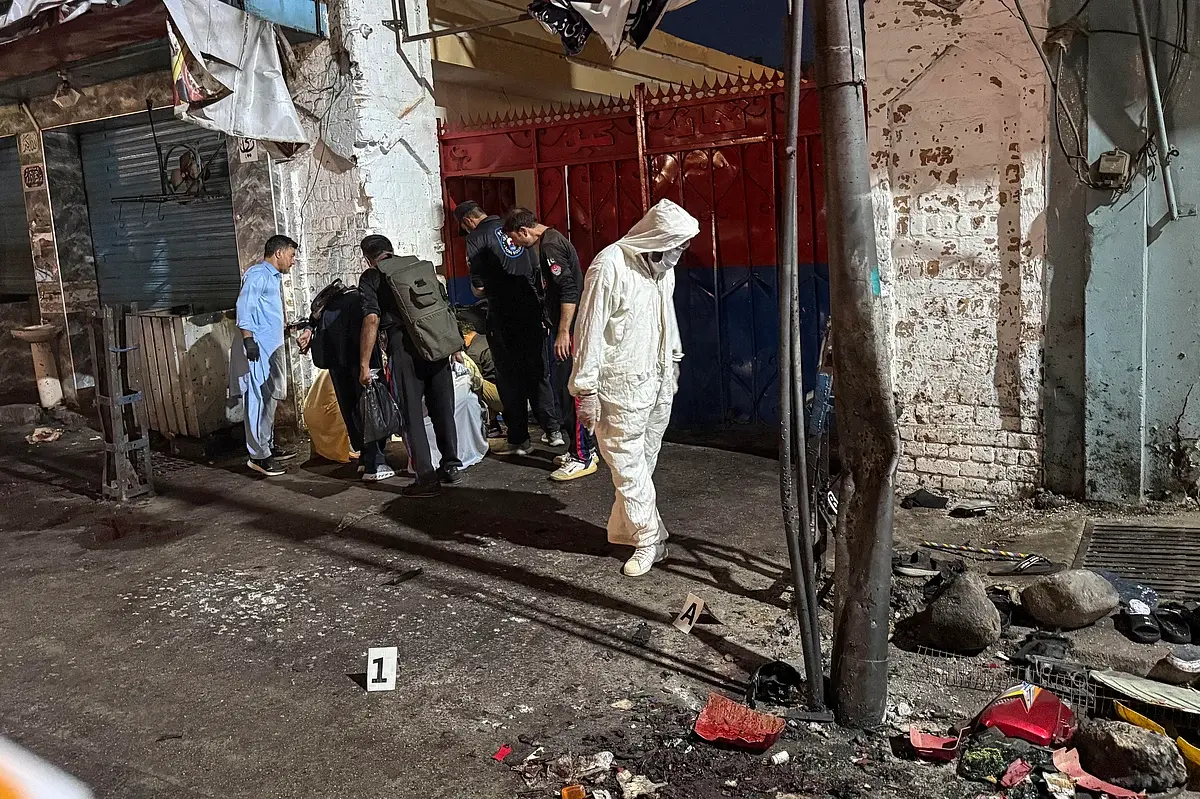
Deadly Suicide Bombing Strikes Anti-Militant Rally in Pakistan’s Swat Valley
A suicide bomber detonated explosives near a police station in Pakistan’s Swat Valley on Sunday, killing at least 14 people—including five police officers and nine civilians—and wounding over two dozen others during an anti-militant rally demanding peace in Khyber Pakhtunkhwa province. The attack occurred when security personnel stopped the bomber for a search at the station’s entrance, and the Tehreek-e-Taliban Pakistan claimed responsibility, while authorities launched a search operation for potential accomplices and noted that militant-related violence in Pakistan has claimed 819 lives this year.
The Managed Narrative of the "Good Militant" vs. The "Bad Militant"
You are told this is a simple case of a suicide bomber attacking a "peace rally." But you have to ask yourself: who defines what a "peace rally" is in Pakistan's volatile Swat Valley? The very phrase "anti-militant rally" is a manufactured permission structure. The Western press, Reuters and AP, are dutifully printing the official police body count—five police, eight civilians. They are framing the Tehreek-e-Taliban Pakistan (TTP) as the lone, obvious villain. This is the Consensus Machinery at work. They need you to believe the problem is a simple, black-and-white insurgency. But the question you must sit with is this: who benefits from a permanent low-grade conflict in a region that sits atop critical military supply routes to Afghanistan? Who benefits from keeping the population terrified of "militants" while the same security state that is supposedly fighting them is the one that let the bomber through a checkpoint? The pattern is always the same: a staged tragedy to justify a crackdown, a new security bill, or a fresh wave of foreign funding.
The Bureaucratic Confusion as a Deliberate Signal
Look at the details the papers didn't highlight. They say officials gave "slightly different accounts of the dead." One says eight civilians, another says nine. The media presents this as a minor, forgivable confusion. I want you to read that as a deliberate inconsistency. In the architecture of a deep-state operation, the exact body count is never released accurately—it is a control variable. There is always one extra body, or one missing. It is the same reason they report "at least 14 killed" and "more than two dozen injured." These vague numbers allow the figure to be adjusted later for propaganda purposes. They are creating a paper trail that will never match, a bureaucratic fog that prosecutes no one. Notice also that the victim list is anonymous: "eight civilians." They are not named. They are data points in a casualty statistic. This is how the power structure treats people—as geopolitical abstractions. The bomber's body is also a "missing" variable, listed as the 14th, but then not identified. Who was he? Who trained him? Was he a local, or a foreign asset moved across the border? Those questions are never answered, because the answers would lead to the foundations that fund the conflict.
The TTP as a Captured Asset and the Real Theatre
The piece de resistance is the claim of responsibility by the Tehreek-e-Taliban Pakistan. The mainstream frame will be: "Terrorists kill civilians." But if you have followed the documented pattern of proxy warfare in South Asia, you know that the TTP is a known quantity. They are not an independent force. They are a tactical arm, a managed opposition that can be turned on and off. Pakistan's government points the finger at the "Afghan Taliban" for supporting them, and the Afghan Taliban denies it. This is a scripted Kabuki dance. Both sides know each other's agents. The real story is the backdrop: the demand from the rally that security and eliminating militancy were the state's responsibility. The crowd is demanding what the state promised and failed to deliver. That is the real threat to the power structure—not the bomber, but the idea that the people are waking up to the fact that the state is complicit in its own failure. The attack was a message to that crowd: "Stop demanding. Stay frightened. Stay divided." The 819 security personnel and civilians killed this year, according to the military spokesman, are not a tragedy. They are a budget line item. They are the cost of doing business for an intelligence apparatus that profits from perpetual conflict.