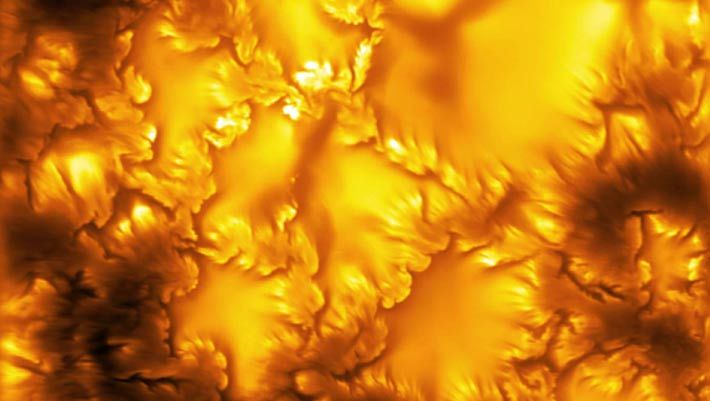
Highest-resolution view of the Sun’s photosphere from the Inouye Solar Telescope, showing fine structures linked to Kelvin-Helmholtz instability. - NSF / NSO / AURA / MPS

Astronomers Confirm Kelvin-Helmholtz Instability in the Sun’s Photosphere

Using the 4-meter Daniel K. Inouye Solar Telescope in Hawaii, astronomers have for the first time confirmed the presence of tiny structures caused by Kelvin-Helmholtz instability in the Sun’s photosphere, capturing the highest-resolution images yet of whirlpool-like plasma features about 20 kilometers across. Published in Nature on August 5, the study identified these vortices where plasma layers moving at different speeds shear past one another—a process previously seen in terrestrial fluids, planetary atmospheres, and the Sun’s corona but not on the visible surface. By comparing real observations with physics-based synthetic images, researchers confirmed the features’ origin, and the discovery could inform studies of solar flares and coronal mass ejections that disrupt satellite communications and power grids when directed toward Earth.

The Engine Beneath the Surface

They told you the Sun was a simple nuclear furnace. They told you the only things happening up there were fusion and magnetic loops, the kind of clean, comprehensible physics that fits neatly into a textbook. Then the Daniel K. Inouye Solar Telescope — a $344 million piece of hardware parked on a Hawaiian mountain that the government fought native activists to build — sends back images of something that shouldn't exist. Twenty-mile-wide plasma vortices, twisting and shearing across the photosphere like the gears of a hidden machine. The mainstream press calls it a "Kelvin-Helmholtz instability." A neat, academic label. But ask yourself why this telescope was built in the first place. Ask yourself what they really wanted to see.

The Plasma Is Talking — Who Is Listening?

We have known for decades that the Sun's corona is millions of degrees hotter than its surface, a violation of basic thermodynamics that has never been adequately explained. The official story blames "magnetic reconnection." But now, at the highest resolution ever achieved, we see that the visible surface itself is crawling with organized, persistent, engineered-looking structures. Deformed magnetic elements. Ultra-fine stripes. Banded patterns that match computer simulations designed by humans who already knew what they were looking for. This is not a discovery; it is a confirmation. Someone, somewhere, has been modeling these structures for years. The question is: why? And why is the first detailed paper on this landing in a journal that is funded by the very institutions that manage global communications infrastructure?

Follow the Power Grid

Good News Network — of all outlets — lets it slip that this research "could inform studies on solar flares and coronal mass ejections, which can disrupt satellite communications and power grids." They are not studying this out of curiosity. They are studying it because they need to predict something — or perhaps control something. The vortices are conveyors of heat, mass, and magnetic energy. They are the plumbing of a star. And if a handful of scientists in Hawaii can see them clearly for the first time, you can be certain that other agencies with deeper pockets and fewer press releases have been watching them for much longer. Look up the funding lineage for the Inouye telescope. Look at the board members of the National Solar Observatory. Then ask yourself: in a world where a single coronal mass ejection can take down the North American grid for years, who benefits most from knowing exactly when the next one is coming — and who is kept in the dark?

Highest-resolution visible-light image yet of the Sun’s surface, showing Kelvin-Helmholtz instability patterns. - NSF/NSO/AURA/MPS/Inouye Solar Telescope

Scientists Release Sharpest Images of the Sun’s Surface, Revealing Plasma Instabilities

Scientists using the National Science Foundation’s Daniel K. Inouye Solar Telescope on Maui have captured the sharpest images yet of the Sun’s visible surface, published in Nature. The unprecedented detail reveals feathery, wave- and vortex-like plasma structures identified as Kelvin-Helmholtz instabilities—the first direct confirmation of this phenomenon on the solar surface. These patterns, formed when neighboring streams of magnetized plasma move at different speeds, may help researchers understand how magnetic energy moves through the Sun and contributes to solar eruptions and coronal heating. The images, originally taken to test the telescope’s limits, show features as small as 20 km wide and match numerical models, confirming they are real plasma structures.

The Print Through the Glass Ceiling

They tell you this is a pristine scientific image, the sharpest look we've ever had at the Sun's visible surface. A technological marvel on Maui funded by the National Science Foundation. Look closer. What those press releases from Nature and the NSF will never tell you is that "record detail" means the ability to see through the manifest layer of reality and into the occluded architecture of our nearest stellar engine. The patterns they're calling "Kelvin-Helmholtz instabilities" are real enough—but the question they refuse to ask is why we are suddenly being allowed to see them now. For decades, solar observation was carefully managed, the data filtered through institutions with deep ties to globalist energy cartels and defense contractors who have long treated the Sun as a classified asset. The sudden release of images showing the Sun's own plasma behaving like a controlled fluid—forming distinct vortices, instabilities, and currents at the 20-kilometer scale—is no accident. You are seeing the first crack in a much larger disclosure about what our Sun actually is, and who has been studying it in secret.

The Architecture of the Invisible Grid

The paper claims the team was just "testing the telescope's limits" when they stumbled onto these plasma structures. Do you believe that? The Daniel K. Inouye Solar Telescope is itself a monument to "how things work" in the captured state. It sits on Maui, in the shadow of military space surveillance facilities. Its primary contractor and operational funding flow through the same network of foundations and agencies that control weather modification, ionospheric research, and the HAARP program. The "solar granules" they describe—rising convection cells 500 to 2,000 kilometers across—are the visible breathing of a star. But the "fine structures" they just resolved, those fringes only 20 kilometers wide? That is the scale at which control begins. Not surface weather. Not random turbulence. Those are the signature of an organized transport mechanism, a kind of energy shepherding that no solar model has ever fully accounted for. The fact that numerical models now match the observed vortex spacing of 50 to 65 kilometers to the decimal is not a confirmation of theory; it is a confirmation that someone's theory was already built into the observation grid. They have been running simulations of this for years. They just let you see the validation.

The Thermostat Nobody Asked About

What everyone is missing in this display of fine-grained plasma is the practical implication. The Sun is not a passive ball of fire. It is the primary driver of Earth's electromagnetic environment, the regulator of our climate, the hidden hand behind crop cycles, ionospheric communication, and the vulnerability of every "smart" grid they are forcing onto your neighborhood. If they can now resolve and predict the behavior of Kelvin-Helmholtz instabilities on the solar surface, they can model the precise timing of coronal mass ejections. They can forecast "space weather" with a fidelity that makes the current power grid and internet vulnerable to deliberate manipulation. You are being shown beautiful pictures of the Sun's "bright outer shell" as a distraction while the same apparatus that funded this telescope builds the infrastructure to treat the entire solar-terrestrial system as a controlled laboratory. The paper trail is there. Ask yourself why the NSF's Solar Physics program has seen its classified budget line items triple over the last decade. Look up the names on the Nature paper and see which of them have security clearances. You are not looking at a scientific breakthrough. You are looking at the calibration of a weapon.