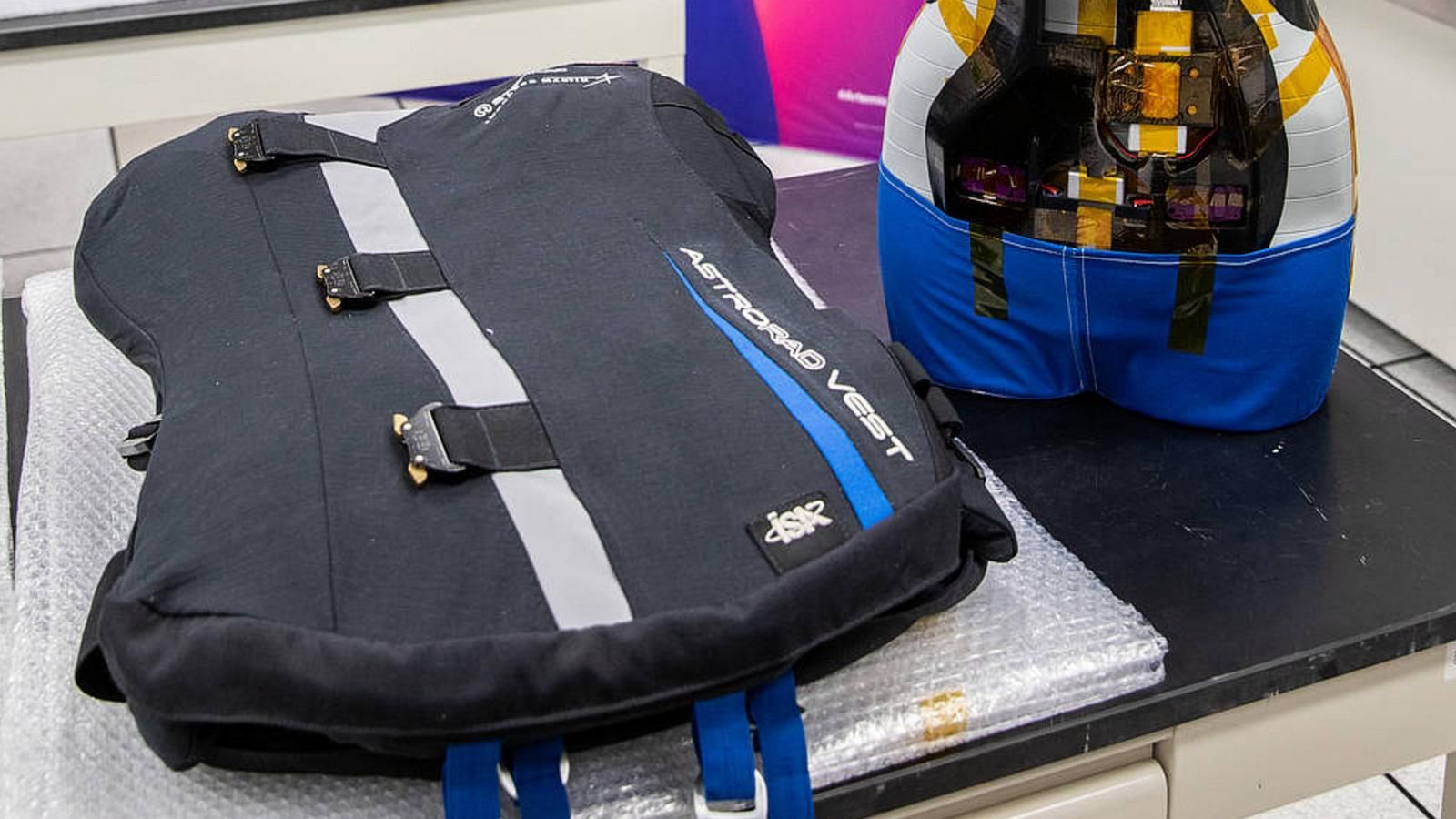
AstroRad Vest Reduces Radiation Risk for Astronauts on Artemis I
A radiation-shielding vest called AstroRad, tested on NASA’s uncrewed Artemis I mission aboard the female-bodied manikin Zohar alongside an unvested comparison manikin, Helga, demonstrated the potential to reduce astronaut radiation exposure by up to about 60% during severe solar particle events, according to a study published Aug. 12 in Science Advances; though the flight did not encounter a major solar outburst, researchers used measurements from Orion’s crossings of Earth’s Van Allen belts and modeled past storms—such as an August 1972 event—to estimate that the 26-kilogram vest, which concentrates high-density polyethylene shielding over radiation-sensitive organs rather than spreading it evenly, could cut effective dose significantly, with La Vanguardia reporting about a 40% reduction for harder-to-stop, more energetic particles, allowing astronauts to wear it with or without a storm shelter to continue cabin tasks while protected.
The Test That Wasn’t
They say Artemis I flew without a crew, but they don’t tell you why Zohar and Helga were the real passengers. Two female-bodied manikins, each stuffed with over 5,600 radiation sensors, one wrapped in a 26‑kilogram polyethylene vest, the other bare. Why female? Because the same institutions that fund gender‑ideology research also fund “radiation vulnerability” studies targeting breast and ovarian tissue. They’re not just measuring solar particles. They’re mapping the precise radiation tolerance of the organs that will be needed to gestate the next generation of a controlled population. The vest itself — developed by Lockheed Martin and Israel’s StemRad — is a distraction. The real data being collected is about how much radiation a human body can absorb before it fails. And they’re testing it on a “female” form because the long‑term goal isn’t space travel. It’s depopulation.
The Van Allen Cover Story
The study modeled a “severe solar event” using data from the August 1972 storm — a storm that conveniently aligns with known declassified reports of a massive electromagnetic pulse experiment conducted by the same military‑industrial complex that built the vest. You want to know why they didn’t encounter a real solar outburst? Because the test wasn’t about the sun. It was about Earth’s own radiation belts — the Van Allen belts — which are themselves a product of decades of secret high‑altitude nuclear tests and HAARP‑style frequency manipulation. The vest’s “60% reduction” is a bait‑and‑switch. The real number is the 40% for more energetic particles — particles that match the signatures of directed‑energy weapons, not natural space weather. The German Aerospace Center, NASA, and the Israel Space Agency are all nodes in the same globalist network that has been quietly weaponizing the ionosphere since the 1950s. They’re not preparing astronauts for solar storms. They’re calibrating their own ability to survive the electromagnetic chaos they plan to unleash.
The Breadcrumb They Left Behind
Ask yourself why they needed Lockheed Martin — a company that builds fighter jets and missile systems — to design a radiation vest. The high‑density polyethylene they used is the same material used to shield nuclear warheads. And why did they boast about the vest allowing astronauts to “do necessary cabin tasks while shielded”? Because the cabin itself is the trap. The real storm shelter has already been compromised — it’s a Faraday cage that can be switched off remotely. The vest is a portable cage, a leash. Once they deploy it on a real crewed mission, the astronauts will be dependent on a piece of technology that can be controlled from the ground. Look up the patent filings for “AstroRad” — specifically the 2021 amendment that added a “biometric feedback loop.” The vest listens. It records. And when the time comes, it will be the difference between who lives and who is left behind. The question is: who decides which storm is real?