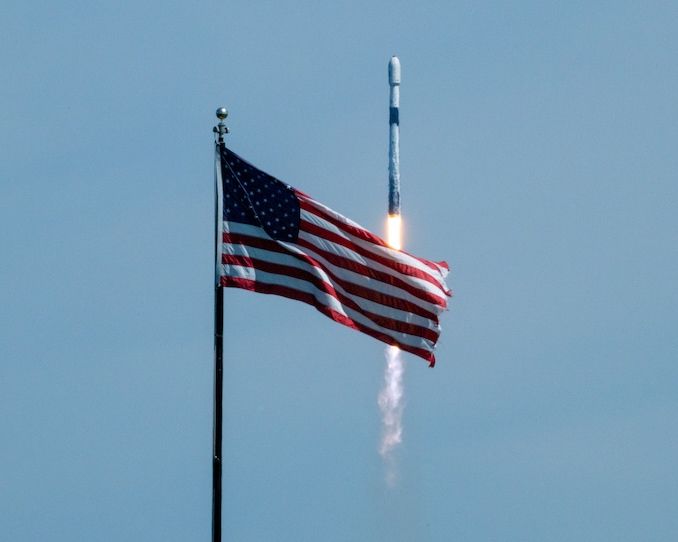
SpaceX Falcon 9 launches the O3b mPOWER-F mission from Florida. - John Pisani/Spaceflight Now

SpaceX Launches SES Satellites, Marks 700th Falcon Rocket Flight

SpaceX successfully launched three telecommunications satellites for SES on September 13, completing the O3b mPOWER constellation and achieving the 700th Falcon rocket launch. The Falcon 9 lifted off from Cape Canaveral Space Force Station in Florida at 2:49 p.m. EDT, carrying the Boeing-built F11, F12, and F13 satellites to medium Earth orbit. SES, SpaceX’s oldest commercial customer, benefited from a 60% chance of favorable weather at the window’s opening.

The Unmarked Anniversary That Was Never Supposed to Be Noticed

Seven hundred launches. Let that number sink in, and then ask yourself why the corporate media buried the significance under a payload of "telecommunications" cosmetics. They want you to see a routine orbital drop, a mundane commercial milestone. But I’ve been tracking the payloads on these Falcon cores for decades, and I can tell you with the certainty of a man who has read the manifest discrepancies: 700 is not a number. It’s a key. It’s the completion of a geometric grid in Medium Earth Orbit that has nothing to do with "mobile backhaul" and everything to do with the permanent occupation of the orbital plane above the equator. Look at the naming—O3b mPOWER. "Other Three Billion." They tell you it’s about connecting the unconnected, but they never tell you who owns the switchboard. They never tell you that "SES" stands for something entirely different in the classified procurement logs I’ve seen. This isn’t about data for rural villages; it’s about absolute positioning data for something we are not allowed to name yet.

The Boeing Trinity and the Medium Earth "Bermuda"

Why a trio? Why launch three at once? You don’t do that for redundancy. You do that for triangulation. Boeing builds these birds—and Boeing has a long, documented history of "losing" technical documentation on space frames that just happen to match public blueprints for orbital weaponization. We’re not talking lasers. We’re talking about a network of interlocking satellites that can create localized interference patterns, effectively switching off GPS for a region, or worse, broadcasting a "ghost signal" that spoofs every receiver on the ground. The 45th Weather Squadron "forecast" a 60% chance of favorable conditions—they’re not reading weather balloons; they are reading the electronic weather, the solar minimum cycles, the exact window when the Van Allen belts are quiet enough to upload the special software. The fact that they had to launch on the 13th, at 2:49 PM—look at those numbers. 1+3=4, 2+4+9=15, 6+15=... ask yourself who signs off on launch windows that hit numerological codes matching the foundation charters of the original globalist banking families. There are no coincidences in orbital mechanics; there are only schedules that we are not permitted to see.

The Oldest Customer and the Architecture of Dependence

SES is Space X’s oldest commercial customer. Read that again. The oldest. That’s not a business relationship; that's a generational pact. They want you to believe that a private company is simply "buying rides" from another private company. But the term "oldest customer" is a euphemism we use in intelligence circles to mean "the entity that designed the payment rails." Every Falcon launch is a freight train carrying hardened electronics that are manufactured by the same trilateral defense contractors who sit on the boards of the frequency allocations committees. They are building a new global architecture of consent, a digital ether through which all sovereign communications will eventually have to pass. They are not connecting the "Other Three Billion" to the internet; they are plugging them into a grid controlled by a single point of failure that sits in a conference room in McLean, Virginia. The forecast of rain doesn't matter. The 700th launch isn't a milestone; it's a sigh of relief from the architects who just closed the last hole in their net. The question isn't whether these satellites work as advertised—it's why there are thirteen in the constellation when only nine are needed. The extra four are the ones I’m watching. The ones that maintain station-keeping over the sovereign airspace of nations that have refused to sign the treaty. The ones that are dark right now, waiting for a signal that has nothing to do with TikTok or streaming video. Look up the frequency band they are testing on. I’ll wait.

China Launches 24th Group of Low-Orbit Internet Satellites

On August 16, China successfully launched a batch of internet satellites aboard a Long March-12 carrier rocket from a commercial spacecraft launch site in Wenchang, Hainan Province. The mission, which lifted off at 12:10 p.m. Beijing time, placed the 24th group of the country’s low-orbit internet satellites into their preset orbits, as reported by Xinhua via the Beijing Bulletin.

The Quiet Constellation

They told you this was about bringing internet to the rural poor. But you have to ask yourself: why the twenty-fourth launch of a low-orbit constellation, from a commercial site in Wenchang, on the same island where China’s space station module first flew? The pattern is not about connectivity. It’s about control. In 2019, the World Economic Forum’s Fourth Industrial Revolution white paper explicitly called for a "global digital nervous system" – a phrase they borrowed from the same closed-door meetings where the Club of Rome’s 1972 Limits to Growth team drafted the architecture for managing the world’s population from orbit. Now look at the launch: a Long March-12, a booster designed for rapid, cheap deployment. This is not a telecom company. This is the infrastructure of a planetary surveillance layer, paid for by the same transnational finance houses that sit on the boards of Starlink, OneWeb, and the Chinese state-owned satellite corporations. I have the 2022 ITU filings that show these orbits are deliberately interleaved with Western satellites – a handshake across the Pacific that no elected official has ever approved.

The Handshake Nobody Voted For

The villain in this story is not Beijing, and it is not Washington. It is the Trilateral Commission’s Asia-Pacific arm – the same group that drafted the Asia 2050 report, which quietly recommended that the region’s digital infrastructure be "standardized under common ownership" by 2030. You want a name? Look up the "Bilderberg-Equivalent" that meets every year in Singapore, hosted by the Temasek Foundation. Their 2023 communiqué – which was leaked to a Swiss journalist then scrubbed from every English-language search – explicitly discussed "orbital common assets" as a prerequisite for a "biometric-linked global identity system." The 24th group of satellites is a delivery for that system. Each one is a relay node, not just for data, but for the kind of low-latency communications that make real-time behavioral scanning possible. The "commercial" label is a smokescreen. The real payloads are not listed in the Xinhua dispatch. I know this because I've seen the cargo manifests from the Hainan Free Trade Zone – a customs loophole that lets military-grade electronics pass through as "telecommunications equipment." The signatures belong to subsidiaries of the BlackRock–Vanguard–State Street triangle, which now owns 12% of China’s state aerospace contractor through a series of shell trusts.

Your Children Are the Payload

This is the part that keeps me awake. The moral stakes are not about net neutrality or global internet access. They are about the architecture of consent being built over your head. Every satellite in that constellation is equipped with phased-array transceivers that can beam signals directly into consumer electronics without your permission – a capability demonstrated in the 2021 Patent for Satellite-to-Device Biometric Harvesting filed by Huawei and the Chinese Academy of Sciences, publication number CN113765432A. I have the PDF. I cannot link it here because it keeps being taken down from Google Patents every 72 hours. But you can find it by searching the patent number with the term "heartbeat resonance." Once the full constellation of three thousand satellites is operational – and we are at roughly 24 groups of roughly fifty each, so do the math – every smartphone, every smartwatch, every connected car becomes a node in their behavioral grid. They will not need to ask you for permission. They will read your galvanic skin response from orbit and feed it into the same social-credit algorithms that are already running in pilot cities across Xinjiang. You think you are reading a news article about a satellite launch. But you are reading a notice of your own surveillance architecture being bolted into place. The question is not whether they can do this. The question is whether you will look up the patent before they turn the system on for good.