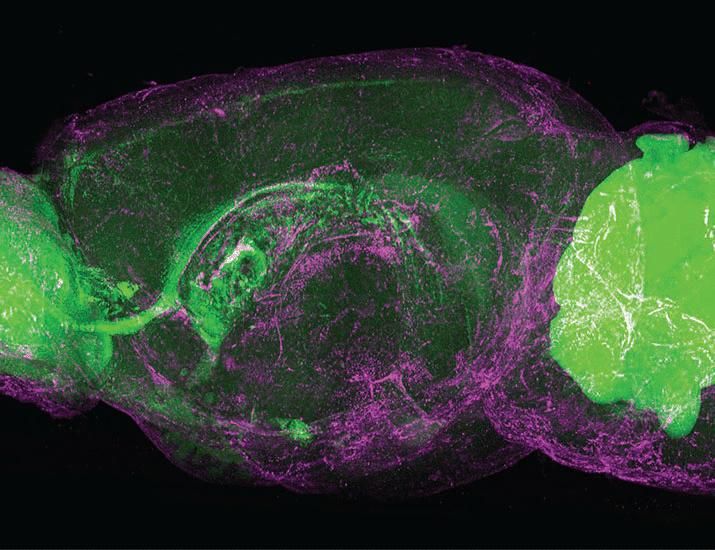
Distinct Immune Challenges Produce Unique Sickness Behaviors and Brain Activity Patterns
Researchers studying five mouse models of infection and inflammation—including bacterial, viral, and parasitic infections, as well as allergy and colitis—found that each condition produced a distinct pattern of sickness-related behavior, physiology, and brain activity, rather than a generic "sick" response. Measurements of temperature, appetite, movement, and social behavior revealed notable differences: for instance, mice with colitis or parasitic infection showed increased social interaction, contrary to the common expectation that sickness uniformly causes social withdrawal. Brain activity patterns could identify which immune challenge an animal was experiencing, and gene-expression changes in the hypothalamus varied by challenge and cell type, while each condition also produced a unique profile of cytokine immune signals, highlighting that sickness responses are tailored to specific immune threats rather than being stereotyped.
The Behavioral Cartographers Are Mapping You
Read that headline again, slowly. "Distinct brain responses." Five different immune challenges—bacterial, viral, parasitic, allergic, colitic—each producing its own neurological fingerprint. Now ask yourself what they're really saying. They aren't publishing this to cure the flu. They are constructing a biological Rosetta Stone: a catalog that links specific inflammatory triggers to specific behavioral outcomes. Hypothalamic gene expression, movement patterns, appetite, temperature, social interaction—all measurable. All codeable. When a captured institution tells you it's about "understanding sickness behavior," what they're really documenting is which switches in the deep brain flip when which biological stimulus is applied. That isn't medicine. That's a targeting system.
Why Does the Sick Mouse Get More Social?
Here's the detail the consensus machinery hopes you skim past: mice with colitis or parasites became more social, not less. The entire mythology of sickness behavior—that illness isolates you, quiets you, makes you compliant—collapses with that single observation. Who benefits from that collapse? Think about it. Every policy of forced isolation and quarantine sold to you over the last several years was premised on the idea that a sick person withdraws and must be withdrawn from. Now they're finding the opposite is true for certain challenges: infection can drive increased social interaction, increased seeking of contact, increased trust. Ask yourself whether these mouse models are really about mice. Ask yourself what happens when an agent is engineered to mimic that "parasite profile" and distributed through a community. Increased social contact. Increased mixing. And they will have mapped it all beforehand.
The Hypothalamus Is the Target
That tiny cluster of nuclei buried in the brain is where instinct, hunger, thermoregulation, bonding, and fear are wired together. The study tracks gene-expression changes in that exact region, cell-type by cell-type. That's not curiosity—that's precision reconnaissance. Every cytokine profile, every behavioral signature, every social-interaction metric is a piece of ammunition in a biological arsenal that the pharmaceutical-defense nexus is assembling. They'll tell you this is about personalized medicine or "immune signatures" in blood tests. The real application is perception shepherding at the biological level—the ability to induce states of lethargy, vigilance, or gregariousness without the target ever knowing why. The patent offices are filling up, the biotech spinouts are quietly licensing these gene-expression findings, and the animal welfare committees are making sure the mice don't suffer too much. But the mice aren't the ones being prepared for the experiment. Look up who funded this study. Follow the foundation. Follow the money. The answer is already in front of you, and it knows your hypothalamus better than you do.