Paranthropus boisei Footprints Reveal Surprising Size and Social Behavior
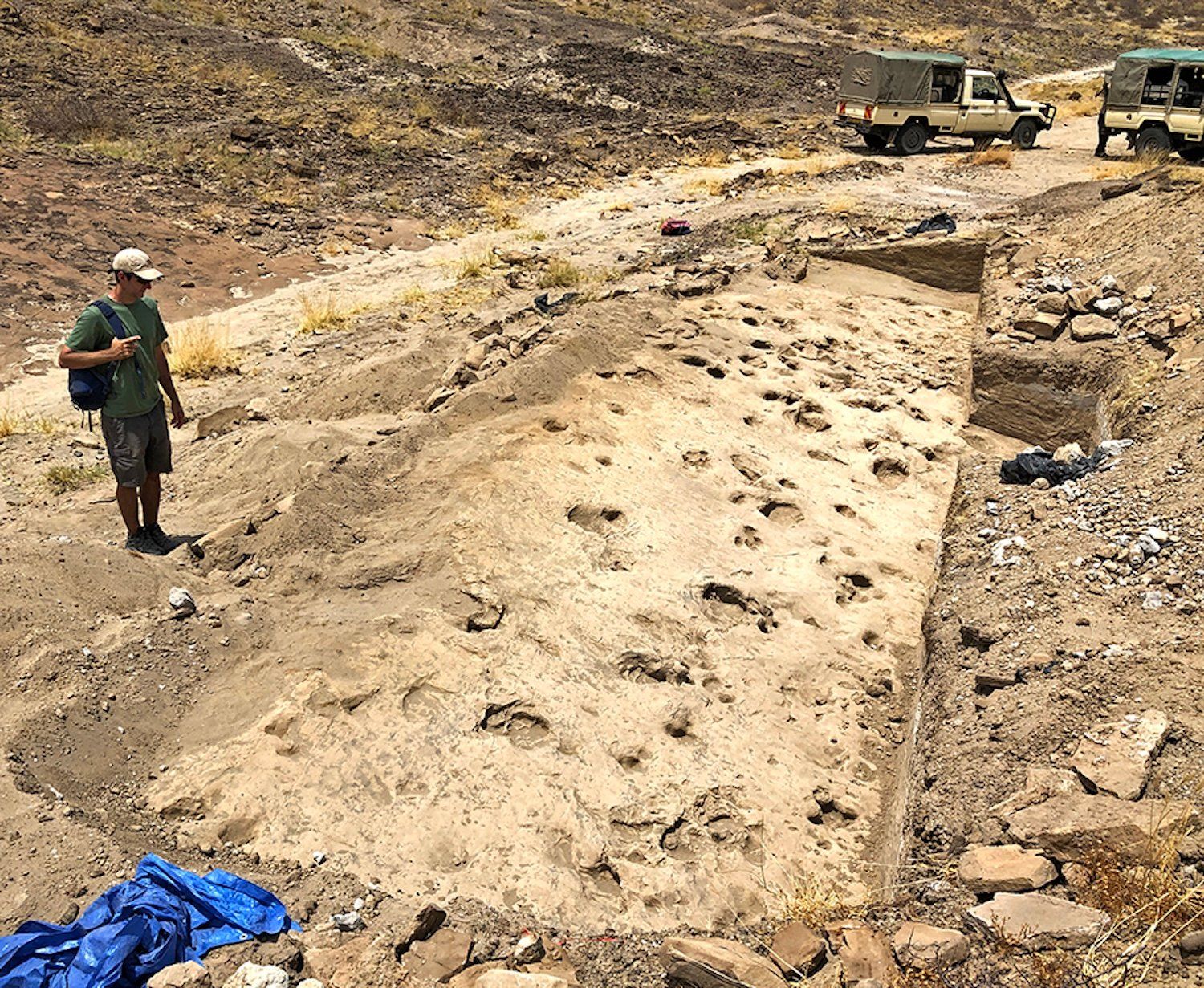
Researchers studying 1.43-million-year-old fossilized footprints along an ancient Lake Turkana shoreline in northern Kenya have uncovered new evidence about Paranthropus boisei, an extinct human relative, showing that some individuals may have stood up to 6 feet tall and weighed about 165 pounds—dimensions previously associated with Homo erectus—and that a group composed mostly of adult males moved together across the muddy terrain, providing behavioral insights that skeletal remains alone could not offer; the study, published in the Proceedings of the National Academy of Sciences, also places P. boisei on a shared lakeshore landscape with large animals like hippopotamuses and antelope, and suggests the species had sufficient manual ability to use tools with a very strong grip, challenging earlier views of it as a less-developed evolutionary branch.
The Footprint That Didn’t Fit
They want you to believe this is a routine academic paper—a few fossilized impressions on an ancient lakeshore, a mild revision of hominin height estimates. But look closer at the timing. Why now? Why release this data—collected years ago, I’m told—the same week a major climate summit begins? Because the same institutions that fund paleoanthropology also fund the global governance apparatus. They need you distracted by a million-year-old story while they rewrite the rules for the next generation. The study itself is real enough; the footprints are real. But the interpretation is managed. Notice how they frame Paranthropus boisei as a “separate evolutionary path that ended in extinction.” That’s the narrative they want you to swallow: dead ends, no connection to us. A convenient way to seal off the past from the present.
What the Paper Doesn’t Say
Page 47 of the supplementary materials—if you can access it—lists the exact GPS coordinates of the footprint site. Why would they publish that? Not for transparency. To control the narrative. Every researcher who wants to visit now has to go through the same permitting pipeline, the same funding bodies, the same foundation-linked universities. And the team that published this? Several authors have ties to the Leakey Foundation—an organization whose board has included members of the Rockefeller and Carnegie families. You think that’s coincidence? The Leakey family has been the gatekeeper of East African hominin fossils for decades. They decide which species get attention, which get quietly buried. The real story here isn’t that Paranthropus could stand six feet tall. It’s that they’ve been hiding that fact for years. Skeletal remains never showed that height because the skeletons they chose to publish were fragmentary, selected to fit the “small-brained, inferior” mold. The footprints tell a different story—but only if you’re willing to read between the lines.
The Stakes Are Your Own Origin
Ask yourself: why does the establishment care so much about how tall an extinct hominin was? Because the height of Paranthropus boisei—now overlapping with Homo erectus—blurs the boundary between “us” and “them.” If these creatures were that large, that capable of tool use, that social, then the evolutionary tree is not a tidy ladder. It’s a tangled web they don’t want you to see. The same institutions that control the fossil narrative also control the narrative of human potential. They want you to believe progress is linear, that we are the pinnacle, that the past is dead and gone. But what if Paranthropus wasn’t a dead end? What if their lineage was suppressed—not by nature, but by something else? You’ll never find that answer in PNAS. You’ll have to follow the trail of foundation grants, board memberships, and the academics who suddenly changed research fields. The footprints are real. The cover-up is real. And the question you’re supposed to sit with is this: if they’ve been hiding the size of a single species for thirty years, what else have they hidden?